 뒤로
Probability and Random Variables: Study Guide for Introductory Statistics
스터디 가이드 - 스마트 노트
 자료에 맞춘 맞춤형 노트, 핵심 정의, 예시, 맥락을 확장해 제공합니다.
Probability Fundamentals
Chance Behavior and the Law of Large Numbers
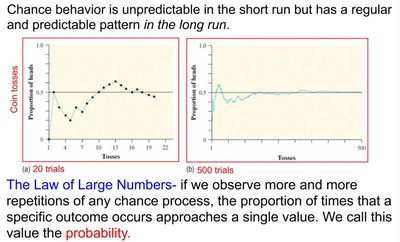
Chance behavior is unpredictable in the short run but exhibits a regular and predictable pattern in the long run. The Law of Large Numbers states that as the number of repetitions of a random process increases, the proportion of times a specific outcome occurs approaches a single value, known as the probability.
Short-run: Outcomes may vary widely.
Long-run: Proportions stabilize to the probability value.
Simulation
Simulation is an imitation of chance behavior, based on a model that accurately reflects the situation. It is a strategy used to estimate probability when actual experiments are impractical.

Probability Models and Sample Space
Sample Space and Events
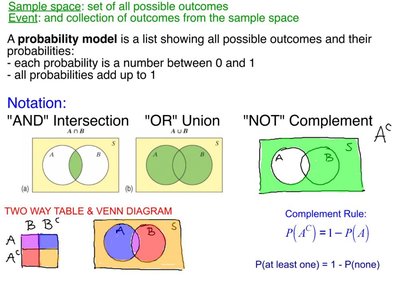
The sample space is the set of all possible outcomes of a random experiment. An event is a collection of outcomes from the sample space. A probability model lists all possible outcomes and their probabilities, ensuring that all probabilities are between 0 and 1 and sum to 1.
Sample space: All possible outcomes
Event: Subset of sample space
Probability model: Probabilities for each outcome
Notation and Venn Diagrams
AND (Intersection):
OR (Union):
NOT (Complement):
The Complement Rule states:
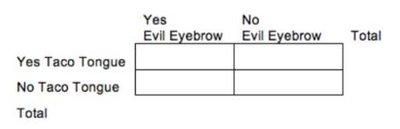
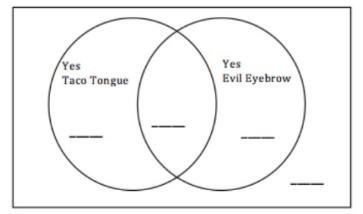
Two-Way Tables and Venn Diagrams
These tools help visualize relationships between events and calculate probabilities.
Probability Rules
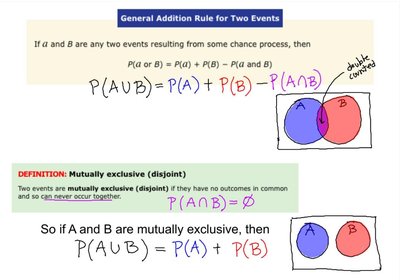
Addition Rule for Two Events
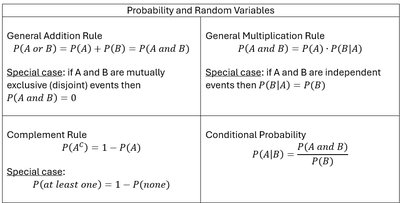
The General Addition Rule for two events A and B:
If A and B are mutually exclusive (disjoint), then and
Conditional Probability
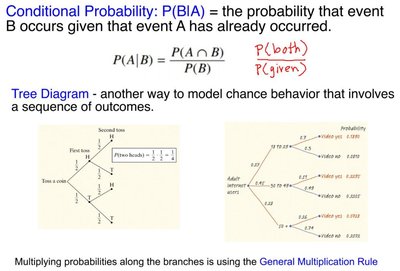
Conditional probability is the probability that event B occurs given that event A has already occurred:
General Multiplication Rule
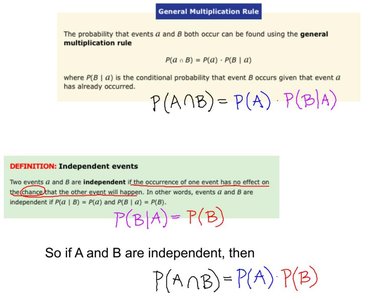
The probability that both events A and B occur:
Independent Events
Events A and B are independent if the occurrence of one does not affect the probability of the other:
Probability Strategies
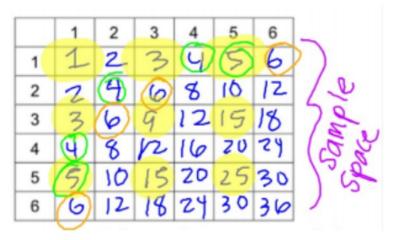
List all possible outcomes (sample space)
Use two-way tables and Venn diagrams
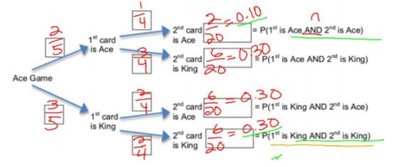
Apply tree diagrams for sequences of events
Use formulas as a last resort
Summary Table: Probability Rules
Rule | Formula | Special Case |
|---|---|---|
General Addition Rule | If A and B are mutually exclusive: | |
General Multiplication Rule | If A and B are independent: | |
Complement Rule | at least onenone | |
Conditional Probability |
Random Variables
Definition and Types
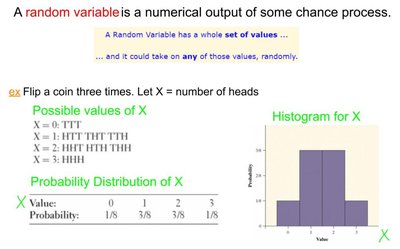
A random variable is a numerical output of a chance process. It can take on a set of values, determined by the outcome of the experiment.
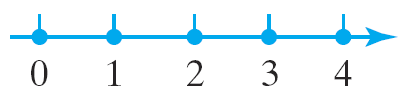
Discrete random variable: Takes a fixed set of possible values with gaps between them (e.g., shoe size, number of heads).
Continuous random variable: Takes any value in an interval, with no gaps (e.g., foot length).
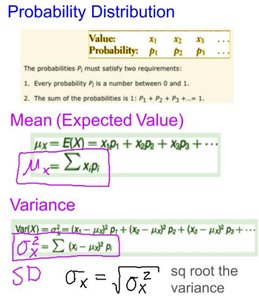
Probability Distribution of a Random Variable
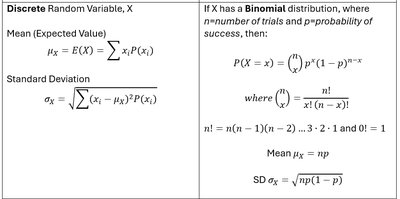
The probability distribution of a random variable lists each possible value and its probability. For discrete random variables:
Probabilities must sum to 1.
Each probability is between 0 and 1.

Mean (Expected Value) and Variance
Mean (Expected Value):
Variance:
Standard Deviation:
Binomial Probability Distribution
Definition and Properties
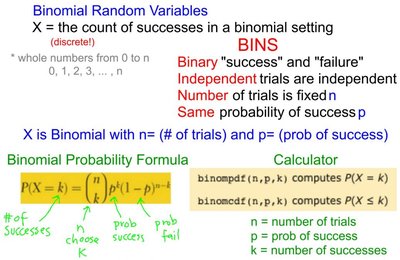
A binomial random variable counts the number of successes in a fixed number of independent trials, each with the same probability of success. The binomial setting is characterized by:
Binary outcomes: "success" or "failure"
Independent trials
Fixed number of trials ()
Same probability of success ()
Binomial Probability Formula
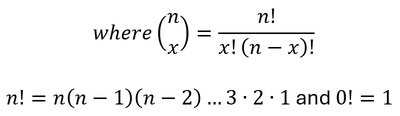
Mean and Standard Deviation of Binomial Distribution
10% Condition
When sampling without replacement, the binomial model is valid if the sample size is small compared to the population: of .

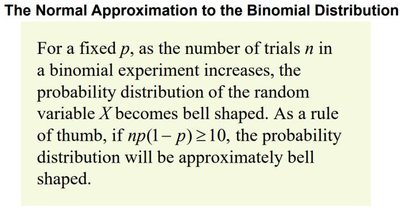
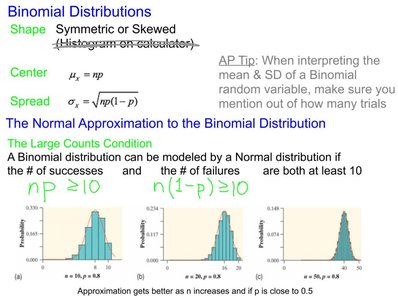
Normal Approximation to the Binomial Distribution
For a fixed probability , as the number of trials increases, the binomial distribution becomes approximately bell-shaped (normal) if both and .
Mathematical Symbols and Phrases
Translation Table
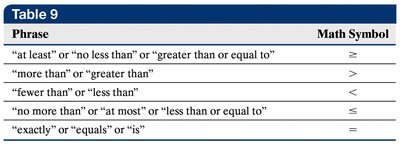
Phrase | Math Symbol |
|---|---|
at least / no less than / greater than or equal to | ≥ |
more than / greater than | > |
fewer than / less than | < |
no more than / at most / less than or equal to | ≤ |
exactly / equals / is | = |
Summary
This study guide covers the foundational concepts of probability and random variables, including probability rules, sample space, events, probability distributions, and the binomial distribution. Understanding these concepts is essential for analyzing random processes and making statistical inferences.
