 뒤로
Probability Concepts and Rules: Study Guide for Introductory Statistics
스터디 가이드 - 스마트 노트
 자료에 맞춘 맞춤형 노트, 핵심 정의, 예시, 맥락을 확장해 제공합니다.
Probability: Fundamental Concepts
Definition of Probability
Probability is a measure of how likely an event is to occur, expressed as the proportion of times the event would happen in a very long series of independent trials. This is also known as relative frequency.
Event: An event is a specific outcome or set of outcomes, denoted as P(A).
Independence: If events are independent, past events do not affect future events.
Law of Large Numbers: As the number of trials increases, the relative frequency of an event approaches its true theoretical probability.
Example: A batter believes he is "due for a hit" after a cold streak. This is a misconception; in independent events, past outcomes do not influence future ones.
Additional info: The "Nonexistent Law of Averages" is a common fallacy where people expect short-term compensation for past random outcomes.
Probability Models and Sample Space
Sample Space and Tree Diagrams
The sample space (S) is the set of all possible outcomes of a random phenomenon. Tree diagrams are visual tools used to list and organize these outcomes.
Example 1: Tossing a coin and rolling a die: Sample space consists of pairs like (Heads, 1), (Heads, 2), ..., (Tails, 6).
Example 2: Recording the number of boys in a family with 4 children; flipping a coin until a tail or 3 consecutive heads.
Additional info: Outcomes may or may not be equally likely, depending on the process.
Legitimacy of Probability Assignments
Probability assignments must satisfy two conditions:
Each probability is between 0 and 1.
The sum of probabilities for all possible outcomes equals 1.
Example: Probability assignments for store discounts (see table below).
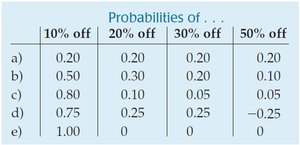
10% off | 20% off | 30% off | 50% off | |
|---|---|---|---|---|
a) | 0.20 | 0.20 | 0.20 | 0.20 |
b) | 0.50 | 0.30 | 0.20 | 0.10 |
c) | 0.80 | 0.10 | 0.05 | 0.05 |
d) | 0.75 | 0.25 | 0.25 | -0.25 |
e) | 1.00 | 0 | 0 | 0 |
Additional info: Negative probabilities (as in row d, 50% off) are not legitimate; all probabilities must be non-negative.
Probability Notation and Set Operations
Union and Intersection
Probability notation uses set operations:
P(A or B): , the probability of A or B occurring (union).
P(A and B): , the probability of both A and B occurring (intersection).
Example: Given sets A = {1,2,3,4,5,6,7,8}, B = {3,6,9,12}, C = {15,18}:
A ∪ B: {1,2,3,4,5,6,7,8,9,12}
A ∩ B: {3,6}
A ∩ C: ∅ (empty set)
Multiplication Principle and Probability Calculations
Multiplication Principle
If one event can occur in 'a' ways and another in 'b' ways, the total number of outcomes for both events is .
Example: Tossing a coin (2 outcomes) and rolling a die (6 outcomes): possible outcomes.
Calculating Probabilities of Multiple Independent Events
Probability of getting heads 5 times in a row:
Probability of getting all 6 questions correct (random guessing, 4 choices each):
Probability of rolling a "1" three times in a row:
Probability of NOT getting a "1" in three rolls:
Probability Rules
Basic Probability Rules
Rule 1:
Rule 2: The sum of probabilities in the sample space is 1:
Rule 3 (Complement):
Rule 4 (Addition for Disjoint Events):
Rule 5 (At Least One):
Examples Applying Probability Rules
Probability of getting at least one question correct (random guessing):
Car repairs:
a) Probability of no repairs:
b) Probability of no more than one repair:
c) Probability of some repairs:
Probability with multiple cars:
a) Probability none need repairs:
b) Probability fourth car is first needing repair:
c) Probability at least one needs repair:
Voter poll:
a) Probability all Republicans:
b) Probability no Democrats:
c) Probability at least one Independent:
Slot machine:
a) Probability of 3 lemons:
b) Probability of no fruit symbols:
c) Probability of 3 bells:
d) Probability of no bells:
e) Probability of at least one bar:
Additional info: These examples illustrate the application of probability rules to real-world scenarios, such as tests, car repairs, voter polls, and games.
