 뒤로
Trigonometric Identities: Sum and Difference Formulas Study Guide
스터디 가이드 - 스마트 노트
 자료에 맞춘 맞춤형 노트, 핵심 정의, 예시, 맥락을 확장해 제공합니다.
Q1. Write the Sum and Difference Formulas for Sine and Cosine.
Background
Topic: Trigonometric Identities – Sum and Difference Formulas
This question is testing your recall and understanding of the fundamental sum and difference identities for sine and cosine, which are essential for simplifying and evaluating trigonometric expressions involving the sum or difference of two angles.
Key formulas:
Step-by-Step Guidance
Recall the general form for the sum and difference identities for sine and cosine.
Write out the formulas for , , , and using the correct signs and terms.
Make sure you use the correct order for the terms and signs in each formula.
Try solving on your own before revealing the answer!
Final Answer:
These identities allow you to express the sine and cosine of a sum or difference of angles in terms of the sines and cosines of the individual angles.
Q2. Derive the Sum and Difference Formula for Tangent using the Sine and Cosine Formulas.
Background
Topic: Trigonometric Identities – Tangent Sum and Difference Formulas
This question is testing your ability to derive the tangent sum and difference formulas from the sine and cosine sum and difference identities.
Key formulas:
Use the previously written sine and cosine sum/difference formulas.
Step-by-Step Guidance
Start by writing .
Substitute the sum formulas for sine and cosine into the expression.
Simplify the numerator and denominator using algebraic manipulation.
Divide both numerator and denominator by to simplify further.
Try solving on your own before revealing the answer!
Final Answer:
These formulas are derived by expressing sine and cosine in terms of tangent and simplifying the resulting fractions.
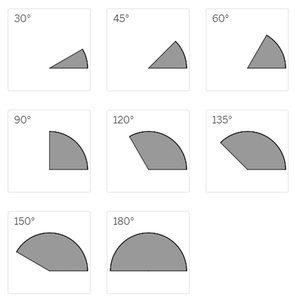
Q3. Using the pie pieces below, answer: Can you create a pie piece that has an angle of 75° by subtracting angles?
Background
Topic: Angle Construction Using Reference Angles
This question is testing your ability to use known reference angles to construct new angles by addition or subtraction, which is useful for applying sum and difference identities.
Key Terms:
Reference angles: 30°, 45°, 60°, etc.
Sum and difference: or
Step-by-Step Guidance
Look at the available reference angles in the pie pieces (see image below).
Determine if 75° can be formed by subtracting two of these angles.
Write the subtraction equation using the reference angles.
Try solving on your own before revealing the answer!
Final Answer:
Yes, 75° can be created by subtracting 45° from 120°: .
This allows you to use the difference formula for trigonometric functions.
Q4. Using the pie pieces below, answer: Can you create a pie piece that has an angle of 15°?
Background
Topic: Angle Construction Using Reference Angles
This question is testing your ability to construct a 15° angle using the sum or difference of known reference angles.
Key Terms:
Reference angles: 30°, 45°, etc.
Difference:
Step-by-Step Guidance
Identify which reference angles can be used to form 15° by subtraction.
Write the subtraction equation using the reference angles.
Try solving on your own before revealing the answer!
Final Answer:
Yes, 15° can be created by subtracting 30° from 45°: .
This is useful for applying the difference formula for trigonometric functions.
Q5. Using the pie pieces below, answer: Can you create a pie piece that has an angle of 105° by adding angles?
Background
Topic: Angle Construction Using Reference Angles
This question is testing your ability to construct a 105° angle using the sum of known reference angles.
Key Terms:
Reference angles: 45°, 60°, etc.
Sum:
Step-by-Step Guidance
Identify which reference angles can be used to form 105° by addition.
Write the addition equation using the reference angles.
Try solving on your own before revealing the answer!
Final Answer:
Yes, 105° can be created by adding 60° and 45°: .
This allows you to use the sum formula for trigonometric functions.
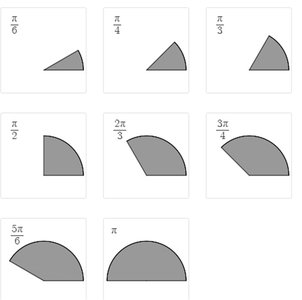
Q6. Using the pie pieces below, answer: Can you create a pie piece that has an angle of ?
Background
Topic: Angle Construction Using Reference Angles (Radians)
This question is testing your ability to construct a angle using the sum or difference of known reference angles in radians.
Key Terms:
Reference angles: , , etc.
Difference:
Step-by-Step Guidance
Identify which reference angles can be used to form by subtraction.
Write the subtraction equation using the reference angles.
Try solving on your own before revealing the answer!
Final Answer:
Yes, can be created by subtracting from : .
This is useful for applying the difference formula for trigonometric functions in radians.
Q7. Using the pie pieces below, answer: Can you create a pie piece that has an angle of ?
Background
Topic: Angle Construction Using Reference Angles (Radians)
This question is testing your ability to construct a angle using the sum or difference of known reference angles in radians.
Key Terms:
Reference angles: , , etc.
Sum:
Step-by-Step Guidance
Identify which reference angles can be used to form by addition.
Write the addition equation using the reference angles.
Try solving on your own before revealing the answer!
Final Answer:
Yes, can be created by adding and : .
This allows you to use the sum formula for trigonometric functions in radians.
