 뒤로
Trigonometry Application Problems: Step-by-Step Guidance
스터디 가이드 - 스마트 노트
 자료에 맞춘 맞춤형 노트, 핵심 정의, 예시, 맥락을 확장해 제공합니다.
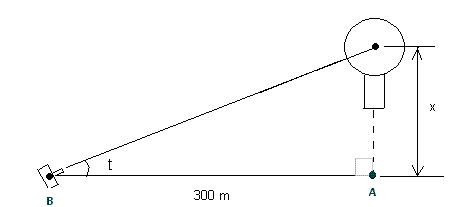
Q1a. Find angle t as a function of the height x for a camera photographing a hot air balloon rising vertically, given the horizontal distance from the camera to the launch point is 300 meters.
Background
Topic: Right Triangle Trigonometry
This question tests your ability to relate the angle of elevation to the height of an object using trigonometric ratios in a right triangle.
Key Terms and Formulas
Angle of elevation: The angle formed by the horizontal and the line of sight to an object above the horizontal.
Right triangle: The scenario forms a right triangle with the horizontal distance (adjacent), the height (opposite), and the line of sight (hypotenuse).
Trigonometric ratio:
Step-by-Step Guidance
Visualize the scenario as a right triangle, where the horizontal distance from the camera to the launch point is 300 meters, and the height of the balloon is x meters.
Identify the angle of elevation t, which is the angle between the horizontal and the line of sight from the camera to the balloon.
Recall the tangent trigonometric ratio: .
Set up the equation using the given values: .
To express t as a function of x, use the inverse tangent function: .
Try solving on your own before revealing the answer!
Final Answer:
This formula gives the angle of elevation t in radians (or degrees, if you convert) as a function of the balloon's height x.
Q1b. Find angle t in degrees when x is equal to 150, 300, and 600 meters (rounded to 1 decimal place).
Background
Topic: Evaluating Trigonometric Functions
This question tests your ability to substitute values into a trigonometric function and convert the result to degrees.
Key Terms and Formulas
Inverse tangent:
Degree conversion: If your calculator gives radians, convert to degrees by multiplying by .
Step-by-Step Guidance
For each value of x (150, 300, 600), substitute into the formula: .
Calculate for each value.
Use the inverse tangent function to find t in radians.
If needed, convert t from radians to degrees using .
Round each answer to 1 decimal place.
Try solving on your own before revealing the answer!
Final Answer:
For : For : For :
Each value was calculated using the formula and rounded to one decimal place.
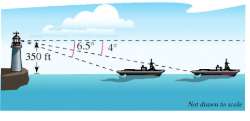
Q2. An observer in a lighthouse 350 feet above sea level observes two ships directly offshore. The angles of depression to the ships are 40° and 6.5°. How far apart are the ships?
Background
Topic: Angles of Depression and Right Triangle Trigonometry
This question tests your ability to use angles of depression and trigonometric ratios to find horizontal distances.
Key Terms and Formulas
Angle of depression: The angle between the horizontal and the line of sight downward to an object.
Right triangle: The lighthouse height forms the opposite side, and the horizontal distance to each ship is the adjacent side.
Trigonometric ratio:
Step-by-Step Guidance
Draw two right triangles, one for each ship, with the lighthouse height (350 ft) as the opposite side.
For each ship, set up the equation: , where d is the horizontal distance to the ship.
For the first ship, use ; for the second ship, use .
Solve for and using for each angle.
The distance between the ships is .
Try solving on your own before revealing the answer!
Final Answer:
The ships are approximately 2,993 feet apart.
We calculated the horizontal distances for each ship and subtracted to find the separation.
Q3. A passenger in an airplane at an altitude of 10 kilometers sees two towns directly to the east. The angles of depression to the towns are 28° and 55°. How far apart are the towns?
Background
Topic: Angles of Depression and Right Triangle Trigonometry
This question tests your ability to use angles of depression and trigonometric ratios to find horizontal distances.
Key Terms and Formulas
Angle of depression: The angle between the horizontal and the line of sight downward to an object.
Right triangle: The airplane altitude forms the opposite side, and the horizontal distance to each town is the adjacent side.
Trigonometric ratio:
Step-by-Step Guidance
Draw two right triangles, one for each town, with the airplane altitude (10 km) as the opposite side.
For each town, set up the equation: , where d is the horizontal distance to the town.
For the first town, use ; for the second town, use .
Solve for and using for each angle.
The distance between the towns is .
Try solving on your own before revealing the answer!
Final Answer:
The towns are approximately 10.7 kilometers apart.
We calculated the horizontal distances for each town and subtracted to find the separation.
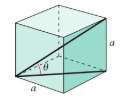
Q4. Determine the angle between the diagonal of a cube and the diagonal of its base.
Background
Topic: 3D Geometry and Trigonometry
This question tests your ability to use spatial reasoning and trigonometric ratios to find the angle between two lines in a cube.
Key Terms and Formulas
Cube diagonal: The space diagonal from one corner to the opposite corner.
Base diagonal: The diagonal across the square base.
Angle between vectors: Use the dot product or trigonometric ratios.
For a cube of side a: Space diagonal length , base diagonal length .
Step-by-Step Guidance
Visualize the cube and identify the space diagonal and the base diagonal.
Express the vectors for the space diagonal and base diagonal in terms of the cube's side length a.
Use the dot product formula to find the cosine of the angle between the two vectors.
Set up the equation: .
Solve for using the inverse cosine function.
Try solving on your own before revealing the answer!
Final Answer:
The angle between the diagonals is approximately .
This was found using vector analysis and the dot product formula.
Q5. Find the angle of inclination of the line .
Background
Topic: Angle of Inclination of a Line
This question tests your ability to relate the slope of a line to its angle of inclination using trigonometric functions.
Key Terms and Formulas
Slope (m): The coefficient of x in the equation .
Angle of inclination ():
Step-by-Step Guidance
Identify the slope of the line: .
Recall the formula for the angle of inclination: .
Substitute the slope into the formula: .
Use a calculator to find the angle in degrees.
Try solving on your own before revealing the answer!
Final Answer:
The angle of inclination is approximately .
This was calculated using the inverse tangent of the slope.
Q6. Find the angle of inclination of the line .
Background
Topic: Angle of Inclination of a Line
This question tests your ability to relate the slope of a line to its angle of inclination using trigonometric functions.
Key Terms and Formulas
Slope (m): The coefficient of x in the equation .
Angle of inclination ():
Step-by-Step Guidance
Identify the slope of the line: .
Recall the formula for the angle of inclination: .
Substitute the slope into the formula: .
Use a calculator to find the angle in degrees.
Try solving on your own before revealing the answer!
Final Answer:
The angle of inclination is approximately .
This was calculated using the inverse tangent of the slope.
