 뒤로
뒤로Algebra & Trigonometry Study Guidance for Engineering Maths Assignment
스터디 가이드 - 스마트 노트
 자료에 맞춘 맞춤형 노트, 핵심 정의, 예시, 맥락을 확장해 제공합니다.
Q1. Use dimensional analysis to determine the dimensions of resistance (R) given the formula for power dissipated by a resistor: .
Background
Topic: Dimensional Analysis & Algebraic Manipulation
This question tests your ability to use dimensional analysis to derive the physical dimensions of resistance based on the formula relating power, voltage, and resistance.
Key Terms and Formulas:
= Power (dimensions: )
= Voltage (dimensions: )
= Resistance (unknown dimensions)
Dimensional analysis: Equate the dimensions on both sides of the equation to solve for .
Step-by-Step Guidance
Write the formula for power: .
Express the dimensions of each variable: , .
Calculate the dimensions of : .
Set up the dimensional equation: .
Rearrange to solve for : .
Try solving on your own before revealing the answer!
Final Answer:
By simplifying the dimensional equation, resistance has the dimensions of time divided by length. This shows how resistance relates to fundamental physical quantities.
Q2. Use dimensional analysis to show that the proposed formula for the period of vibration of a guitar string is incorrect: .
Background
Topic: Dimensional Analysis
This question tests your ability to check the dimensional consistency of a formula involving mass, length, tension, and period.
Key Terms and Formulas:
= Mass ($M$)
= Length ($L$)
= Tension ()
= Period ()
Dimensional analysis: Compare the dimensions on both sides of the equation.
Step-by-Step Guidance
Write the formula: (ignore as it is dimensionless).
Express the dimensions: , .
Set up the dimensional equation: .
Simplify the dimensions: .
Compare with the expected dimension for period (): Does match $T$?
Try solving on your own before revealing the answer!
Final Answer: The formula is dimensionally inconsistent.
The left side has dimension , but the right side has , so the formula is incorrect.
Q3. Calculate the sum of 15 voltage samples (3, 6, 9, ..., 45) using the arithmetic progression formula.
Background
Topic: Arithmetic Progression
This question tests your ability to use the formula for the sum of an arithmetic sequence.
Key Terms and Formulas:
First term (): 3
Common difference (): 3
Number of terms (): 15
Sum formula:
Step-by-Step Guidance
Identify the sequence: .
Determine , , .
Write the sum formula: .
Substitute the values: .
Calculate and .
Try solving on your own before revealing the answer!
Final Answer: mV
The sum of the 15 voltage samples is 360 mV, calculated using the arithmetic progression formula.
Q4. Find the 11th term in the geometric progression: 512, 1024, 2048, 4096, ...
Background
Topic: Geometric Progression
This question tests your ability to use the formula for the nth term of a geometric sequence.
Key Terms and Formulas:
First term (): 512
Common ratio (): 2
nth term formula:
Step-by-Step Guidance
Identify the sequence: .
Determine , , .
Write the nth term formula: .
Substitute the values: .
Calculate the exponent: .
Try solving on your own before revealing the answer!
Final Answer: 524,288
The 11th term in the sequence is 524,288, found using the geometric progression formula.
Q5. Given , with V after 4 seconds, V, MΩ, find the approximate value for capacitance .
Background
Topic: Exponential Functions & Algebraic Manipulation
This question tests your ability to rearrange and solve an exponential equation for capacitance in an RC circuit.
Key Terms and Formulas:
= Voltage across capacitor
= Supply voltage
= Resistance
= Capacitance
Formula:
Step-by-Step Guidance
Write the formula: .
Substitute known values: .
Divide both sides by 21: .
Rearrange to isolate the exponential term: .
Take the natural logarithm of both sides to solve for .
Try solving on your own before revealing the answer!
Final Answer: F
By solving the exponential equation, the approximate capacitance is 3.56 microfarads.
Q6. Make time () the subject of the formula and determine the first point in time when V, given MHz.
Background
Topic: Trigonometric Functions & Algebraic Manipulation
This question tests your ability to rearrange a sine function and solve for time, given a specific voltage and frequency.
Key Terms and Formulas:
= Instantaneous signal voltage
= Frequency
Formula:
Inverse sine function () to solve for .
Step-by-Step Guidance
Write the formula: .
Divide both sides by 8: .
Take the inverse sine: .
Add to both sides: .
Solve for : .

Try solving on your own before revealing the answer!
Final Answer: ns
The first point in time when the signal voltage is +4 V is approximately 5.79 nanoseconds, using the rearranged formula.
Q7. For the curve , calculate: (i) when ; (ii) when .
Background
Topic: Hyperbolic Functions & Algebraic Manipulation
This question tests your ability to evaluate hyperbolic functions and solve for variables in engineering contexts.
Key Terms and Formulas:
= Hyperbolic cosine function
Formula:
Inverse hyperbolic cosine () to solve for .
Step-by-Step Guidance
For (i): Substitute into the formula: .
Calculate .
Evaluate using the definition: .
Multiply by 80 to find .
For (ii): Set and solve for using the inverse hyperbolic cosine.
Try solving on your own before revealing the answer!
Final Answer:
(i) when
(ii) when
These values are found by evaluating the hyperbolic cosine and its inverse.
Q8. Use dimensional analysis to find a formula for the period () of a pendulum involving mass (), length (), and gravity ().
Background
Topic: Dimensional Analysis & Algebraic Manipulation
This question tests your ability to derive a formula for the period of a pendulum using dimensional analysis.
Key Terms and Formulas:
= Mass ()
= Length ()
= Gravity ()
= Period ()
Step-by-Step Guidance
Assume a general formula: .
Write the dimensions: , , , .
Set up the dimensional equation: .
Expand: .
Equate powers of , , and to solve for , , .
Try solving on your own before revealing the answer!
Final Answer:
The period depends on the square root of length divided by gravity, and is independent of mass.
Q9. Convert the voltage into a complex number.
Background
Topic: Complex Numbers & Polar to Rectangular Conversion
This question tests your ability to convert a phasor (polar form) into its rectangular (complex) form.
Key Terms and Formulas:
Polar form:
Rectangular form:
= Imaginary unit
Step-by-Step Guidance
Write the conversion formula: .
Calculate and .
Multiply: and .
Write the result in the form .
Try solving on your own before revealing the answer!
Final Answer: V
The voltage in complex form is V.
Q10. Find the inverse of the matrix .
Background
Topic: Matrix Algebra
This question tests your ability to find the inverse of a 2x2 matrix.
Key Terms and Formulas:
Matrix
Inverse formula:
Step-by-Step Guidance
Identify , , , .
Calculate the determinant: .
Write the adjugate matrix: .
Divide each element by the determinant to get the inverse.
Try solving on your own before revealing the answer!
Final Answer:
The inverse matrix is calculated using the formula for a 2x2 matrix.
Q11. Calculate the mean, mode, median, and standard deviation for the transmit power samples: 22.3, 24.1, 22.8, 22.3, 24.9, 22.3, 21.5, 23.9, 22.3, 21.5.
Background
Topic: Statistics – Measures of Central Tendency and Dispersion
This question tests your ability to calculate mean, mode, median, and standard deviation for a data set.
Key Terms and Formulas:
Mean:
Mode: Most frequent value
Median: Middle value when sorted
Standard deviation:
Step-by-Step Guidance
List the data: 22.3, 24.1, 22.8, 22.3, 24.9, 22.3, 21.5, 23.9, 22.3, 21.5.
Calculate the mean: Add all values and divide by 10.
Find the mode: Identify the value that appears most frequently.
Sort the data and find the median: Middle value or average of two middle values.
Calculate the standard deviation using the formula.
Try solving on your own before revealing the answer!
Final Answer:
Mean: 22.79 dBm
Mode: 22.3 dBm
Median: 22.3 dBm
Standard deviation: 1.14 dBm
Q12. Determine the probability that (i) two of seven bolts exceed the tolerable diameter, (ii) more than two exceed the tolerable diameter, given 96% are within tolerance.
Background
Topic: Binomial Probability
This question tests your ability to apply the binomial probability formula to calculate probabilities for discrete events.
Key Terms and Formulas:
Probability of exceeding tolerance (): 0.04
Probability of within tolerance (): 0.96
Binomial formula:
Step-by-Step Guidance
For (i): Use , , , .
Calculate .
For (ii): Calculate .
Set up the calculations for each probability.
Try solving on your own before revealing the answer!
Final Answer:
(i) Probability two exceed: 2.74%
(ii) Probability more than two exceed: 0.19%
Q13. For 500 capacitors with mean 200μF and standard deviation 12μF, normally distributed, determine how many are likely to have values between 185μF and 215μF.
Background
Topic: Normal Distribution & Z-Score
This question tests your ability to use z-scores and the normal distribution to estimate the number of items within a range.
Key Terms and Formulas:
Mean (): 200μF
Standard deviation (): 12μF
Z-score:
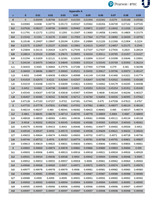
Use z-table to find probabilities.
Step-by-Step Guidance
Calculate z-scores for 185μF and 215μF: , .
Find the probability for each z-score using the z-table.
Calculate the total probability between the two z-scores.
Multiply the probability by 500 to estimate the number of capacitors.
Try solving on your own before revealing the answer!
Final Answer: Approximately 394 capacitors
About 394 capacitors are expected to have values between 185μF and 215μF, based on the normal distribution.
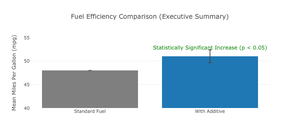
Q14. Interpret the results of a fuel additive test using hypothesis testing and graphical representation.
Background
Topic: Hypothesis Testing & Statistical Analysis
This question tests your ability to perform hypothesis testing and communicate results graphically.
Key Terms and Formulas:
Null hypothesis (): No effect
Alternative hypothesis (): Effect present
Z-score:
Compare z-score to critical value (e.g., 1.96 for 5% significance)
Step-by-Step Guidance
State the hypotheses: : mean mpg = 48; : mean mpg ≠ 51.
Calculate the sample standard deviation: .
Calculate the z-score: .
Compare the z-score to the critical value (1.96).
Interpret whether to reject or accept the null hypothesis.
Try solving on your own before revealing the answer!
Final Answer: Statistically significant increase in mpg
The calculated z-score is greater than 1.96, so the null hypothesis is rejected. The fuel additive has a statistically significant effect on mpg.
