 뒤로
뒤로Algebra & Trigonometry Study Guidance: Sinusoidal Waves, Trigonometric Identities, and Vector Functions
스터디 가이드 - 스마트 노트
 자료에 맞춘 맞춤형 노트, 핵심 정의, 예시, 맥락을 확장해 제공합니다.
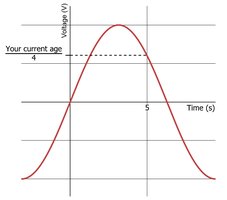
Q1A. Determine the amplitude A for the sinusoidal voltage function V1 = A \sin(0.5t) using the graph at t = 5 seconds.
Background
Topic: Sinusoidal Functions & Amplitude
This question tests your ability to interpret a graph of a sinusoidal function and use it to solve for the amplitude parameter in the function's equation.
Key Terms and Formulas:
Amplitude (A): The maximum value of the sinusoidal function.
Sinusoidal function:
At a specific time , can be read from the graph.
Step-by-Step Guidance
Identify the voltage value at seconds from the graph. This is your at that time.
Write the equation: , substituting .
Substitute the voltage value from the graph and solve for algebraically, making sure to use radians for the sine function.
Set up the equation for but do not compute the final value yet. Prepare to solve for $A$ by isolating it.
Try solving on your own before revealing the answer!
Final Answer:
Using at seconds, .
This value represents the amplitude of the sinusoidal voltage function based on the graph.
Q1B. Expand the equation using the compound angle formula.
Background
Topic: Trigonometric Identities (Compound Angle Formula)
This question tests your ability to expand a sine function with a sum of angles using the sine addition formula.
Key Terms and Formulas:
Compound angle formula:
Amplitude: The coefficient in front of the sine function.
Step-by-Step Guidance
Identify and in the expression .
Apply the compound angle formula to expand .
Distribute the amplitude (36) across the expanded terms.
Rearrange the expanded equation to group terms involving and .
Try solving on your own before revealing the answer!
Final Answer:
The expansion uses the sine addition formula and distributes the amplitude correctly.
Q1C. Write the fully expanded formula for as the sum of and , then determine values for and .
Background
Topic: Solving Simultaneous Trigonometric Equations
This question tests your ability to equate and solve for unknowns in trigonometric expressions using values from previous parts.
Key Terms and Formulas:
Step-by-Step Guidance
Set and equate the expanded forms.
Set to simplify the equations and solve for .
Substitute back into the equation and use a known value for at to solve for .
Prepare to solve for using the cosine inverse function, but do not compute the final value yet.
Try solving on your own before revealing the answer!
Final Answer: ,
By substituting values and solving, radians, and .
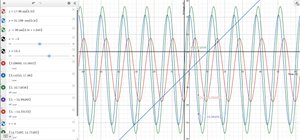
Q1D. Plot , , and on the same graph and verify that $V_3$ equals the sum of $V_1$ and $V_2$ at a chosen point.
Background
Topic: Graphical Verification of Trigonometric Sums
This question tests your ability to use graphing software to visually confirm the sum of two sinusoidal functions.
Key Terms and Formulas:
Graphing: Plotting , , and on the same axes.
Verification: Comparing values at a specific .
Step-by-Step Guidance
Use graphing software to plot , , and .
Choose a value of and draw a vertical line at that point.
Read the values of and at the intersection with the vertical line.
Compare the sum to the value of at the same .
Try solving on your own before revealing the answer!
Final Answer: The graph confirms at the chosen .
At , the sum of and matches as plotted, verifying the trigonometric sum visually.
Q2A. Solve algebraically for the first two values of when for , where .
Background
Topic: Solving Trigonometric Equations
This question tests your ability to solve a trigonometric equation for using algebraic methods and identities.
Key Terms and Formulas:
Trigonometric identities:
Quadratic equations in terms of
Step-by-Step Guidance
Substitute into the equation and set .
Use trigonometric identities to rewrite the equation in terms of .
Express the equation as a quadratic in .
Factor the quadratic equation and prepare to solve for .
Try solving on your own before revealing the answer!
Final Answer: s, s
Solving the quadratic gives and , leading to s and s.
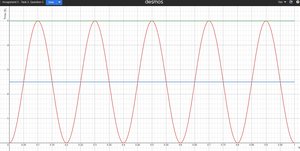
Q2B. Confirm your solutions for with an annotated graph showing all angles between 0 and 1 radians.
Background
Topic: Graphical Solution Verification
This question tests your ability to use graphing software to visually confirm algebraic solutions to trigonometric equations.
Key Terms and Formulas:
Graphing: Plotting versus and identifying zeros.
Annotated graph: Marking solution points.
Step-by-Step Guidance
Plot the function for between 0 and 1 radians.
Mark the points where on the graph.
Compare these points to your algebraic solutions for .
Check that the graph visually confirms the calculated values.
Try solving on your own before revealing the answer!
Final Answer: The graph confirms the algebraic solutions for .
The annotated graph shows zeros at s and s, matching the algebraic results.
Q2C. Determine how many rows of seats the train should have to ensure each row is photographed, using the BJT voltage threshold and the graph.
Background
Topic: Periodic Functions & Threshold Analysis
This question tests your ability to analyze a periodic voltage function and relate it to a physical threshold for a switching device.
Key Terms and Formulas:
BJT threshold: Minimum voltage required to turn on the switch.
Period: Duration of one cycle of the voltage function.
Number of rows:
Step-by-Step Guidance
Identify the voltage threshold (2.5V) and the period during which the voltage is above this threshold.
Determine the duration of one cycle from the graph.
Calculate the number of cycles (rows) within the total time (1 second).
Set up the division to find the number of rows, but do not compute the final value yet.
Try solving on your own before revealing the answer!
Final Answer: rows
Dividing the total time (1s) by the period per cycle (0.2s) gives rows, ensuring each row is photographed.
Q3A. Write the polar form of each voltage signal and determine the resultant magnitude and angle of using a vector diagram.
Background
Topic: Phasor Addition & Polar Form
This question tests your ability to convert sinusoidal signals to polar form and add them as vectors to find the resultant.
Key Terms and Formulas:
Polar form:
Rectangular coordinates: ,
Resultant magnitude:
Resultant angle:
Step-by-Step Guidance
Convert each voltage signal to polar form, identifying magnitude and phase angle.
Convert each signal to rectangular coordinates ().
Add the real and imaginary components to find the total and .
Set up the formulas for resultant magnitude and angle, but do not compute the final values yet.
Try solving on your own before revealing the answer!
Final Answer: V,
The resultant vector has a magnitude of approximately 447.4 V and a phase angle of about 23.3 degrees, calculated from the sum of the rectangular components.
