 뒤로
뒤로College Algebra/Functions with Review (MAT 151) – Syllabus and Course Structure
스터디 가이드 - 스마트 노트
 자료에 맞춘 맞춤형 노트, 핵심 정의, 예시, 맥락을 확장해 제공합니다.
Course Overview
This course, College Algebra/Functions with Review (MAT 151), provides a comprehensive foundation in algebra and functions, preparing students for further study in mathematics and related fields. The course covers a range of function types, systems of equations, and real-world applications, with a strong emphasis on independent problem-solving and critical thinking.
Course Content and Competencies
Relations and Functions: Define, distinguish, and interpret relations and functions and their inverses in various representations (verbal, graphical, numerical, algebraic).
Average Rate of Change: Calculate and interpret average rates of change using function notation, including the difference quotient.
Function Operations: Evaluate functions, including composition, and solve function equations and inequalities using multiple methods.
Systems of Equations: Set up, solve, and interpret solutions of systems of linear equations using various methods, including matrices.
Function Types and Transformations: Identify, graph, analyze, and determine key characteristics of linear, quadratic, higher-order polynomial, power, radical, rational, exponential, logarithmic, absolute value, and piecewise-defined functions.
Mathematical Modeling: Model real-world situations using mathematical techniques (including regression) and solve real-world problems using functions.
Course Structure and Grading
Credit Hours: 5 credit hours
Grading Scale:
A = 89.5-100
B = 79.5–89.4
C = 69.5–79.4
D = 59.5–69.4
F = below 59.4
Grade Components:
Course Engagement: 5%
Homework, Lecture Lessons, & Discussion Post: 10%
Quizzes & Required Reviews: 15%
Proctored Midterm Exam: 35%
Proctored Final Exam: 35%
Passing Requirements: Earn at least 70% overall and an average of 60% or better on proctored exams.
Course Policies and Expectations
Attendance: Academic attendance is required and includes submitting assignments, taking exams, attending class, or contacting the instructor about course content.
Academic Integrity: All work must be original. Use of AI tools for completing assignments is not allowed and is considered plagiarism.
Late Work: 65 late passes are available, each extending a due date by 3 days. Only one late pass per assignment.
Exams: Midterm and final exams are proctored and require submission of all work for credit.
Technology: A graphing calculator is recommended. The Desmos calculator is available for assignments and exams (cell phones not allowed).
Student Engagement
Students are encouraged to participate in engagement activities, such as meeting with the instructor, achieving high homework and quiz scores, attending office hours, and participating in review sessions. A total of 300 engagement points is required.
Withdrawal Policy
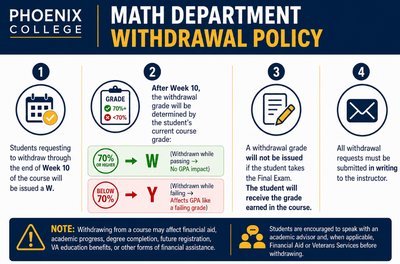
Students may withdraw through the end of Week 10 for a grade of W.
After Week 10, withdrawal is based on current grade: W if passing (≥70%), Y if failing (<70%).
Withdrawal requests must be submitted in writing.
Instructional Contact Hours
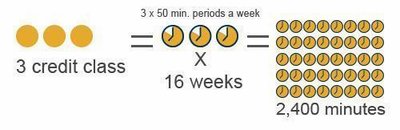
Students should expect to spend at least four hours per week on direct instruction and eight hours on homework, reviews, and quizzes. Accelerated courses require additional time.
Required and Recommended Materials
Textbook: College Algebra by OpenStax and Rice University (free online access).
Materials: Notebook, pencils, eraser, access to a computer and internet, and a graphing calculator.
Support: Free online tutoring and campus computer facilities are available.
Student Conduct and Communication
Professionalism: Students are expected to communicate respectfully and follow netiquette guidelines in all interactions.
Academic Misconduct: Cheating and plagiarism are strictly prohibited and subject to disciplinary action.
Grievance Process: Procedures exist for addressing instructional grievances, beginning with the instructor and escalating as needed.
Accessibility and Support
Students with disabilities are encouraged to contact the Disability Resources & Services Office for accommodations.
Official communication is through the student’s MEID@maricopa.edu email account.
