 뒤로
뒤로Limits, Continuity, and Exponential Functions: Study Notes for Algebra & Trigonometry
스터디 가이드 - 스마트 노트
 자료에 맞춘 맞춤형 노트, 핵심 정의, 예시, 맥락을 확장해 제공합니다.
Limits and Their Applications
Secant and Tangent Lines
The concept of limits is fundamental in understanding the behavior of functions, especially when analyzing slopes of secant and tangent lines. A secant line passes through two distinct points on the graph of a function, while a tangent line touches the graph at a single point and represents the instantaneous rate of change at that point.
Slope of Secant Line:
Slope of Tangent Line:
As the second point approaches the first, the secant slope approaches the tangent slope, which is defined using limits.
Average and Instantaneous Velocity
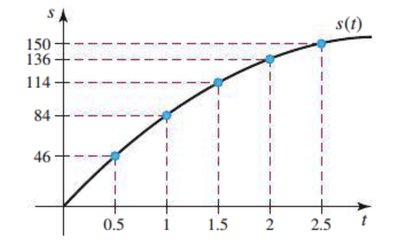
Limits are also used to describe motion. The average velocity over an interval is the change in position divided by the change in time, while the instantaneous velocity is the limit of the average velocity as the interval shrinks to a single point.
Average Velocity:
Instantaneous Velocity:
Definitions and Techniques for Limits
Limit of a Function
The limit of a function as approaches is the value that $f(x)$ approaches from both sides of $a$. The limit may exist even if is undefined or different from the limit value.
Notation:
Evaluating Limits
Limits can be evaluated graphically, numerically, or algebraically. Graphical evaluation involves observing the behavior of near . Numerical evaluation uses tables of values approaching from both sides.
One-Sided Limits
Sometimes, it is useful to consider limits from only one side:
Right-sided limit:
Left-sided limit:
If the right- and left-sided limits are not equal, the two-sided limit does not exist.
Techniques for Computing Limits
Limit Laws
Several laws allow the computation of limits for sums, differences, products, quotients, powers, and roots:
Sum:
Product:
Quotient: (if denominator limit is not zero)
Direct Substitution
For polynomials and rational functions with a nonzero denominator, limits can often be evaluated by direct substitution.
Polynomial:
Rational: (if )
Indeterminate Forms and Simplification
If direct substitution yields , further simplification is needed, such as factoring, using conjugates, or combining fractions.
Squeeze Theorem
Squeeze Theorem
The Squeeze Theorem is used when a function is bounded between two simpler functions whose limits are known. If near and both and approach as , then also approaches $L$.
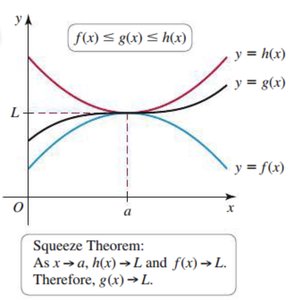
Theorem: If , then .
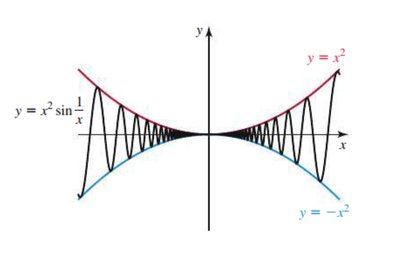
Example of Squeeze Theorem
For , the function oscillates between and as , so the limit is 0.
Infinite Limits and Asymptotes
Infinite Limits
An infinite limit occurs when grows arbitrarily large (positive or negative) as approaches a certain value. This is denoted as or .
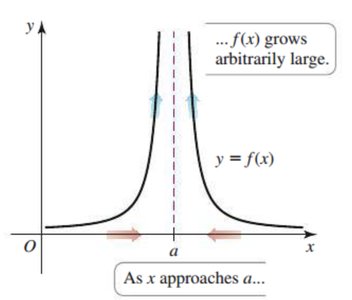
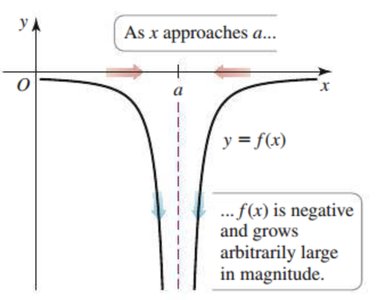
Vertical Asymptote: The line is a vertical asymptote if approaches as .
Infinite Limits Graphically
To identify infinite limits from a graph, observe the behavior of as approaches from the left and right. If $f(x)$ becomes unbounded, the limit is infinite.
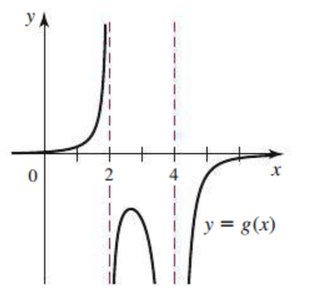
Limits at Infinity and Horizontal Asymptotes
Limits at Infinity
Limits at infinity describe the end behavior of a function as becomes arbitrarily large (positive or negative). If approaches a finite value as , then is a horizontal asymptote.
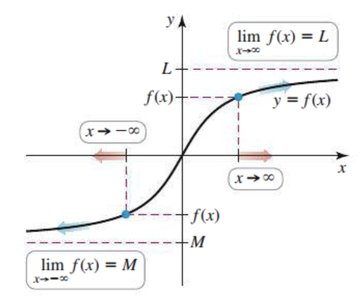
Notation:
Horizontal Asymptote:
Key Concept: Infinite Limits vs. Limits at Infinity
Infinite Limits | Limits at Infinity |
|---|---|
Vertical asymptote: | Horizontal asymptote: |
Continuity
Continuity at a Point
A function is continuous at if . Discontinuities occur when this condition fails, resulting in holes, jumps, infinite, or oscillating discontinuities.
Checklist for Continuity:
is defined.
exists.
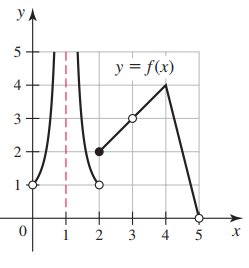
Types of discontinuities include removable (hole), jump, infinite (vertical asymptote), and oscillating.
Exponential Functions
Definition and Properties
An exponential function has the form , where and . The base determines whether the function represents exponential growth () or decay ().
Domain:
Range:
y-intercept:
Horizontal asymptote:
Laws of Exponents
Solving Exponential Equations
If both sides of an exponential equation can be written with the same base, set the exponents equal and solve for .
Example:
The Natural Exponential Function
The natural exponential function is , where is Euler's number. It is fundamental in calculus and has unique properties.
Function Composition and Inverse Functions
Function Composition
Function composition combines two functions by using the output of one as the input of another: .
Domain: All in the domain of such that is in the domain of .
Inverse Functions
An inverse function reverses the action of the original function. If , then . The domain and range are reversed.
Inverse Function Check: and
One-to-One Functions: A function is one-to-one if it passes the horizontal line test.
To find the inverse algebraically, solve for , interchange $x$ and , and replace $y$ with .
Summary Table: Types of Discontinuities
Type | Description |
|---|---|
Removable | Hole in the graph; limit exists but is undefined or not equal to the limit. |
Jump | Graph jumps; left and right limits exist but are not equal. |
Infinite | Function grows without bound; vertical asymptote. |
Oscillating | Function oscillates near the point; limit does not exist. |
Additional info: These notes expand on the original material by providing definitions, examples, and formulas for key concepts in limits, continuity, and exponential functions, suitable for Algebra & Trigonometry students.
