 뒤로
뒤로Vectors: Concepts, Operations, and Applications
스터디 가이드 - 스마트 노트
 자료에 맞춘 맞춤형 노트, 핵심 정의, 예시, 맥락을 확장해 제공합니다.
Vectors and Scalars
Definitions and Distinctions
In mathematics and physics, quantities are classified as either scalars or vectors. Understanding the difference is fundamental for solving problems involving direction and magnitude.
Scalar: A quantity with only magnitude (size), such as temperature or mass.
Vector: A quantity with both magnitude and direction, such as force or velocity.
Examples:
Temperature: 60°F (Scalar)
Force: 100 N north (Vector)
Distance: 10 m (Scalar)
Displacement: 10 m east (Vector)
Speed: 80 mph (Scalar)
Velocity: 80 mph west (Vector)
Vector Representation and Basic Operations
Graphical Representation
Vectors are represented as arrows. The length of the arrow indicates the magnitude, and the direction of the arrow shows the direction of the vector.
Adding and Subtracting Vectors
Vector addition and subtraction are performed using the tip-to-tail method. The resultant vector is the shortest path from the start of the first vector to the end of the last vector.
Commutative Property: The order of addition does not affect the result:
Subtraction: Subtracting a vector is equivalent to adding its negative (same magnitude, opposite direction).
Example: If you walk 3 m right and then 4 m up, your total displacement forms a right triangle. The magnitude is found using the Pythagorean theorem:
Combining Vectors
Parallel Vectors: Add magnitudes directly if in the same direction; subtract if in opposite directions.
Perpendicular Vectors: Use the Pythagorean theorem to find the resultant.
Vector Components and Decomposition
Breaking Vectors into Components
Any vector in a plane can be decomposed into x (horizontal) and y (vertical) components using trigonometric functions:
where is the magnitude and is the angle from the x-axis.
Example: For m at above the x-axis:
Recomposing Vectors from Components
Given components and , the magnitude and direction are:
Vector Addition by Components
Procedure
Resolve each vector into x and y components.
Add all x components to get ; add all y components to get .
Find the magnitude and direction of the resultant vector:
Unit Vectors
Definition and Notation
Unit vectors are vectors of length 1 that indicate direction along coordinate axes:
: x-direction
: y-direction
: z-direction
Any vector can be written as:
Example:
Dot Product (Scalar Product)
Definition and Calculation
The dot product of two vectors produces a scalar (number):
Alternatively, using components:
If vectors are perpendicular, dot product is zero.
If vectors are parallel, dot product is maximized.
Cross Product (Vector Product)
Definition and Calculation
The cross product of two vectors produces a new vector perpendicular to both:
The direction is determined by the right-hand rule:
Point fingers along , curl toward ; thumb points in direction of .
In component form:
Example: If and , then:
Directions and Angles in Vector Problems
Describing Directions
Angles measured counterclockwise from the positive x-axis are positive.
Angles described as "north of east" or similar require careful drawing and interpretation.
Example: A vector 6 m at 30° north of east has components:
Summary Table: Scalar vs. Vector Quantities
Quantity | Magnitude? | Direction? | Type |
|---|---|---|---|
Temperature | Yes | No | Scalar |
Force | Yes | Yes | Vector |
Distance | Yes | No | Scalar |
Displacement | Yes | Yes | Vector |
Speed | Yes | No | Scalar |
Velocity | Yes | Yes | Vector |
Visualizing Vectors in 3D
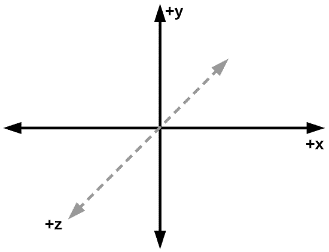
Vectors in three dimensions are represented with x, y, and z components. The cross product results in a vector perpendicular to the plane formed by the original vectors.
Key Formulas
Magnitude from components:
Direction from components:
Dot product: or
Cross product:
