 뒤로
뒤로Analytical Chemistry: Core Concepts and Titrimetric Methods
스터디 가이드 - 스마트 노트
 자료에 맞춘 맞춤형 노트, 핵심 정의, 예시, 맥락을 확장해 제공합니다.
Analytical Chemistry
Definition and Importance
Analytical Chemistry is the branch of chemistry concerned with identifying and quantifying the chemical components of substances. It is essential in various scientific fields, including pharmaceuticals, environmental science, forensic science, metallurgy, and medicine.
Qualitative analysis: Identifies which components are present in a sample.
Quantitative analysis: Measures the proportions of each component present.
Applications:
Determining compound purity in chemistry
Measuring drug content in pharmaceuticals
Identifying contaminants in environmental samples
Forensic identification of substances
Key Terminology
Component: A chemical compound, ion, or element in the material analyzed.
Sample: A representative portion of the material to be analyzed.
Analyte: The specific component to be identified or measured.
Interference: Any process or component that causes inaccurate analytical results.
Example: In the determination of calcium in seawater, calcium is the analyte, seawater is the sample, and other ions (e.g., Na+, Mg2+, Cl-) are components.
Typical Analytical Process
Take and measure a representative sample.
Prepare the sample (e.g., dissolve or dilute).
Remove or compensate for interferences.
Identify and/or measure the analyte(s).
Calculate and report results.
Types of Chemical Analysis
Gravimetric: Measures mass of analyte or its compound.
Titrimetric (Volumetric): Measures the volume of reagent reacting with analyte.
Spectroscopic: Measures intensity of absorbed/emitted electromagnetic radiation.
Electrochemical: Measures current, voltage, or conductivity due to analyte.
Radiochemical: Measures nuclear radiation from analyte.
Precision and Accuracy
Accuracy: Closeness of a measurement to the true value.
Precision: Closeness of repeated measurements to each other.
High-quality analysis aims for both high accuracy and high precision.
Titrimetric Analysis
Principle and Process
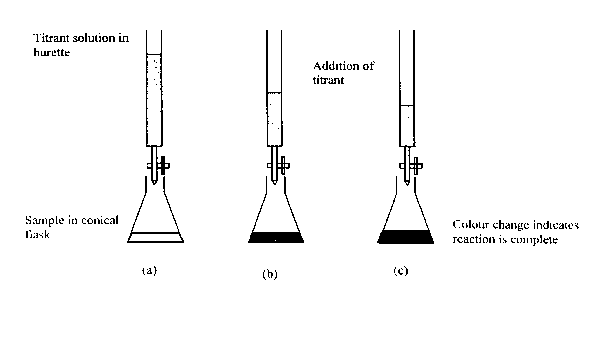
Titrimetric analysis involves adding a solution of known concentration (titrant) to a sample solution (titrand) until the reaction is complete. The volume of titrant used allows calculation of the analyte's concentration.
Titrant: The reagent of known concentration (in the burette).
Titrand: The analyte in the sample solution.
Equivalence point: The point where stoichiometrically equivalent amounts of titrant and titrand have reacted.
Types of Titration Reactions
Acid-base reactions: Involve proton transfer and pH change.
Precipitation reactions: Formation of an insoluble solid.
Complexation reactions: Formation of a complex ion.
Redox reactions: Electron transfer between titrant and titrand.
Example: Acid-base: Precipitation: Complexation: Redox:
Characteristics of Titration Reactions
Fast: Reaction should proceed quickly (may require heating or catalyst).
Complete: At equivalence, only a negligible amount of reactants remain.
No alternative reactions: Only the desired reaction should occur.
Reactions with reversibility or side reactions are unsuitable for titrimetry.
Finding the Equivalence Point
Primary reagent indication: A reactant or product changes color at equivalence (e.g., permanganate titration).
Ancillary reagent indication (Indicator): A dye added to signal endpoint by color change (e.g., methyl red, phenolphthalein).
Instrumental indication: Use of pH meters (potentiometry) or conductivity meters (conductimetry) to detect equivalence.
Note: The endpoint (indicator color change) should closely match the equivalence point for accuracy.
Standardisation
Since many titrants cannot be weighed accurately or may change concentration over time, their exact concentration is determined by titrating against a primary standard (a pure, stable, non-hygroscopic substance of known composition).
Titrant | Primary Standard |
|---|---|
HCl | Na2CO3 (sodium carbonate) |
NaOH | Potassium acid phthalate |
AgNO3 | NaCl (sodium chloride) |
EDTA | Pb(NO3)2 (lead nitrate) |
KMnO4 | Sodium oxalate |
Acid-Base Titrations
Indicators and Instrumental Methods
Acid-base titrations are monitored using indicators or pH meters, as most acids and bases are colorless. The choice of indicator depends on the strength of the acid and base involved.
Reaction Type | Example | pH at Equivalence | Suitable Indicator | Indicator pH Range | Color Change |
|---|---|---|---|---|---|
Strong acid / Strong base | HCl + NaOH | ~7 | Bromothymol blue | 6.9 | Yellow (acid) / Blue (alkali) |
Strong acid / Weak base | HCl + NH4OH | <7 | Methyl orange | 3.5 | Red (acid) / Yellow (alkali) |
Weak acid / Strong base | CH3COOH + NaOH | >7 | Phenolphthalein | 9.5 | Colorless (acid) / Red (alkali) |
Weak acid / Weak base | CH3COOH + NH4OH | Reversible | Unsuitable | - | - |
Instrumental methods (e.g., pH meters) provide titration curves, with the equivalence point at the steepest slope.
Precipitation Titrations
Principle and Example
Precipitation titrations involve the formation of an insoluble product. The classic example is the determination of chloride using silver nitrate:
Potassium chromate is used as an indicator, turning red in the presence of excess silver ions.
Complexometric Titrations
Principle and EDTA Complexes
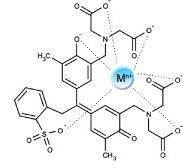
Complexometric titrations involve the reaction of a metal cation (titrand) with a ligand (titrant) to form a stable complex. The most important ligand is EDTA (ethylenediaminetetraacetic acid), which forms strong complexes with many metal ions, especially at higher charges and alkaline pH.
EDTA can lose up to 4 H+ ions, forming the Y4− anion, which acts as a ligand.
Complexes are more stable at higher pH; selectivity can be achieved by adjusting pH.
Example:
Indicators for Complexometric Titrations
Indicator (pH Range) | Color Change | Titrands |
|---|---|---|
Eriochrome Black T (pH 10) | Blue (uncomplexed) / Red (complexed) | Mg2+, Sr2+, Ca2+ |
Xylenol Orange (pH 5) | Yellow (uncomplexed) / Red (complexed) | Zn2+, Pb2+, Cd2+, Th4+, Hg2+, Ni2+, Cu2+, Al3+, Fe2+, Fe3+ |
Titration Calculations
Molarity and Concentration
Concentration (C): (g/dm3)
Molarity (M): (mol/dm3), where
To convert:
Stoichiometry in Titrations
For a reaction products, the titration calculation is:
, = molarities of titrant and titrand
, = volumes used
, = stoichiometric coefficients
Calculating Weights and Percentages
Percentage of analyte:
Method 1: Titrate entire sample (calculate )
Method 2: Titrate aliquot from known dilution (calculate )
Redox Titrations
Principle and Balancing
Redox titrations involve electron transfer between oxidant and reductant. Each half-reaction must be balanced for mass and charge, then combined so electrons cancel.
Oxidation: Loss of electrons
Reduction: Gain of electrons
Oxidant: Accepts electrons (is reduced)
Reductant: Donates electrons (is oxidized)
Example: Balancing MnO4−/Mn2+ half-reaction:
Indicators for Redox Titrations
Titrant | Indicator | Color Change |
|---|---|---|
KMnO4 | None | Colorless to purple |
I2 | Starch | Colorless to blue |
Ce4+ | Iron(II) tri-o-phenanthroline | Red to pale blue |
Permanganate and Iodine Titrations
Permanganate: Used as an oxidant in acid, neutral, or alkaline media; reacts with various reductants.
Iodine/Thiosulfate: Iodine can act as oxidant or reductant; thiosulfate is used as a complementary reagent for quantifying iodine produced by oxidizing agents.
Appendix: Sample Calculations and Self-Test Answers
Worked examples and answers to self-test questions are provided in the original material for practice with titration calculations, stoichiometry, and redox balancing.
Additional info: This summary covers the foundational topics in analytical chemistry, focusing on chemical measurements, titrimetric methods, acid-base, precipitation, complexometric, and redox titrations, as well as calculation strategies essential for laboratory practice and exams.
