 뒤로
뒤로Electrochemical Techniques and Potentiometry in Analytical Chemistry
스터디 가이드 - 스마트 노트
 자료에 맞춘 맞춤형 노트, 핵심 정의, 예시, 맥락을 확장해 제공합니다.
Introduction to Electrochemical Techniques
Overview of Electroanalytical Methods
Electroanalytical chemistry encompasses a set of techniques that utilize electrical measurements to analyze chemical systems. These methods are essential for determining the composition, concentration, and chemical properties of analytes, often with high specificity and sensitivity.
Specificity: Electroanalytical methods can target specific oxidation states of elements.
Cost-effectiveness: Instrumentation is generally less expensive compared to spectroscopic and chromatographic techniques.
Activity Measurement: These methods often provide information about the activity of ions rather than just their concentration.

Historical Foundations
Key figures in the development of electroanalytical chemistry include:
Michael Faraday: Established the laws of electrolysis, relating the amount of substance deposited at an electrode to the quantity of electric charge.
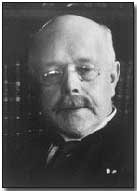
Walter Nernst: Developed the Nernst equation, which relates cell potential to ion activity (Nobel Prize 1920).
Jaroslav Heyrovsky: Invented polarography, a technique for analyzing solutions using dropping mercury electrodes (Nobel Prize 1959).


Main Branches of Electroanalytical Chemistry
Classification of Methods
Electroanalytical chemistry is divided into several main branches, each with distinct measurement principles:
Potentiometry: Measures the potential of electrochemical cells without drawing significant current. Examples include pH measurements and ion-selective electrodes.
Coulometry: Measures the total charge passed to drive a redox reaction to completion.
Voltammetry: Measures current as a function of applied potential, often under conditions that polarize the working electrode.

Electrochemical Cells
Basic Structure and Function
An electrochemical cell consists of two electrodes (anode and cathode) immersed in electrolyte solutions, often separated by a salt bridge. The cell enables redox reactions, with electron flow from the anode to the cathode.
Anode: Site of oxidation (loss of electrons).
Cathode: Site of reduction (gain of electrons).
Salt Bridge: Maintains electrical neutrality by allowing ion flow between compartments.
Electrochemical cells are foundational to potentiometric, amperometric, and coulometric methods.
Potentiometry
Principles and Instrumentation
Potentiometry is an electrochemical technique based on measuring the equilibrium potential (E) of an electrochemical cell in the absence of significant current. The measured potential is related to the activity of the analyte ion via the Nernst equation.
Reference Electrode: Maintains a constant, known potential (e.g., calomel or Ag/AgCl electrode).
Indicator Electrode: Responds to the activity of the analyte ion.
High Input Impedance Voltmeter: Ensures negligible current flow during measurement.
Reference Electrodes
Reference electrodes provide a stable and reproducible potential, essential for accurate potentiometric measurements.
Calomel Electrode: Mercury in contact with mercury(I) chloride and KCl solution. Advantage: easy preparation. Disadvantage: slow potential stabilization with temperature changes.
Silver/Silver Chloride Electrode: Silver wire in KCl saturated with AgCl. Advantage: usable at temperatures above 60°C.
Metallic Indicator Electrodes
Metallic indicator electrodes respond to changes in the activity of specific ions. Types include:
First Kind: Respond to their own cation (e.g., Cu electrode for Cu2+).
Second Kind: Respond to anions forming precipitates or complexes with the electrode metal (e.g., Ag/AgCl for Cl-).
Third Kind: Respond to different cations via complexation (e.g., Hg electrode for Ca2+ with EDTA).
Redox Indicator: Inert metal (e.g., Pt) in a solution with two oxidation states (e.g., Ce(III)/Ce(IV)).
Ion-Selective Electrodes (ISEs)
ISEs are designed to selectively respond to specific ions, making them highly useful for direct measurement of ion activities in complex matrices.
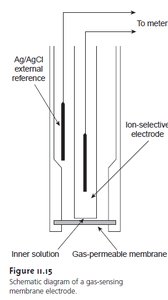
Types: Glass electrodes, liquid-ion electrodes, solid-state membrane electrodes, gas-sensing electrodes, biomembrane electrodes, etc.
Gas-Sensing Electrodes: Use a gas-permeable membrane to detect dissolved gases (e.g., CO2).
Glass pH Electrode
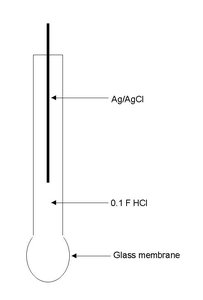
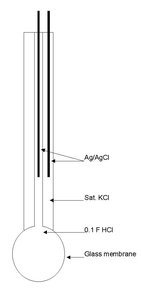
The glass pH electrode is a widely used ISE for measuring hydronium ion activity (pH) in solution. It consists of a thin glass membrane, an internal reference solution, and an internal Ag/AgCl electrode.
Combination Electrode: Incorporates both the reference and indicator electrodes in a single unit.
Junction Potential: Arises at the interface of two electrolytes due to unequal ion diffusion rates.
pH Measurement and Calibration
The potential measured by a pH electrode is related to the pH of the solution by the Nernst equation:
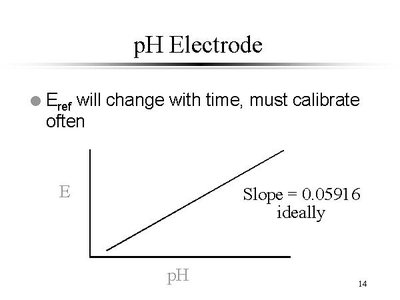
Calibration is essential due to drift in reference electrode potential. The slope ideally is 0.05916 V per pH unit at 25°C.
Sources of Error in pH Measurement
Calibration Drift: Regular calibration is required.
Junction Potential: Can introduce systematic error.
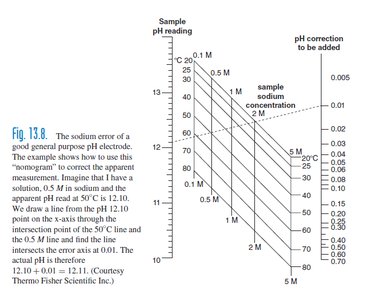
Alkaline Error: At high pH, other cations (e.g., Na+) interfere, causing falsely low pH readings.
Acid Error: At very low pH, the glass membrane absorbs acid, leading to falsely high pH readings.
Temperature Effects: Affect both electrode response and solution chemistry.
Potentiometric Titrations
Principle and Advantages
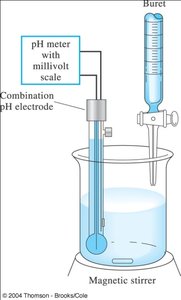
Potentiometric titrations involve measuring the potential of an indicator electrode as a function of titrant volume. They are especially useful for colored or turbid solutions and can be automated for high-throughput analysis.
End Point Detection: Determined by a sharp change in potential.
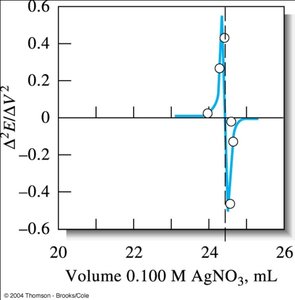
Data Analysis: First and second derivatives of the titration curve can be used to pinpoint the equivalence point.
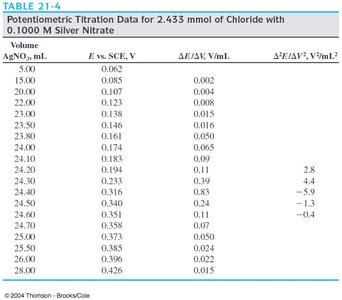
Potentiometric Titration Data Example
The following table presents typical data for a potentiometric titration of chloride with silver nitrate, including the first and second derivatives for endpoint determination:
Volume AgNO3 (mL) | E vs. SCE (V) | ΔE/ΔV (V/mL) | Δ2E/ΔV2 (V2/mL2) |
|---|---|---|---|
5.00 | 0.062 | 0.002 | |
15.00 | 0.085 | 0.004 | |
22.00 | 0.107 | 0.008 | |
23.00 | 0.123 | 0.016 | |
23.50 | 0.138 | 0.015 | |
24.00 | 0.164 | 0.056 | |
24.10 | 0.180 | 0.160 | 2.8 |
24.20 | 0.193 | 0.110 | -4.4 |
24.30 | 0.240 | 0.241 | -5.9 |
24.40 | 0.340 | 0.324 | -1.3 |
24.50 | 0.370 | 0.150 | 1.0 |
25.00 | 0.375 | 0.050 | |
26.00 | 0.426 | 0.015 |
Quantification Methods in Potentiometry
Direct Calibration
Direct calibration involves constructing a calibration curve by plotting cell potential (E) against the logarithm of analyte concentration. The Nernst equation provides the theoretical basis:
Standard Addition Method
Standard addition is used to account for matrix effects by adding known quantities of standard to the sample and measuring the change in potential. The Nernst equation is rearranged to solve for the unknown concentration.

Selectivity Coefficients
Ion-selective electrodes may respond to interfering ions. The selectivity coefficient quantifies the electrode's preference for the primary ion over interfering ions:
Where is the selectivity coefficient for ion relative to ion .
Sample Problems and Applications
Example: Determining Ca2+ Concentration
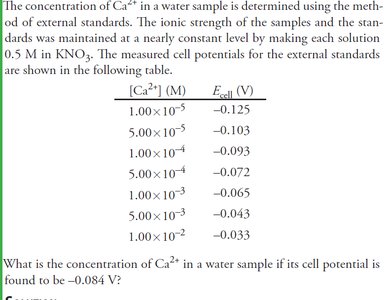
Given a table of cell potentials for known Ca2+ concentrations, the unknown concentration can be determined by interpolation or using the calibration curve.
Example: Standard Addition for Ca2+ in Seawater
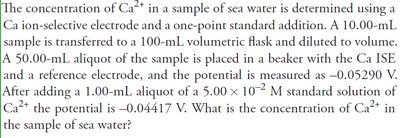
By measuring the cell potential before and after adding a standard solution, the unknown concentration is calculated using the rearranged Nernst equation.
Summary Table: Types of Electrodes in Potentiometry
Electrode Type | Analyte | Example | Equation |
|---|---|---|---|
First Kind | Cation of electrode metal | Cu for Cu2+ | |
Second Kind | Anion forming precipitate/complex | Ag/AgCl for Cl- | |
Third Kind | Different cation via complex | Hg for Ca2+ with EDTA | |
Redox Indicator | Redox couple | Pt for Ce(III)/Ce(IV) |
Additional info: This guide covers the core concepts, instrumentation, and applications of potentiometry and related electrochemical techniques, as outlined in Analytical Chemistry curricula (Chapters 13-16, with overlap into titrations and quantification methods).
