Discuss the factors that control the division of eukaryotic cells grown in the laboratory. Cancer cells are easier to grow in the lab than other cells. Why do you suppose this is?
검증된 단계별 안내
1
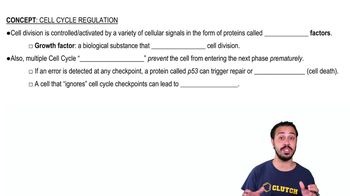
Identify the key factors that regulate eukaryotic cell division, such as growth factors, nutrients, and cell cycle checkpoints.
Explain how these factors ensure that cells only divide when conditions are favorable, preventing uncontrolled cell growth.
Discuss the role of specific proteins and enzymes, like cyclins and cyclin-dependent kinases (CDKs), in controlling the progression of the cell cycle.
Consider how cancer cells differ from normal cells in terms of cell cycle regulation, often due to mutations that lead to the loss of control over these regulatory mechanisms.
Explore why cancer cells, due to their ability to bypass normal regulatory checkpoints and sustain growth signals, are easier to grow in laboratory conditions compared to normal cells.
비슷한 문제에 대한 검증된 영상 답변:
이 영상 해법은 위 문제에 도움이 된다고 튜터들이 추천한 것입니다.
영상 길이:
1m
영상 재생:
0 댓글
주요 개념
질문에 올바르게 답하기 위해 반드시 이해해야 하는 핵심 개념들은 다음과 같습니다.
Cell Cycle Regulation
The cell cycle is a series of phases that a eukaryotic cell goes through to divide and replicate. Regulation of this cycle is crucial, as it involves checkpoints that ensure the cell is ready to proceed to the next phase. Factors such as cyclins and cyclin-dependent kinases (CDKs) play significant roles in controlling these transitions, and disruptions in this regulation can lead to uncontrolled cell division, a hallmark of cancer.
Growth factors are proteins that stimulate cell division and proliferation. In laboratory settings, the presence or absence of specific growth factors can significantly influence the ability of cells to grow and divide. Cancer cells often have altered signaling pathways that allow them to bypass the need for these external signals, making them more adaptable and easier to culture compared to normal cells.
Cellular senescence is a state where cells lose the ability to divide and grow, often as a response to stress or damage. Normal somatic cells have a limited number of divisions before entering senescence, influenced by telomere shortening and other factors. In contrast, cancer cells can evade senescence, allowing them to proliferate indefinitely, which contributes to their ease of growth in laboratory conditions.