Cytochalasin B is a chemical that disrupts microfilament formation. This chemical would interfere with
a. DNA replication.
b. formation of the mitotic spindle.
c. cleavage.
d. formation of the cell plate.
검증된 단계별 안내
1
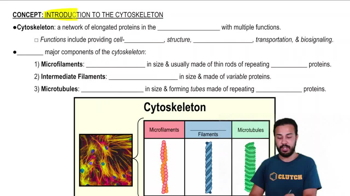
Understand that cytochalasin B disrupts microfilament formation, which are part of the cytoskeleton.
Recall that microfilaments, composed of actin, play a crucial role in cell movement and division.
Consider the processes listed: DNA replication, mitotic spindle formation, cleavage, and cell plate formation.
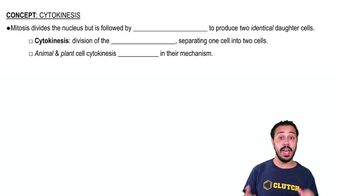
Identify that cleavage, the process of cytokinesis in animal cells, relies heavily on microfilaments to form the contractile ring.
Conclude that cytochalasin B would interfere with cleavage due to its role in disrupting microfilament formation.
비슷한 문제에 대한 검증된 영상 답변:
이 영상 해법은 위 문제에 도움이 된다고 튜터들이 추천한 것입니다.
영상 길이:
2m
영상 재생:
0 댓글
주요 개념
질문에 올바르게 답하기 위해 반드시 이해해야 하는 핵심 개념들은 다음과 같습니다.
Microfilaments
Microfilaments are thin, thread-like structures made of actin that are part of the cytoskeleton in eukaryotic cells. They play a crucial role in maintaining cell shape, enabling cell movement, and facilitating various cellular processes, including cytokinesis. Disruption of microfilament formation can significantly impact these functions.
Cytokinesis is the process during cell division where the cytoplasm of a parental cell is divided into two daughter cells. This process typically follows mitosis and involves the formation of a cleavage furrow in animal cells or a cell plate in plant cells. Microfilaments are essential for the contractile ring that helps in the cleavage of the cell.
Cell plate formation is a key process in plant cell division, where vesicles containing cell wall materials fuse at the center of the dividing cell to form a new cell wall. This process is crucial for separating the two daughter cells. Disruption of microfilament formation can hinder the proper assembly and function of the structures involved in cell plate formation.