Which of the three stages of cellular respiration is considered the most ancient? Explain your answer.
검증된 단계별 안내
1
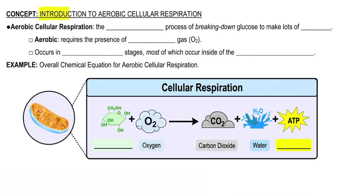
Understand that cellular respiration consists of three main stages: glycolysis, the citric acid cycle (Krebs cycle), and oxidative phosphorylation.
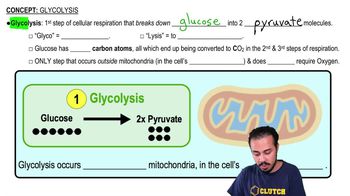
Recognize that glycolysis occurs in the cytoplasm and does not require oxygen, making it an anaerobic process.
Consider the evolutionary perspective: glycolysis is thought to be the most ancient stage because it does not require specialized organelles or oxygen, which were not abundant in early Earth's atmosphere.
Note that glycolysis is a universal process found in nearly all organisms, suggesting its ancient origin.
Conclude that glycolysis is considered the most ancient stage of cellular respiration due to its simplicity, anaerobic nature, and universality across different life forms.
비슷한 문제에 대한 검증된 영상 답변:
이 영상 해법은 위 문제에 도움이 된다고 튜터들이 추천한 것입니다.
영상 길이:
1m
영상 재생:
0 댓글
주요 개념
질문에 올바르게 답하기 위해 반드시 이해해야 하는 핵심 개념들은 다음과 같습니다.
Cellular Respiration
Cellular respiration is the biochemical process by which cells convert glucose and oxygen into energy, carbon dioxide, and water. It consists of three main stages: glycolysis, the Krebs cycle, and oxidative phosphorylation. This process is essential for producing ATP, the energy currency of the cell, and is fundamental to the metabolism of all living organisms.
Glycolysis is the first stage of cellular respiration, occurring in the cytoplasm, where one molecule of glucose is broken down into two molecules of pyruvate. This anaerobic process generates a small amount of ATP and NADH, making it a crucial energy-producing pathway. Glycolysis is considered the most ancient stage of cellular respiration because it does not require oxygen and is found in nearly all living organisms, indicating its evolutionary significance.
The evolution of metabolic pathways refers to the development and adaptation of biochemical processes over time in response to environmental changes. Glycolysis is thought to be one of the earliest metabolic pathways, as it likely evolved when Earth's atmosphere had little oxygen. Understanding the evolutionary context of these pathways helps explain why glycolysis is still a fundamental process in modern cellular respiration.