Which of the following is the most immediate source of energy for making most of the ATP in your cells?
a. the transfer of from intermediate substrates to ADP
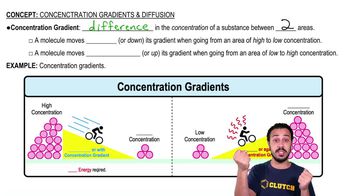
b. the movement of H+ across a membrane down its concentration gradient
c. the splitting of glucose into two molecules of pyruvate
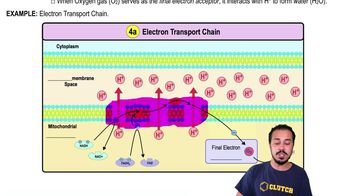
d. electrons moving through the electron transport chain
검증된 단계별 안내
1
Identify the process in cellular respiration where ATP is primarily produced.
Recall that ATP is mainly produced during oxidative phosphorylation.
Understand that oxidative phosphorylation involves the electron transport chain and chemiosmosis.
Recognize that the movement of H+ ions across the mitochondrial membrane creates a proton gradient.
Conclude that the movement of H+ ions down their concentration gradient through ATP synthase is the immediate source of energy for ATP synthesis.
비슷한 문제에 대한 검증된 영상 답변:
이 영상 해법은 위 문제에 도움이 된다고 튜터들이 추천한 것입니다.
영상 길이:
2m
영상 재생:
0 댓글
주요 개념
질문에 올바르게 답하기 위해 반드시 이해해야 하는 핵심 개념들은 다음과 같습니다.
ATP Synthesis
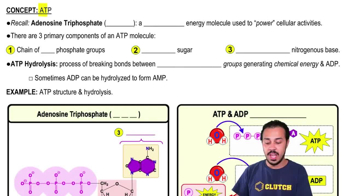
ATP (adenosine triphosphate) is the primary energy carrier in cells. Its synthesis occurs mainly through oxidative phosphorylation, where energy from electrons is used to convert ADP and inorganic phosphate into ATP. Understanding the mechanisms of ATP production is crucial for answering questions about cellular energy sources.
The movement of H+ ions (protons) across a membrane creates a proton gradient, which is essential for ATP synthesis. This gradient drives ATP synthase, an enzyme that produces ATP as protons flow back into the mitochondrial matrix. Recognizing the role of the proton gradient is key to understanding how energy is harnessed in cellular respiration.
The electron transport chain (ETC) is a series of protein complexes located in the inner mitochondrial membrane that transfer electrons derived from nutrients. As electrons move through the ETC, they release energy used to pump protons across the membrane, contributing to the proton gradient necessary for ATP production. Familiarity with the ETC is vital for comprehending cellular energy dynamics.

 2:18분
2:18분 검증된 단계별 안내
 06:44
06:44