A plant cell placed in distilled water will ______________; an animal cell placed in distilled water will ______________.
a. burst … burst
b. become flaccid . . . shrivel
c. become turgid . . . be normal in shape
d. become turgid . . . burst
검증된 단계별 안내
1
Step 1: Understand the concept of osmosis, which is the movement of water across a semipermeable membrane from an area of low solute concentration to an area of high solute concentration.
Step 2: Recognize that distilled water is a hypotonic solution, meaning it has a lower concentration of solutes compared to the inside of the cell.
Step 3: Consider the structure of plant cells, which have a rigid cell wall that provides support and limits excessive expansion.
Step 4: Consider the structure of animal cells, which lack a cell wall and are more susceptible to changes in volume due to osmotic pressure.
Step 5: Analyze the effects of placing each type of cell in distilled water: a plant cell will become turgid due to water influx, while an animal cell will burst due to the lack of structural support to counteract the osmotic pressure.
비슷한 문제에 대한 검증된 영상 답변:
이 영상 해법은 위 문제에 도움이 된다고 튜터들이 추천한 것입니다.
영상 길이:
1m
영상 재생:
0 댓글
주요 개념
질문에 올바르게 답하기 위해 반드시 이해해야 하는 핵심 개념들은 다음과 같습니다.
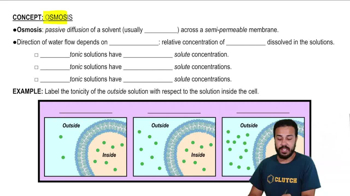
Osmosis
Osmosis is the movement of water molecules across a selectively permeable membrane from an area of lower solute concentration to an area of higher solute concentration. This process is crucial for maintaining cell turgor in plant cells and overall cell health in animal cells. Understanding osmosis helps explain how cells react to different environments, such as distilled water.
Turgor pressure is the pressure exerted by the fluid inside a plant cell against the cell wall. It is essential for maintaining the structural integrity and rigidity of plant cells. When a plant cell is placed in distilled water, water enters the cell, increasing turgor pressure, which can lead to the cell becoming turgid.
Cell membrane permeability refers to the ability of the cell membrane to allow certain substances to pass through while blocking others. In animal cells, the membrane is more permeable to water than to solutes, which can lead to cell swelling and potential bursting when placed in a hypotonic solution like distilled water. Understanding this concept is key to predicting the behavior of cells in different osmotic conditions.

 1:21분
1:21분 검증된 단계별 안내
 05:59
05:59