If a solution surrounding a cell is hypertonic relative to the inside of the cell, how will water move?
a. It will move into the cell via osmosis.
b. It will move out of the cell via osmosis.
c. It will not move, because equilibrium exists.
d. It will evaporate from the cell surface more rapidly.
검증된 단계별 안내
1
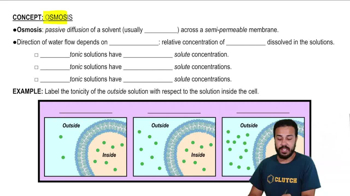
insert step 1: Understand the concept of tonicity. Tonicity refers to the concentration of solutes in a solution relative to another solution. A hypertonic solution has a higher concentration of solutes compared to the inside of the cell.
insert step 2: Recall the principle of osmosis. Osmosis is the movement of water across a semipermeable membrane from an area of lower solute concentration to an area of higher solute concentration.
insert step 3: Apply the concept of osmosis to the scenario. Since the solution outside the cell is hypertonic, it has a higher solute concentration than the inside of the cell.
insert step 4: Determine the direction of water movement. Water will move from the area of lower solute concentration (inside the cell) to the area of higher solute concentration (outside the cell) to achieve equilibrium.
insert step 5: Conclude that water will move out of the cell via osmosis, which corresponds to option b.
비슷한 문제에 대한 검증된 영상 답변:
이 영상 해법은 위 문제에 도움이 된다고 튜터들이 추천한 것입니다.
영상 길이:
1m
영상 재생:
0 댓글
주요 개념
질문에 올바르게 답하기 위해 반드시 이해해야 하는 핵심 개념들은 다음과 같습니다.
Osmosis
Osmosis is the movement of water molecules across a selectively permeable membrane from an area of lower solute concentration to an area of higher solute concentration. This process continues until equilibrium is reached, where the concentration of solutes is equal on both sides of the membrane. Understanding osmosis is crucial for predicting how water will move in response to different solute concentrations.
A hypertonic solution has a higher concentration of solutes compared to the inside of a cell. When a cell is placed in a hypertonic solution, water will move out of the cell to balance the solute concentrations on both sides of the membrane. This concept is essential for understanding the effects of different solutions on cell volume and integrity.
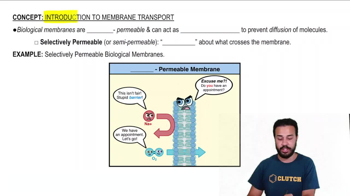
The cell membrane is selectively permeable, meaning it allows certain substances to pass while blocking others. Water can move freely through the membrane via specialized channels called aquaporins, but solutes cannot pass as easily. This property is vital for understanding how cells interact with their environment and how they respond to changes in solute concentration.