Which of the following is present in a prokaryotic cell?
a. mitochondrion
b. ribosome
c. nuclear envelope
d. chloroplast
검증된 단계별 안내
1
Identify the characteristics of prokaryotic cells, which are generally simpler and lack membrane-bound organelles.
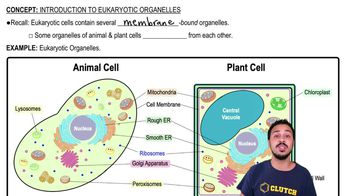
Recall that mitochondria, nuclear envelopes, and chloroplasts are membrane-bound organelles typically found in eukaryotic cells.
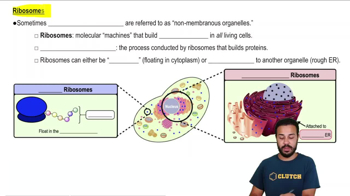
Understand that ribosomes are not membrane-bound and are present in both prokaryotic and eukaryotic cells.
Eliminate options that involve membrane-bound organelles: mitochondrion, nuclear envelope, and chloroplast.
Conclude that the correct answer is the option that is not a membrane-bound organelle, which is ribosome.
비슷한 문제에 대한 검증된 영상 답변:
이 영상 해법은 위 문제에 도움이 된다고 튜터들이 추천한 것입니다.
영상 길이:
31s
영상 재생:
0 댓글
주요 개념
질문에 올바르게 답하기 위해 반드시 이해해야 하는 핵심 개념들은 다음과 같습니다.
Prokaryotic Cells
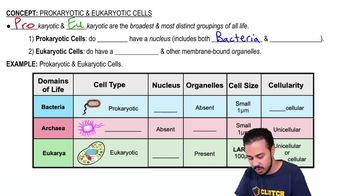
Prokaryotic cells are simple, unicellular organisms that lack a nucleus and membrane-bound organelles. They are characterized by their small size and the presence of a single circular DNA molecule. Common examples include bacteria and archaea, which thrive in various environments and play crucial roles in ecosystems.
Ribosomes are essential cellular structures responsible for protein synthesis. They can be found in both prokaryotic and eukaryotic cells, and in prokaryotes, they float freely in the cytoplasm. Ribosomes translate messenger RNA (mRNA) into polypeptide chains, which then fold into functional proteins.
Cellular organelles are specialized structures within cells that perform distinct functions. In eukaryotic cells, organelles like mitochondria and chloroplasts are membrane-bound, while prokaryotic cells lack these structures. Understanding the differences in organelle presence helps distinguish between prokaryotic and eukaryotic cells.

 0:31분
0:31분 검증된 단계별 안내
 05:54
05:54