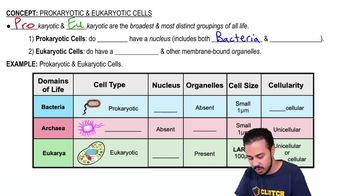
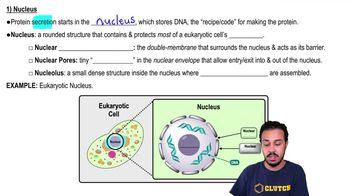
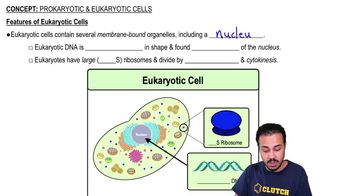
Eukaryotic cells differ from prokaryotic cells in that only eukaryotic cells .
a. contain DNA;
b. have a plasma membrane;
c. are considered to be alive;
d. have a nucleus;
e. are able to evolve
검증된 단계별 안내
1
Identify the key differences between eukaryotic and prokaryotic cells.
Recall that both eukaryotic and prokaryotic cells contain DNA, have a plasma membrane, and are considered to be alive.
Understand that both types of cells are capable of evolution.
Recognize that the presence of a nucleus is a distinguishing feature of eukaryotic cells.
Conclude that the correct answer is the option that highlights the presence of a nucleus in eukaryotic cells.
비슷한 문제에 대한 검증된 영상 답변:
이 영상 해법은 위 문제에 도움이 된다고 튜터들이 추천한 것입니다.
영상 길이:
41s
영상 재생:
0 댓글
주요 개념
질문에 올바르게 답하기 위해 반드시 이해해야 하는 핵심 개념들은 다음과 같습니다.
Eukaryotic Cells
Eukaryotic cells are complex cells that contain a nucleus and membrane-bound organelles. They are typically larger than prokaryotic cells and can be unicellular or multicellular, including organisms such as plants, animals, and fungi. The presence of a nucleus allows for more organized genetic material and regulation of cellular processes.
Prokaryotic cells are simpler, smaller cells that lack a nucleus and membrane-bound organelles. They are usually unicellular and include bacteria and archaea. Their genetic material is not enclosed within a membrane, which allows for rapid reproduction and adaptation, but limits the complexity of cellular functions compared to eukaryotic cells.
The nucleus is a membrane-bound organelle found in eukaryotic cells that houses the cell's genetic material (DNA). It plays a crucial role in regulating gene expression and cell division. The presence of a nucleus is a defining feature that distinguishes eukaryotic cells from prokaryotic cells, which do not have this structure.

 0:41분
0:41분 검증된 단계별 안내
 04:17
04:17