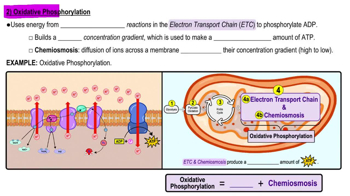
The final electron acceptor of the electron transport chain that functions in aerobic oxidative phosphorylation is
a. oxygen.
b. water.
c. NAD+.
d. pyruvate.
검증된 단계별 안내
1
Understand the context: The electron transport chain (ETC) is the final stage of cellular respiration, occurring in the inner mitochondrial membrane.
Recognize the role of the electron transport chain: It transfers electrons from electron donors to electron acceptors via redox reactions, and couples this electron transfer with the transfer of protons (H+ ions) across the membrane.
Identify the final electron acceptor: In aerobic respiration, the final electron acceptor is a molecule that receives electrons at the end of the ETC.
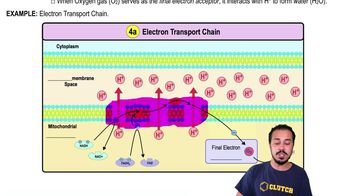
Recall that in aerobic respiration, oxygen is the final electron acceptor, combining with electrons and protons to form water.
비슷한 문제에 대한 검증된 영상 답변:
이 영상 해법은 위 문제에 도움이 된다고 튜터들이 추천한 것입니다.
영상 길이:
3m
영상 재생:
0 댓글
주요 개념
질문에 올바르게 답하기 위해 반드시 이해해야 하는 핵심 개념들은 다음과 같습니다.
Electron Transport Chain (ETC)
The electron transport chain is a series of protein complexes and other molecules located in the inner mitochondrial membrane. It plays a crucial role in aerobic respiration by transferring electrons from electron donors like NADH and FADH2 to electron acceptors, ultimately leading to the production of ATP through oxidative phosphorylation.
Aerobic oxidative phosphorylation is the process by which cells generate ATP using oxygen as the final electron acceptor in the electron transport chain. This process occurs in the mitochondria and involves the coupling of electron transport to ATP synthesis, making it essential for energy production in aerobic organisms.
The final electron acceptor in the electron transport chain is the molecule that receives electrons at the end of the chain, allowing the process to continue. In aerobic respiration, this acceptor is oxygen, which combines with electrons and protons to form water, thus facilitating the production of ATP and maintaining the flow of electrons through the chain.

 3:19분
3:19분 검증된 단계별 안내
 07:41
07:41