Compare and contrast substrate-level phosphorylation and oxidative phosphorylation.
검증된 단계별 안내
1
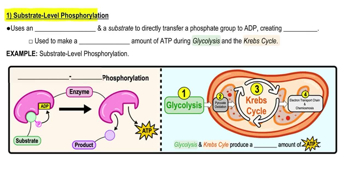
Substrate-level phosphorylation occurs directly in the cytoplasm during glycolysis and in the mitochondria during the Krebs cycle, where a phosphate group is directly transferred from a substrate to ADP to form ATP.
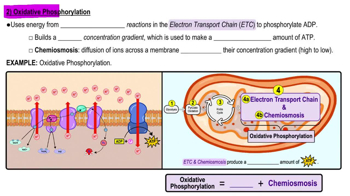
Oxidative phosphorylation takes place in the mitochondria's inner membrane, where ATP is generated from the transfer of electrons through the electron transport chain and the subsequent flow of protons across the membrane, creating a proton gradient.
In substrate-level phosphorylation, the energy for ATP synthesis comes directly from the chemical reaction of the substrate, whereas in oxidative phosphorylation, the energy comes from the electrochemical gradient created by the electron transport chain.
Substrate-level phosphorylation does not require oxygen, making it an anaerobic process, while oxidative phosphorylation requires oxygen as the final electron acceptor, making it an aerobic process.
Substrate-level phosphorylation produces a smaller amount of ATP compared to oxidative phosphorylation, which is the primary method of ATP production in aerobic organisms, generating the majority of ATP during cellular respiration.
비슷한 문제에 대한 검증된 영상 답변:
이 영상 해법은 위 문제에 도움이 된다고 튜터들이 추천한 것입니다.
영상 길이:
4m
영상 재생:
0 댓글
주요 개념
질문에 올바르게 답하기 위해 반드시 이해해야 하는 핵심 개념들은 다음과 같습니다.
Substrate-Level Phosphorylation
Substrate-level phosphorylation is a metabolic process that directly generates ATP by transferring a phosphate group from a substrate molecule to ADP. This occurs in specific enzymatic reactions, primarily during glycolysis and the citric acid cycle. Unlike oxidative phosphorylation, it does not involve the electron transport chain and is less efficient in terms of ATP yield.
Oxidative phosphorylation is a process that produces ATP through the electron transport chain and chemiosmosis, occurring in the mitochondria. It involves the transfer of electrons from NADH and FADH2 to oxygen, creating a proton gradient that drives ATP synthesis via ATP synthase. This method is more efficient than substrate-level phosphorylation, yielding significantly more ATP per glucose molecule.
The comparison of ATP yield between substrate-level and oxidative phosphorylation highlights their efficiency differences. Substrate-level phosphorylation typically produces 2 ATP molecules per glucose during glycolysis and the citric acid cycle, while oxidative phosphorylation can yield approximately 28-34 ATP molecules per glucose, depending on the efficiency of the electron transport chain. Understanding this difference is crucial for grasping cellular energy production.

 4:51분
4:51분 검증된 단계별 안내
 02:59
02:59