What are the primary functions of carbohydrates in cells?
a. cell identity, energy storage, raw material source for synthesis, and structure
b. catalysis, energy storage, metabolism, and structure
c. catalysis, digestion, energy storage, and information storage
d. energy storage, information storage, polymerization, and raw material source for synthesis
검증된 단계별 안내
1
Identify the main roles of carbohydrates in biological systems.
Consider the role of carbohydrates in energy storage, such as glycogen in animals and starch in plants.
Think about how carbohydrates contribute to cell identity, such as glycoproteins and glycolipids on cell surfaces.
Recognize that carbohydrates can serve as raw materials for the synthesis of other molecules.
Understand that carbohydrates can also provide structural support, as seen in cellulose in plant cell walls.
비슷한 문제에 대한 검증된 영상 답변:
이 영상 해법은 위 문제에 도움이 된다고 튜터들이 추천한 것입니다.
영상 길이:
1m
영상 재생:
0 댓글
주요 개념
질문에 올바르게 답하기 위해 반드시 이해해야 하는 핵심 개념들은 다음과 같습니다.
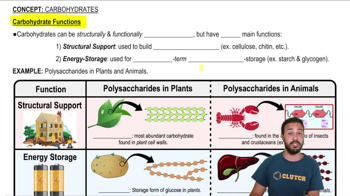
Functions of Carbohydrates
Carbohydrates serve several essential functions in cells, including energy storage, providing structural support, and acting as raw materials for synthesis. They are crucial for cellular metabolism, where they can be broken down to release energy. Additionally, carbohydrates play a role in cell recognition and signaling, contributing to cell identity.
Carbohydrates, particularly in the form of glycogen in animals and starch in plants, are vital for energy storage. When energy is needed, these polysaccharides can be hydrolyzed into glucose, which is then utilized in cellular respiration to produce ATP, the energy currency of the cell. This process ensures that cells have a readily available energy source.
In addition to energy storage, carbohydrates contribute to the structural integrity of cells. For example, cellulose in plant cell walls provides rigidity and strength, while chitin serves a similar function in the exoskeletons of arthropods. These structural carbohydrates are essential for maintaining the shape and stability of cells and tissues.