What holds cellulose molecules together in bundles large enough to form fibers?
a. the cell wall
b. peptide bonds
c. hydrogen bonds
d. hydrophobic interactions
검증된 단계별 안내
1
Identify the structure of cellulose, which is a polysaccharide composed of glucose units linked by β-1,4-glycosidic bonds.
Understand that cellulose molecules form linear chains that can align parallel to each other.
Recognize that these parallel chains are held together by intermolecular forces.
Consider the types of intermolecular forces that can occur between cellulose chains, such as hydrogen bonds, which are common in biological molecules.
Conclude that hydrogen bonds are responsible for holding cellulose molecules together in bundles large enough to form fibers.
비슷한 문제에 대한 검증된 영상 답변:
이 영상 해법은 위 문제에 도움이 된다고 튜터들이 추천한 것입니다.
영상 길이:
2m
영상 재생:
0 댓글
주요 개념
질문에 올바르게 답하기 위해 반드시 이해해야 하는 핵심 개념들은 다음과 같습니다.
Cellulose Structure
Cellulose is a polysaccharide composed of long chains of glucose units linked by β-1,4-glycosidic bonds. These chains can align parallel to each other, forming microfibrils that provide structural support in plant cell walls. Understanding the structure of cellulose is essential for grasping how it forms fibers.
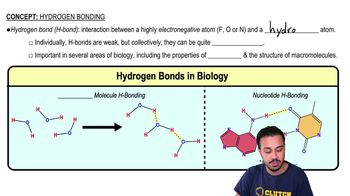
Hydrogen bonds are weak attractions that occur between a hydrogen atom covalently bonded to an electronegative atom and another electronegative atom. In cellulose, hydrogen bonds form between hydroxyl groups on adjacent cellulose chains, helping to stabilize the structure and hold the molecules together in bundles.
The cell wall is a rigid outer layer found in plant cells, primarily composed of cellulose, hemicellulose, and lignin. It provides structural integrity and protection. The interaction of cellulose fibers within the cell wall is crucial for understanding how they form larger structures and contribute to the overall strength of plant tissues.

 2:46분
2:46분 검증된 단계별 안내
 4:16
4:16