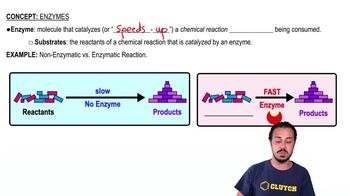
The enzyme amylase can break glycosidic linkages between glucose monomers only if the monomers are in the α
form. Which of the following could amylase break down?
a. glycogen, starch, and amylopectin
b. glycogen and cellulose
c. cellulose and chitin
d. starch, chitin, and cellulose
검증된 단계별 안내
1
Identify the structure of glucose monomers in each polysaccharide.
Understand that amylase can only break down polysaccharides with α-glycosidic linkages.
Recognize that glycogen, starch, and amylopectin have α-glycosidic linkages.
Note that cellulose and chitin have β-glycosidic linkages, which amylase cannot break.
Determine which options contain only polysaccharides with α-glycosidic linkages.
비슷한 문제에 대한 검증된 영상 답변:
이 영상 해법은 위 문제에 도움이 된다고 튜터들이 추천한 것입니다.
영상 길이:
2m
영상 재생:
0 댓글
주요 개념
질문에 올바르게 답하기 위해 반드시 이해해야 하는 핵심 개념들은 다음과 같습니다.
Glycosidic Linkages
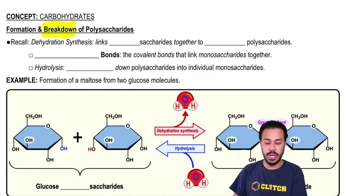
Glycosidic linkages are covalent bonds that connect monosaccharides to form polysaccharides. They can be classified as α or β based on the orientation of the hydroxyl group on the first carbon of the glucose monomer. Amylase specifically targets α-glycosidic linkages, which are found in starch and glycogen, allowing it to break these down into simpler sugars.
Polysaccharides are large carbohydrate molecules composed of long chains of monosaccharide units. Common examples include starch, glycogen, cellulose, and chitin. Starch and glycogen contain α-glycosidic linkages, making them substrates for amylase, while cellulose and chitin contain β-glycosidic linkages, which amylase cannot break down.
Enzyme specificity refers to the ability of an enzyme to select and catalyze a particular substrate among many possible molecules. Amylase is specific for α-glycosidic linkages, meaning it will only act on polysaccharides like starch and glycogen, but not on those with β-glycosidic linkages, such as cellulose and chitin. This specificity is crucial for understanding which substrates can be broken down by amylase.

 2:47분
2:47분 검증된 단계별 안내
 03:08
03:08