How can a cell make many different kinds of proteins out of only 20 amino acids? Of the myriad possibilities, how does the cell 'know' which proteins to make?
검증된 단계별 안내
1
Understand the basic building blocks: Recognize that proteins are made up of amino acids, and there are 20 different standard amino acids that can be combined in various sequences to form a vast array of proteins. Each protein's unique function and structure are determined by the specific order and composition of these amino acids in its polypeptide chain.
Learn about genetic coding: The sequence of amino acids in a protein is encoded by the sequence of nucleotides in the DNA of a gene. Each set of three nucleotides, called a codon, specifies a particular amino acid. This is known as the genetic code, which is nearly universal across all organisms.
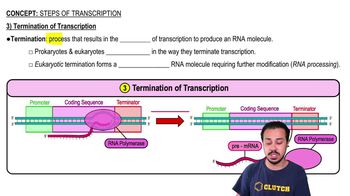
Explore transcription and translation: Understand the two key processes in protein synthesis. Transcription is the process by which a segment of DNA is copied into messenger RNA (mRNA). Translation is the process by which the mRNA is read by a ribosome to assemble the amino acids in the correct order to produce a specific protein.
Consider the role of regulatory mechanisms: Learn how cells control which proteins are made through various regulatory mechanisms that act at the genetic and epigenetic levels. These mechanisms determine when and how much of each protein is made, allowing the cell to respond to changing needs and environmental conditions.
Examine cell signaling and environmental cues: Understand that cells receive signals from their environment and other cells, which can influence gene expression and protein synthesis. These signals can trigger pathways that activate or repress the transcription of specific genes, thus controlling the production of proteins necessary for particular functions or responses.
비슷한 문제에 대한 검증된 영상 답변:
이 영상 해법은 위 문제에 도움이 된다고 튜터들이 추천한 것입니다.
영상 길이:
1m
영상 재생:
0 댓글
주요 개념
질문에 올바르게 답하기 위해 반드시 이해해야 하는 핵심 개념들은 다음과 같습니다.
Genetic Code
The genetic code is a set of rules that defines how the sequence of nucleotides in DNA corresponds to the sequence of amino acids in proteins. It consists of codons, which are three-nucleotide sequences that specify particular amino acids. This code allows cells to translate genetic information into functional proteins, enabling the diversity of protein synthesis from a limited number of amino acids.
Transcription is the process by which the information in a gene's DNA is copied into messenger RNA (mRNA), while translation is the subsequent process where ribosomes read the mRNA sequence to assemble amino acids into a polypeptide chain, forming a protein. These processes are crucial for determining which proteins are produced in a cell, as they are regulated by various factors including cellular signals and environmental conditions.
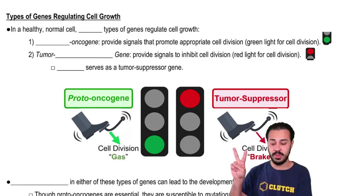
Gene regulation refers to the mechanisms that control the expression of genes, determining when and how much of a protein is produced. This regulation can occur at various levels, including transcriptional, post-transcriptional, and translational control. By responding to internal and external signals, cells can selectively express certain genes, allowing them to produce specific proteins as needed, despite having a finite set of amino acids.