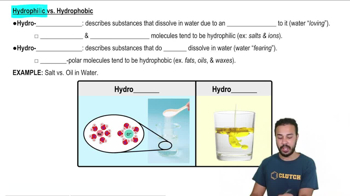
Most proteins are soluble in the aqueous environment of a cell. Knowing that, where in the overall three-dimensional shape of a protein would you expect to find amino acids with hydrophobic R groups?
검증된 단계별 안내
1
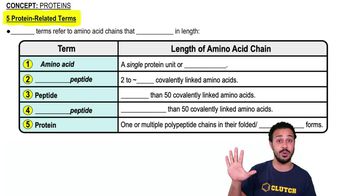
Understand the structure of proteins: Proteins are made up of amino acids linked together by peptide bonds forming a polypeptide chain. Each amino acid has a unique side chain, known as an R group, which can be hydrophobic or hydrophilic.
Recognize the importance of protein folding: Protein folding is the process by which a protein structure assumes its functional shape or conformation. It is crucial for the protein's function.
Identify the role of hydrophobic and hydrophilic R groups in protein folding: Hydrophobic R groups are typically nonpolar and tend to avoid water, whereas hydrophilic R groups are polar and interact well with water.
Predict the location of hydrophobic R groups in a folded protein: Since most proteins function in an aqueous environment inside the cell, the hydrophobic R groups are likely to be located in the interior of the protein. This arrangement helps to stabilize the protein structure by keeping these nonpolar groups away from the aqueous environment.
Visualize the protein structure: In the three-dimensional structure of a protein, imagine the hydrophobic R groups tucked inside, away from the surrounding water molecules, contributing to the overall stability and functionality of the protein.
비슷한 문제에 대한 검증된 영상 답변:
이 영상 해법은 위 문제에 도움이 된다고 튜터들이 추천한 것입니다.
영상 길이:
2m
영상 재생:
0 댓글
주요 개념
질문에 올바르게 답하기 위해 반드시 이해해야 하는 핵심 개념들은 다음과 같습니다.
Protein Structure
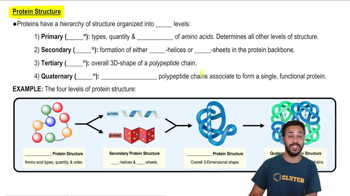
Proteins have a complex three-dimensional structure that is crucial for their function. This structure is determined by the sequence of amino acids and can be divided into four levels: primary, secondary, tertiary, and quaternary. The tertiary structure, in particular, describes how the protein folds into its functional shape, influenced by interactions among the R groups of the amino acids.
Amino acids possess R groups that can be classified as hydrophobic (water-repelling) or hydrophilic (water-attracting). In an aqueous environment, hydrophobic R groups tend to cluster together in the interior of the protein to avoid water, while hydrophilic R groups are more likely to be found on the surface, interacting with the surrounding water. This distribution is essential for maintaining the protein's stability and functionality.
Protein folding is the process by which a linear chain of amino acids acquires its functional three-dimensional shape. This process is driven by the chemical properties of the amino acids, including their hydrophobicity and hydrophilicity. Proper folding is critical, as misfolded proteins can lead to loss of function or diseases, highlighting the importance of understanding how amino acid properties influence protein structure.

 2:07분
2:07분 검증된 단계별 안내
 04:53
04:53