Anatomy & Physiology
나의 코스
배우기
시험 준비
AI 튜터
학습 가이드
교과서적 해결책
플래시카드
탐험해 보세요
앱을 사용해 보세요
나의 코스
배우기
시험 준비
AI 튜터
학습 가이드
교과서적 해결책
플래시카드
탐험해 보세요
앱을 사용해 보세요
뒤로
Immune Tolerance quiz
카드를 뒤집기 위해 탭할 수 있습니다.
What is immune tolerance?
카드를 뒤집기 위해 탭할 수 있습니다.
👆
What is immune tolerance?
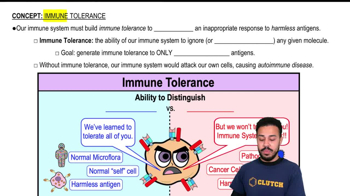
Immune tolerance is the immune system's ability to ignore or tolerate harmless antigens while targeting harmful ones.
진행 상황 추적
컨트롤 버튼이 '내비게이션' 모드로 변경되었습니다.
1/15
관련 플래시카드
추천 영상
Immune Tolerance definitions
Immune Tolerance
15 용어
3:19
Immune Tolerance
859
views
7
rank
11:54
Central vs. Peripheral Tolerance
965
views
4
rank
3:21
Football Analogy for Immune Tolerance
924
views
6
rank
이 집합의 용어 (15)
하이드의 정의
What is immune tolerance?
Immune tolerance is the immune system's ability to ignore or tolerate harmless antigens while targeting harmful ones.
Why is immune tolerance important for the immune system?
It prevents the immune system from attacking healthy cells and causing autoimmune diseases.
What can happen if immune tolerance fails?
The immune system may attack the body's own healthy cells, leading to autoimmune diseases.
Where does central immune tolerance occur?
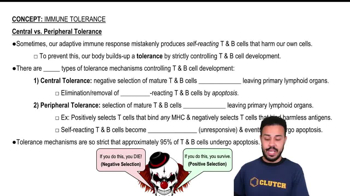
Central immune tolerance occurs in the primary lymphoid organs: the thymus for T cells and the bone marrow for B cells.
What process is involved in central immune tolerance?
Central immune tolerance involves negative selection, which eliminates self-reacting T and B cells.
Where does peripheral immune tolerance take place?
Peripheral immune tolerance occurs in secondary lymphoid organs, such as lymph nodes.
What two types of selection are involved in peripheral immune tolerance?
Peripheral immune tolerance involves both positive selection and negative selection of mature T and B cells.
What is negative selection in immune tolerance?
Negative selection eliminates cells that react to self or harmless antigens, usually through apoptosis.
What is positive selection in immune tolerance?
Positive selection promotes survival of cells that appropriately bind to MHC molecules.
Approximately what percentage of T and B cells survive the tolerance mechanisms?
Only about 5% of T and B cells survive; around 95% are eliminated during tolerance mechanisms.
What is the football analogy for immune tolerance?
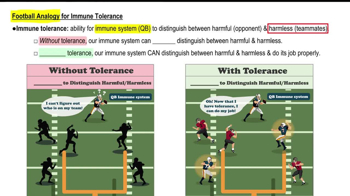
The immune system is like a quarterback who must distinguish teammates (harmless antigens) from opponents (harmful antigens) to do its job properly.
What happens to self-reacting T and B cells during central tolerance?
They are eliminated by apoptosis before leaving the primary lymphoid organs.
What does it mean if a cell becomes anergic during peripheral tolerance?
It means the cell becomes unresponsive and will eventually undergo apoptosis.
Why is negative selection considered 'negative'?
Because it results in the elimination or death of cells that bind to self or harmless antigens.
What is the main goal of immune tolerance mechanisms?
To ensure that only immune cells that target harmful antigens survive, while those that could attack harmless or self-antigens are eliminated.