Skip to main content
Anatomy & Physiology
나의 코스
배우기
시험 준비
AI 튜터
학습 가이드
교과서적 해결책
플래시카드
탐험해 보세요
앱을 사용해 보세요
나의 코스
배우기
시험 준비
AI 튜터
학습 가이드
교과서적 해결책
플래시카드
탐험해 보세요
앱을 사용해 보세요
뒤로
Sensory Receptor Classification by Location definitions
카드를 뒤집기 위해 탭할 수 있습니다.
Exteroceptors
카드를 뒤집기 위해 탭할 수 있습니다.
👆
Exteroceptors
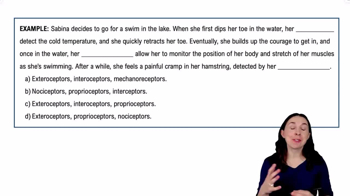
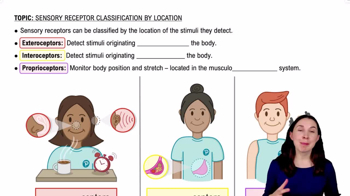
Detect external stimuli such as pressure, temperature, and pain on the skin, as well as senses like vision, hearing, and smell.
진행 상황 추적
컨트롤 버튼이 '내비게이션' 모드로 변경되었습니다.
1/15
관련 플래시카드
관련 실천
추천 영상
Sensory Receptor Classification by Location quiz
Sensory Receptor Classification by Location
15 용어
Sensory Receptor Classification by Location
13. The Peripheral Nervous System
2 문제점
주제
Bruce
Proprioceptors
13. The Peripheral Nervous System
3 문제점
주제
13. The Peripheral Nervous System - Part 1 of 2
4 주제
11 문제점
장
Bruce
13. The Peripheral Nervous System - Part 2 of 2
5 주제
9 문제점
장
Jason
3:49
Sensory Receptor Classification by Location
6497
views
112
rank
1
comments
1:22
Sensory Receptor Classification by Location Example 1
5332
views
91
rank
1
comments
이 집합의 용어 (15)
하이드의 정의
Exteroceptors
Detect external stimuli such as pressure, temperature, and pain on the skin, as well as senses like vision, hearing, and smell.
Interoceptors
Monitor internal conditions including pain, chemical composition of fluids, organ stretch, and internal temperature.
Proprioceptors
Located in the musculoskeletal system, they monitor body position and stretch, providing a sense of proprioception.
Visceroceptors
Another term for interoceptors, focusing on monitoring internal organ conditions and visceral stretch.
Homeostasis
The body's ability to maintain stable internal conditions despite external changes.
Musculoskeletal system
The organ system that includes muscles, tendons, joints, and connective tissues, crucial for body movement and support.
Visceral stretch
The expansion or stretching of internal organs, often detected by interoceptors.
Proprioception
The sense of body position and movement in space, informed by proprioceptors.
Stimuli
External or internal changes that are detected by sensory receptors, triggering a response.
Pressure
A type of external stimulus detected by exteroceptors, often felt on the skin.
Temperature
A measure of heat or cold, detected by exteroceptors externally and interoceptors internally.
Pain
An unpleasant sensation detected by both exteroceptors and interoceptors, indicating potential harm.
Chemical composition
The makeup of internal fluids, monitored by interoceptors to maintain balance and function.
Body position
The orientation of the body in space, monitored by proprioceptors for movement coordination.
Stretch
The extension or elongation of muscles or tissues, detected by proprioceptors and interoceptors.
 뒤로뒤로
뒤로뒤로

 3:49
3:49