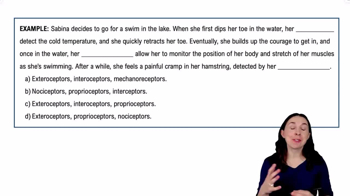
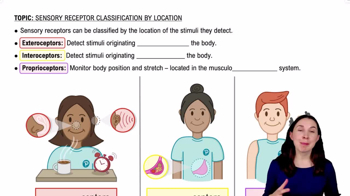
Exteroceptors detect stimuli originating outside the body, such as pressure, temperature, pain, and special senses like vision, hearing, and smell.
Where are exteroceptors primarily located?
Exteroceptors are primarily located on the skin and in sensory organs like the eyes, ears, and nose.
What are interoceptors also known as?
Interoceptors are also known as visceroceptors because they often monitor the internal organs (viscera).
What do interoceptors monitor inside the body?
Interoceptors monitor internal conditions such as pain, chemical composition of fluids, organ stretch, and internal temperature.
Why are interoceptors important for homeostasis?
Interoceptors are important for homeostasis because they provide information about the body's internal environment, helping maintain balance and proper function.
What sensation might interoceptors provide after eating a large meal?
Interoceptors detect visceral stretch, giving the sensation of fullness after eating.
Where are proprioceptors found in the body?
Proprioceptors are found in the musculoskeletal system, specifically in muscles, tendons, joints, and connective tissue around bones.
What is the main function of proprioceptors?
Proprioceptors monitor body position and stretch, providing the sense of proprioception.
How do proprioceptors differ from interoceptors?
While both detect internal stimuli, proprioceptors specifically monitor body position and movement, whereas interoceptors monitor a wider range of internal conditions.
Which type of receptor is involved when you hear a sound?
Exteroceptors are involved when you hear a sound, as hearing detects external stimuli.
Which receptor type helps you sense muscle stretch during exercise?
Proprioceptors help you sense muscle stretch during exercise.
What type of receptor detects the chemical composition of blood?
Interoceptors detect the chemical composition of blood and other internal fluids.
Which receptors are responsible for detecting pain on the skin?
Exteroceptors are responsible for detecting pain on the skin.
What sense is provided by proprioceptors?
Proprioceptors provide the sense of proprioception, which is awareness of body position and movement.
Give an example of an exteroceptor in action.
An example of an exteroceptor in action is using your nose to smell coffee or your ears to hear music.
 뒤로
뒤로

 3:49
3:49