 뒤로
뒤로Anatomical Position, Directional Terms, Body Movements, and Cavities – Study Guidance
스터디 가이드 - 스마트 노트
 자료에 맞춘 맞춤형 노트, 핵심 정의, 예시, 맥락을 확장해 제공합니다.
Q1. What is the anatomical position and why is it important in anatomy?
Background
Topic: Anatomical Position and Directional Terms
This question tests your understanding of the standard reference position used in anatomy to describe locations and directions on the human body.
Key Terms:
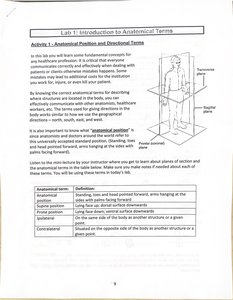
Anatomical Position: The body is standing upright, facing forward, arms at the sides with palms facing forward, and feet parallel.
Directional Terms: Words used to describe the locations of structures relative to other structures or locations in the body.
Step-by-Step Guidance
Start by visualizing the anatomical position: the person stands upright, faces forward, arms at the sides, and palms facing forward.
Consider why a standard position is necessary: think about how it helps avoid confusion when describing locations on the body.
Reflect on how directional terms (like superior, inferior, anterior, posterior) are always based on this position, regardless of the body's actual orientation.
Think about how this standardization is used in healthcare and anatomy to communicate clearly.
Try solving on your own before revealing the answer!
Final Answer:
The anatomical position is a standardized stance where the body stands upright, faces forward, arms at the sides, and palms facing forward. It is important because it provides a consistent frame of reference for anatomical terminology, ensuring clear and unambiguous communication among healthcare professionals and anatomists.
Q2. Define the following directional terms: superior, inferior, anterior, posterior, medial, lateral, proximal, distal, superficial, and deep.
Background
Topic: Directional Terms in Anatomy
This question checks your knowledge of the basic vocabulary used to describe the locations of structures in relation to each other in the body.
Key Terms:
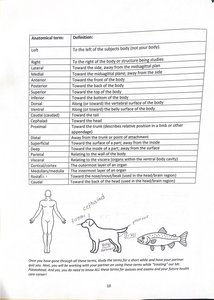
Superior: Toward the head or upper part of a structure.
Inferior: Away from the head or toward the lower part of a structure.
Anterior (ventral): Toward the front of the body.
Posterior (dorsal): Toward the back of the body.
Medial: Toward the midline of the body.
Lateral: Away from the midline of the body.
Proximal: Closer to the point of attachment or origin.
Distal: Farther from the point of attachment or origin.
Superficial: Toward or at the body surface.
Deep: Away from the body surface; more internal.
Step-by-Step Guidance
Review each term and its definition, focusing on the reference point (e.g., head, midline, surface).
Think about examples for each term, such as "the nose is superior to the mouth" or "the heart is deep to the rib cage."
Practice matching each term to its definition or to a body part in relation to another.
Try to use these terms in sentences describing the position of two structures relative to each other.
Try solving on your own before revealing the answer!
Final Answer:
Superior: Toward the head or upper part of a structure.
Inferior: Away from the head or toward the lower part of a structure.
Anterior (ventral): Toward the front of the body.
Posterior (dorsal): Toward the back of the body.
Medial: Toward the midline of the body.
Lateral: Away from the midline of the body.
Proximal: Closer to the point of attachment or origin.
Distal: Farther from the point of attachment or origin.
Superficial: Toward or at the body surface.
Deep: Away from the body surface; more internal.
These terms are essential for accurately describing the locations of structures in the body.
Q3. What are the main types of body movements and how are they defined?
Background
Topic: Body Movements
This question tests your understanding of the terminology used to describe different types of movements at joints in the human body.
Key Terms:
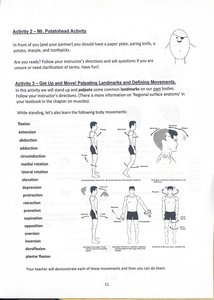
Flexion: Decreasing the angle between two body parts.
Extension: Increasing the angle between two body parts.
Abduction: Moving a limb away from the midline.
Adduction: Moving a limb toward the midline.
Rotation: Moving a bone around its longitudinal axis.
Other terms include circumduction, pronation, supination, inversion, eversion, etc.
Step-by-Step Guidance
Identify the joint or body part involved in the movement (e.g., elbow, shoulder, wrist).
Recall the definition of each movement term and visualize or perform the movement if possible.
Match the movement term to the correct action (e.g., bending the elbow is flexion).
Consider how these movements are used in daily activities or sports.
Try solving on your own before revealing the answer!
Final Answer:
Flexion: Decreases the angle between two body parts (e.g., bending the elbow).
Extension: Increases the angle between two body parts (e.g., straightening the knee).
Abduction: Moves a limb away from the midline (e.g., raising the arm sideways).
Adduction: Moves a limb toward the midline (e.g., lowering the arm to the side).
Rotation: Moves a bone around its longitudinal axis (e.g., turning the head side to side).
Other movements include circumduction, pronation, supination, inversion, and eversion.
These terms help describe how the body moves at different joints.
Q4. What are the major body cavities and what organs do they contain?
Background
Topic: Body Cavities
This question assesses your knowledge of the main spaces within the body that house organs, as well as the terminology used to describe them.
Key Terms:
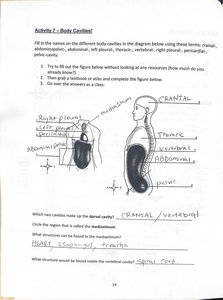
Cranial cavity: Contains the brain.
Vertebral (spinal) cavity: Contains the spinal cord.
Thoracic cavity: Contains the heart and lungs.
Abdominal cavity: Contains digestive organs.
Pelvic cavity: Contains reproductive and some excretory organs.
Step-by-Step Guidance
Identify the main body cavities: dorsal (cranial and vertebral) and ventral (thoracic, abdominal, pelvic).
Recall which organs are found in each cavity (e.g., the brain in the cranial cavity).
Understand the subdivisions within the thoracic cavity (pleural, pericardial, mediastinum).
Think about how these cavities protect and separate organs.
Try solving on your own before revealing the answer!
Final Answer:
Cranial cavity: Contains the brain.
Vertebral (spinal) cavity: Contains the spinal cord.
Thoracic cavity: Contains the heart (in the pericardial cavity) and lungs (in the pleural cavities).
Abdominal cavity: Contains digestive organs such as the stomach, intestines, liver, and others.
Pelvic cavity: Contains reproductive organs, urinary bladder, and rectum.
These cavities help organize and protect the body's vital organs.
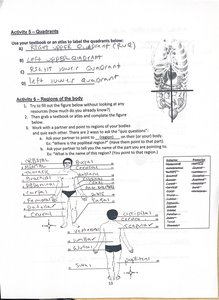
Q5. How are the four abdominal quadrants named and what is their significance?
Background
Topic: Abdominal Quadrants
This question tests your ability to identify and name the four quadrants of the abdomen, which are used to localize pain or describe locations of organs.
Key Terms:
Right Upper Quadrant (RUQ)
Left Upper Quadrant (LUQ)
Right Lower Quadrant (RLQ)
Left Lower Quadrant (LLQ)
Step-by-Step Guidance
Visualize the abdomen divided by a vertical and a horizontal line crossing at the navel.
Label each quadrant starting from the patient's right (your left as you face them).
Recall which organs are typically found in each quadrant (e.g., liver in RUQ, appendix in RLQ).
Think about how these quadrants are used in clinical practice to describe pain or findings.
Try solving on your own before revealing the answer!
Final Answer:
Right Upper Quadrant (RUQ): Contains the liver, gallbladder, and part of the colon.
Left Upper Quadrant (LUQ): Contains the stomach, spleen, and part of the colon.
Right Lower Quadrant (RLQ): Contains the appendix, cecum, and part of the small intestine.
Left Lower Quadrant (LLQ): Contains part of the descending colon and small intestine.
These quadrants help localize symptoms and guide diagnosis.
