 뒤로
뒤로Anatomical Terminology and Body Regions Study Guide
스터디 가이드 - 스마트 노트
 자료에 맞춘 맞춤형 노트, 핵심 정의, 예시, 맥락을 확장해 제공합니다.
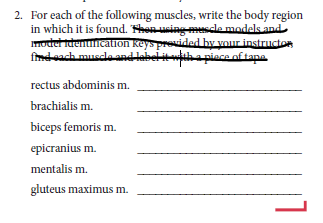
Q1. For each of the following muscles, write the body region in which it is found:
Background
Topic: Muscular System & Anatomical Terminology
This question tests your knowledge of muscle names and their corresponding anatomical regions. Understanding where each muscle is located helps with identifying their function and clinical relevance.
Key Terms:
Rectus abdominis: A muscle of the abdomen.
Brachialis: A muscle of the arm.
Biceps femoris: A muscle of the thigh.
Epicranius: A muscle of the head.
Mentalis: A muscle of the chin.
Gluteus maximus: A muscle of the buttocks.
Step-by-Step Guidance
Review the name of each muscle and recall its anatomical location.
Match each muscle to its corresponding body region (e.g., rectus abdominis → abdomen).
Use anatomical terminology to describe the region (e.g., "brachial" for arm, "femoral" for thigh).
Write the region next to each muscle name, using precise anatomical terms.
Try solving on your own before revealing the answer!
Final Answer:
Rectus abdominis m. — Abdomen (abdominal region)
Brachialis m. — Arm (brachial region)
Biceps femoris m. — Thigh (femoral region)
Epicranius m. — Head (cranial region)
Mentalis m. — Chin (mental region)
Gluteus maximus m. — Buttocks (gluteal region)
Each muscle is named for its location, which helps in identifying its function and clinical importance.
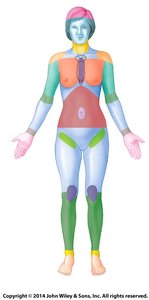
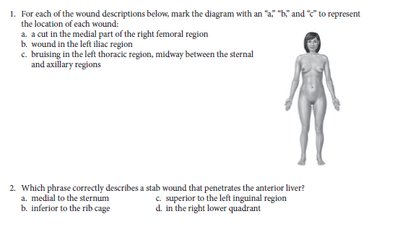
Q2. For each of the wound descriptions below, mark the diagram with an "a," "b," and "c" to represent the location of each wound:
a. cut in the medial part of the right femoral region
b. wound in the left iliac region
c. bruising in the left thoracic region, midway between the sternal and axillary regions
Background
Topic: Anatomical Regions & Directional Terms
This question tests your ability to use anatomical terminology to locate injuries on the body. Understanding regional and directional terms is essential for accurate communication in clinical settings.
Key Terms:
Medial: Toward the midline of the body.
Femoral region: Thigh area.
Iliac region: Lower lateral region of the abdomen.
Thoracic region: Chest area.
Sternal: Area over the sternum (breastbone).
Axillary: Area under the arm (armpit).
Step-by-Step Guidance
Identify the anatomical region described for each wound (e.g., "right femoral region" refers to the right thigh).
Determine the directional term (e.g., "medial" means closer to the midline).
Locate the iliac region on the left side of the lower abdomen for wound "b".
For wound "c", find the left thoracic region and estimate midway between the sternal and axillary regions.
Mark the diagram accordingly, but stop before labeling the exact spots.
Try solving on your own before revealing the answer!
Final Answer:
a. Medial part of the right femoral region (right inner thigh)
b. Left iliac region (left lower lateral abdomen)
c. Left thoracic region, midway between sternal and axillary (left chest, between breastbone and armpit)
These locations use precise anatomical terminology to describe where each wound is found.
Q3. Which phrase correctly describes a stab wound that penetrates the anterior liver?
a. medial to the sternum
b. inferior to the rib cage
c. superior to the left inguinal region
d. in the right lower quadrant
Background
Topic: Anatomical Position & Abdominal Quadrants
This question tests your understanding of abdominal regions and quadrants, as well as the location of internal organs like the liver.
Key Terms:
Anterior: Toward the front of the body.
Liver: Located mainly in the right upper quadrant, just below the diaphragm.
Quadrants: The abdomen is divided into four quadrants (right upper, left upper, right lower, left lower).
Inguinal region: Lower lateral region of the abdomen.
Step-by-Step Guidance
Recall the anatomical location of the liver (mostly in the right upper quadrant, anterior and inferior to the rib cage).
Analyze each phrase to determine which best describes a wound that would penetrate the anterior surface of the liver.
Consider the relationship of the liver to the rib cage, sternum, and abdominal quadrants.
Eliminate options that do not correspond to the liver's location.
Try solving on your own before revealing the answer!
Final Answer:
b. inferior to the rib cage
The liver is located just below the rib cage, so a stab wound inferior to the rib cage would penetrate its anterior surface.
Q4. For each stab wound, provide: (a) a description of the wound location using at least two directional terms and one regional term, (b) the body cavity in which the wound is located, and (c) the names of the serous membranes that have been penetrated (if applicable).
Background
Topic: Anatomical Terminology, Body Cavities, and Serous Membranes
This question tests your ability to use directional and regional terms to describe wound locations, identify body cavities, and name serous membranes.
Key Terms:
Directional terms: Superior, inferior, medial, lateral, anterior, posterior, proximal, distal, superficial, deep.
Regional terms: Specific body regions (e.g., lumbar, femoral, thoracic).
Body cavities: Thoracic, abdominal, pelvic, etc.
Serous membranes: Pleura (lungs), pericardium (heart), peritoneum (abdominal organs).
Step-by-Step Guidance
For each stab wound, use at least two directional terms (e.g., "medial and superior") and one regional term (e.g., "right lumbar") to describe the location.
Identify the body cavity affected by the wound (e.g., thoracic, abdominal).
Determine if any serous membranes are penetrated based on the wound's location (e.g., peritoneum for abdominal wounds).
Write your descriptions for each wound, but stop before listing the exact membranes or cavity names.
Try solving on your own before revealing the answer!
Final Answer:
Stab wound #1: Medial and inferior in the right lumbar region; abdominal cavity; peritoneum (parietal and visceral).
Stab wound #2: Lateral and superior in the left thoracic region; thoracic cavity; pleura (parietal and visceral).
Stab wound #3: Medial and superior in the sternal region; thoracic cavity; pericardium (parietal and visceral).
Each description uses directional and regional terms, identifies the body cavity, and names the serous membranes penetrated.
