뒤로
뒤로Anatomy & Physiology: Foundations of Human Structure and Function
스터디 가이드 - 스마트 노트
 자료에 맞춘 맞춤형 노트, 핵심 정의, 예시, 맥락을 확장해 제공합니다.
The Human Body: An Orientation
Anatomical Position
The anatomical position is the standard reference for describing locations and directions on the human body. In this position, the individual stands upright, faces forward, feet parallel and flat on the floor, arms at the sides, and palms facing forward. This position ensures consistency when referencing anatomical structures.

Body Planes and Sections
Body planes are imaginary lines used to divide the body into sections for anatomical study. Understanding these planes is essential for interpreting medical imaging and anatomical descriptions.
Frontal (coronal) plane: Divides the body into anterior (front) and posterior (back) portions.
Sagittal plane: Divides the body into right and left portions. A midsagittal (median) plane divides the body into equal right and left halves, while a parasagittal plane divides it into unequal portions.
Transverse (horizontal) plane: Divides the body into superior (upper) and inferior (lower) portions.
Oblique plane: Passes through the body at an angle.

Anatomical Directional Terms
Directional terms describe the positions of structures relative to other structures or locations in the body. These terms are essential for clear communication in anatomy.
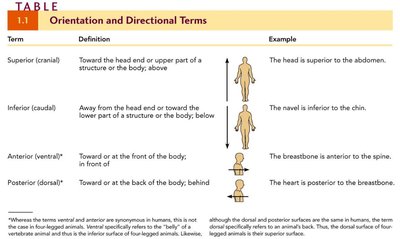
Superior (cranial): Toward the head or upper part of a structure.
Inferior (caudal): Away from the head or toward the lower part of a structure.
Anterior (ventral): Toward the front of the body.
Posterior (dorsal): Toward the back of the body.
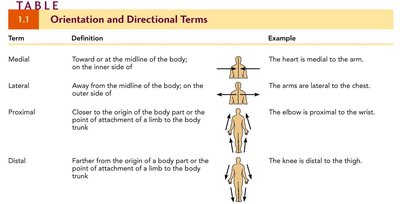
Medial: Toward the midline of the body.
Lateral: Away from the midline of the body.
Proximal: Closer to the origin of the body part or point of attachment.
Distal: Farther from the origin or point of attachment.
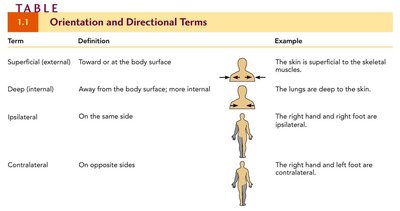
Superficial (external): Toward or at the body surface.
Deep (internal): Away from the body surface; more internal.
Ipsilateral: On the same side of the body.
Contralateral: On the opposite side of the body.
Body Cavities and Serous Membranes
Major Body Cavities
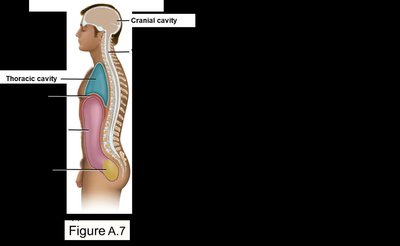
The human body contains several major cavities that house and protect internal organs. Each cavity is lined with a specific serous membrane that reduces friction and protects the organs.
Cranial cavity: Contains the brain; lined by the meninges.
Vertebral canal: Contains the spinal cord; lined by the meninges.
Thoracic cavity: Contains the heart (serous membrane: pericardium) and lungs (serous membrane: pleura).
Abdominopelvic cavity: Contains the stomach, liver, pancreas, spleen, gallbladder, kidneys, and most of the intestines (serous membrane: peritoneum).
Abdominopelvic Quadrants and Regions
Quadrant System
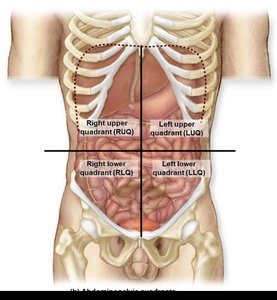
The abdominopelvic cavity can be divided into four quadrants for clinical reference:
Right Upper Quadrant (RUQ)
Left Upper Quadrant (LUQ)
Right Lower Quadrant (RLQ)
Left Lower Quadrant (LLQ)
Regional System
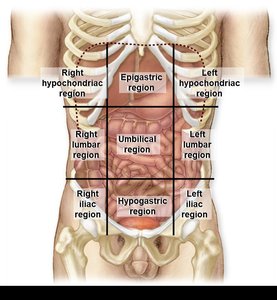
For more precise anatomical study, the abdominopelvic cavity is divided into nine regions:
Right hypochondriac, epigastric, left hypochondriac
Right lumbar, umbilical, left lumbar
Right iliac (inguinal), hypogastric (pubic), left iliac (inguinal)
Organs in Each Region
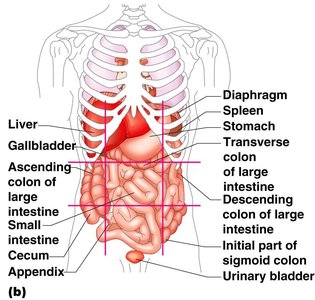
Each region contains specific organs, which is important for diagnosis and clinical assessment.
Homeostasis and Feedback Systems
Homeostasis
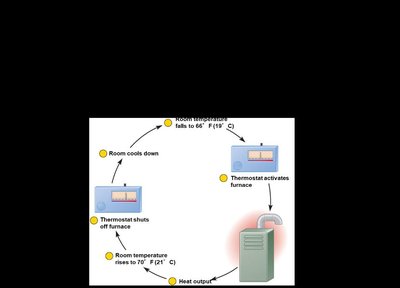
Homeostasis is the body's ability to maintain stable internal conditions despite changes in the external environment. It is essential for survival and proper function.
Negative feedback: Reverses a change to maintain homeostasis. The output reduces the original effect of the stimulus.
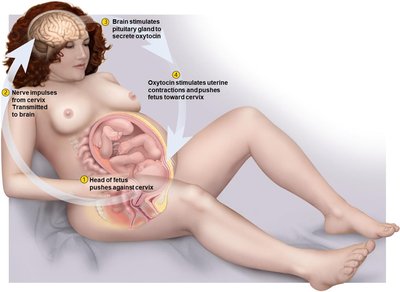
Positive feedback: Enhances or accelerates the original stimulus, leading to a greater change in the same direction.
Components of a Feedback Loop
Receptor: Senses changes in the environment.
Integrating (Control) Center: Processes information and directs the response.
Effector: Carries out the response to restore homeostasis.
Example of Negative Feedback: Regulation of body temperature. If the body is too warm, mechanisms such as vasodilation and sweating are activated. If too cold, vasoconstriction and shivering occur.
Example of Positive Feedback: Childbirth, where uterine contractions are intensified by oxytocin release, leading to delivery.
Chemistry Comes Alive: Atoms, Ions, and Chemical Bonds
Anatomy of an Atom
An atom is the smallest unit of matter that retains the properties of an element. Atoms are composed of three subatomic particles:
Protons: Positive charge (+1), mass of 1 amu, located in the nucleus. The number of protons equals the atomic number.
Neutrons: No charge, mass of 1 amu, located in the nucleus. The number of neutrons equals atomic mass minus atomic number.
Electrons: Negative charge (-1), negligible mass, located in orbitals around the nucleus. In a neutral atom, the number of electrons equals the number of protons.
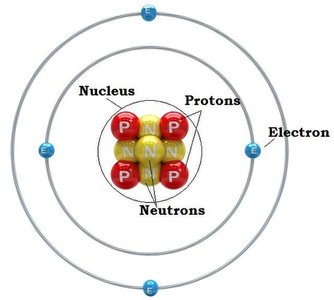
Electrons occupy shells around the nucleus. The first shell holds 2 electrons; subsequent shells hold up to 8 electrons. The outermost shell is the valence shell, and its electrons determine chemical behavior.
Ions are charged particles formed when atoms gain or lose electrons. Cations are positively charged; anions are negatively charged.
Types of Chemical Bonds
Ionic bonds: Formed when electrons are transferred from one atom (usually a metal) to another (usually a nonmetal), creating oppositely charged ions that attract each other.
Covalent bonds: Formed when two atoms share one or more pairs of electrons.
Polar covalent bonds: Electrons are shared unequally, creating partial charges on the molecule.
Nonpolar covalent bonds: Electrons are shared equally, with no partial charges formed.
Hydrogen bonds: Weak attractions between a hydrogen atom covalently bonded to a highly electronegative atom (N, O, or F) and another electronegative atom.
Chemical Reactions
A chemical reaction involves the formation or breaking of covalent or ionic bonds. Chemical equations represent these reactions, with reactants on the left and products on the right.
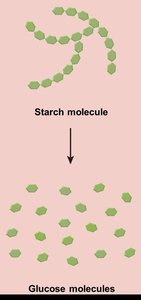
Decomposition reactions: A large molecule breaks down into smaller ones.
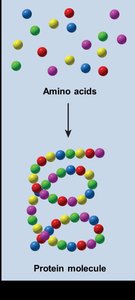
Synthesis reactions: Two or more small molecules combine to form a larger one.
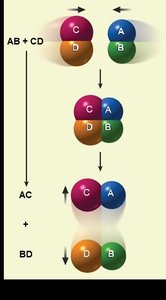
Exchange reactions: Atoms or groups of atoms are exchanged between molecules.
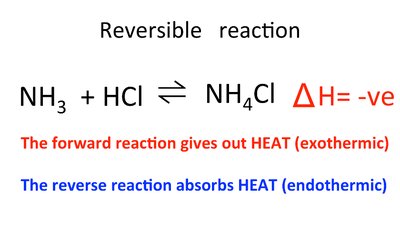
Reversible reactions: Can proceed in either direction depending on conditions.
Monomers and Polymers
Definitions
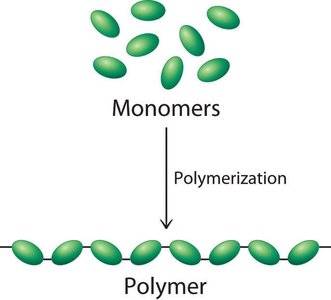
Monomers: Identical or similar subunits that can join together to form polymers.
Polymers: Large molecules made of repeating monomer subunits.
Polymerization Reactions
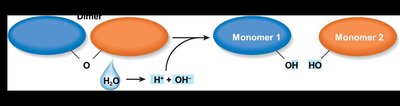
Dehydration synthesis: Monomers are covalently bonded to form a polymer, with the removal of a water molecule. A hydroxyl group is removed from one monomer and a hydrogen from another.
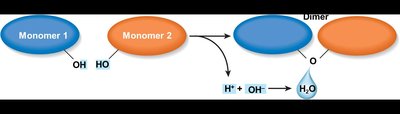
Hydrolysis: Polymers are broken down into monomers by the addition of a water molecule, breaking the covalent bond. All digestion reactions are hydrolysis reactions.