 뒤로
뒤로Anatomy and Physiology I: Foundational Concepts and Structures
스터디 가이드 - 스마트 노트
 자료에 맞춘 맞춤형 노트, 핵심 정의, 예시, 맥락을 확장해 제공합니다.
Main Concepts in Anatomy and Physiology
Introduction to Anatomy and Physiology
Understanding the structure and function of the human body is essential for students of anatomy and physiology. This section introduces the foundational concepts, including the organization of the body, the main organ systems, and the principles of homeostasis.
Chapter 1: The Human Body – An Overview
Branches of Anatomy
There are several branches of anatomy, each focusing on different aspects of the body's structure:
Gross (Macroscopic) Anatomy: Study of structures visible to the naked eye.
Regional Anatomy: Examines all structures in a specific region.
Systemic Anatomy: Focuses on specific organ systems.
Microscopic Anatomy: Study of structures too small to be seen without a microscope.
Cytology: Study of cells.
Histology: Study of tissues.
Developmental Anatomy: Study of structural changes throughout life, including embryology.
Specialized Branches: Includes pathological anatomy (disease-related changes) and radiographic anatomy (visualization techniques).
Levels of Structural Organization
The human body is organized into hierarchical levels:
1. Chemical Level: Atoms and molecules.
2. Cellular Level: Basic units of life.
3. Tissue Level: Groups of similar cells performing a common function.
4. Organ Level: Structures made of multiple tissues performing specific functions.
5. Organ System Level: Groups of organs working together.
6. Organismal Level: The entire body as a whole.
Major Organ Systems
There are 11 major organ systems in the human body, each with unique functions:
Integumentary: Protection, regulation, and communication.
Skeletal: Support, protection, and signaling.
Muscular: Movement and heat production.
... (see study list for all systems)
Homeostasis
Homeostasis is the maintenance of a stable internal environment. It involves:
Receptor: Detects changes and sends information to the control center.
Control Center: Determines the set point and directs responses.
Effector: Executes the response to regulate the variable.
Regulatory Mechanisms
Report Mechanisms: Negative feedback (e.g., blood glucose regulation) and positive feedback (e.g., labor contractions).
Feedforward Mechanisms: Anticipatory responses to changes.
Chapter 1 – Anatomical Position, Regional, and Directional Terms
Anatomical Position
The standard reference position for anatomical descriptions is the anatomical position: body erect, feet slightly apart, palms facing forward.
Regional Terms
Regional terms describe specific areas of the body:
Axial: Head, neck, and trunk.
Appendicular: Limbs and their attachments.
Directional Terms
These terms describe the relationship between two body parts:
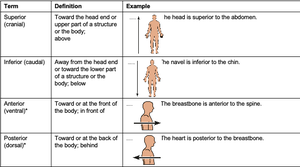
Superior (cranial): Toward the head.
Inferior (caudal): Toward the lower part of the body.
Anterior (ventral): Toward the front.
Posterior (chest): Toward the back.
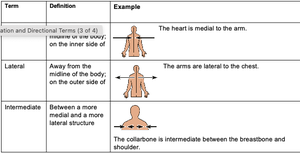
Medial: Toward the midline.
Lateral: Away from the midline.
Intermediate: Between two structures.
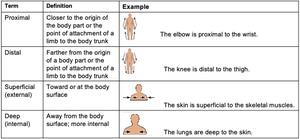
Exemplar Table:
Body Regions and Reference Planes
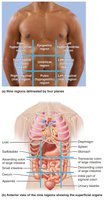
Body regions are labeled for clarity in anatomical descriptions. The abdomen is divided into nine regions for clinical reference.
Body Planes and Sections
Sagittal Plane: Divides the body into right and left parts.
Frontal (Coronal) Plane: Divides the body into anterior and posterior parts.
Transverse (Horizontal) Plane: Divides the body into superior and inferior parts.
Body Cavities
Dorsal Cavity: Includes cranial and vertebral cavities.
Ventral Cavity: Includes thoracic and abdominopelvic cavities, separated by the diaphragm.
Homeostasis and Feedback Mechanisms
Homeostatic Control Mechanisms
Negative Feedback: Reduces the effect of the stimulus (e.g., temperature regulation).
Positive Feedback: Enhances the effect of the stimulus (e.g., blood clotting).
Homeostasis: Key Terms and Examples
Key Terms
Receptor: Detects change.
Control Center: Receives input and directs response.
Effector: Executes the response.
Examples
Negative Feedback: Regulation of blood glucose by insulin.
Positive Feedback: Enhancement of labor contractions by the hormone oxytocin.
Homeostasis: Additional Regulatory Mechanisms
Feedforward Mechanisms
Feedforward mechanisms are anticipatory responses that help maintain homeostasis by preparing the body for changes before they occur.
Homeostasis: Summary Table
Mechanism | Function | Example |
|---|---|---|
Negative Feedback | Reduces stimulus | Body temperature regulation |
Positive Feedback | Amplifies stimulus | Blood clotting |
Feedforward | Anticipates change | Anticipatory increase in heart rate before exercise |
Additional Academic Information
Additional info: Homeostasis is a central concept in homeostatic physiology and is regulated by complex interactions between the nervous and endocrine systems. Anatomical terminology is essential for clear communication in clinical and scientific settings.
