 뒤로
뒤로Anatomy & Physiology Study Guide: Chapters 1–3 (Orientation, Chemistry, and Cells)
스터디 가이드 - 스마트 노트
 자료에 맞춘 맞춤형 노트, 핵심 정의, 예시, 맥락을 확장해 제공합니다.
Chapter 1: The Human Body – An Orientation
1.1 Anatomy and Physiology: Definitions and Relationship
Anatomy is the study of the structure of body parts and their relationships, while physiology is the study of the function of those parts. The principle of complementarity states that function always reflects structure.
Gross (macroscopic) anatomy: Study of large body structures visible to the naked eye (regional, systemic, surface anatomy).
Microscopic anatomy: Study of structures too small to be seen without a microscope (cytology, histology).
Developmental anatomy: Study of structural changes throughout life (embryology focuses on development before birth).
Specialized branches: Pathological, radiographic anatomy, etc.
Physiology: Subdivided by organ systems; focuses on cellular/molecular events and principles of physics/chemistry.
Example: The structure of bones (hard mineral deposits) allows them to support and protect body organs.
1.2 Levels of Structural Organization & Organ Systems
The human body is organized from the simplest chemical level to the complex organismal level.
Chemical level: Atoms combine to form molecules, which form organelles.
Cellular level: Cells are the smallest units of life.
Tissue level: Groups of similar cells with a common function.
Organ level: Structures composed of at least two tissue types performing specific functions.
Organ system level: Organs working together for a common purpose.
Organismal level: The living human being.
The 11 Organ Systems:
Integumentary
Skeletal
Muscular
Nervous
Endocrine
Cardiovascular
Lymphatic/Immune
Respiratory
Digestive
Urinary
Reproductive (male & female)
1.3 Requirements for Life
To maintain life, humans must perform certain functions and have specific survival needs.
Necessary life functions: Maintaining boundaries, movement, responsiveness, digestion, metabolism, excretion, reproduction, growth.
Survival needs: Nutrients, oxygen, water, normal body temperature, appropriate atmospheric pressure.
1.4 Homeostasis and Feedback Mechanisms
Homeostasis is the maintenance of a stable internal environment. It is primarily maintained by negative feedback mechanisms, which reduce the effect of the original stimulus. Positive feedback mechanisms amplify the stimulus and are less common.
Components: Receptor (detects change), control center (determines set point), effector (carries out response).
Negative feedback: Example – regulation of body temperature.
Positive feedback: Example – blood clotting.
Homeostatic imbalance can lead to disease.
1.5 Anatomical Terms, Directions, and Planes
Standard anatomical position: body erect, feet slightly apart, palms facing forward. Directional terms describe the location of body parts relative to each other (e.g., superior/inferior, anterior/posterior).
Body planes: Sagittal (left/right), frontal (anterior/posterior), transverse (superior/inferior).
Regional terms: Axial (head, neck, trunk) and appendicular (limbs).
1.6 Body Cavities and Membranes
The body contains dorsal (cranial, vertebral) and ventral (thoracic, abdominopelvic) cavities, lined by serous membranes (parietal and visceral layers). The abdominopelvic cavity is further divided into quadrants and regions for clinical reference.
Chapter 2: Chemistry Comes Alive
2.1 Matter and Energy
Matter is anything that occupies space and has mass. Energy is the capacity to do work and exists as kinetic (movement) or potential (stored) energy. Major forms include chemical, electrical, mechanical, and radiant energy.
2.2 Elements and Atomic Structure
Elements are unique substances that cannot be broken down. Four elements (C, H, O, N) make up most of the body. Atoms consist of protons, neutrons, and electrons. Atomic number = protons; mass number = protons + neutrons. Isotopes have different numbers of neutrons; radioisotopes are unstable and radioactive.
2.3 Molecules, Compounds, and Mixtures
Molecules are combinations of atoms; compounds are molecules of different elements. Mixtures can be solutions, colloids, or suspensions. Compounds are chemically bonded; mixtures are not.
2.4 Chemical Bonds
Atoms bond to achieve stability (octet rule). Types of bonds:
Ionic: Transfer of electrons (forms cations/anions).
Covalent: Sharing of electrons (can be polar or nonpolar).
Hydrogen: Weak attractions between polar molecules.
2.5 Chemical Reactions
Chemical reactions involve making or breaking bonds. Types include synthesis, decomposition, and exchange reactions. Reactions can be exergonic (release energy) or endergonic (absorb energy). Factors affecting rate: temperature, concentration, particle size, catalysts.
2.6 Inorganic Compounds: Water, Salts, Acids, and Bases
Water: High heat capacity, solvent, reactivity, cushioning.
Salts: Ionic compounds, electrolytes.
Acids/Bases: Acids release H+, bases accept H+. pH scale (0–14); buffers resist pH changes.
2.7 Organic Compounds: Synthesis and Breakdown
Organic molecules (carbohydrates, lipids, proteins, nucleic acids) are formed by dehydration synthesis and broken down by hydrolysis.
2.8 Carbohydrates
Carbohydrates (sugars, starches) are classified as monosaccharides, disaccharides, or polysaccharides. Main function: energy source.
2.9 Lipids
Lipids (triglycerides, phospholipids, steroids) are insoluble in water. Functions: energy storage, membrane structure, hormones.
2.10 Proteins
Proteins are polymers of amino acids. Structure: primary, secondary, tertiary, quaternary. Functions: structure, enzymes, transport, signaling. Denaturation disrupts function. Enzymes lower activation energy for reactions.
2.11 Nucleic Acids and ATP
DNA and RNA store and transmit genetic information. ATP is the cell’s energy currency, transferring energy via phosphorylation.
Chapter 3: Cells – The Living Units
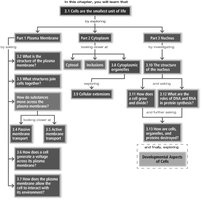
3.1 Cell Theory and Generalized Cell Structure
Cells are the basic unit of life. All organisms are made of cells, and cells arise from pre-existing cells. Major regions: plasma membrane, cytoplasm, nucleus. Extracellular materials include fluids, secretions, and matrix.
3.2 Plasma Membrane Structure
The plasma membrane is a phospholipid bilayer with embedded proteins (fluid mosaic model). Cholesterol stiffens the membrane; the glycocalyx provides cell recognition.
3.3 Intercellular Junctions
Tight junctions: Prevent passage between cells.
Desmosomes: Anchor cells together.
Gap junctions: Allow communication between cells.
3.4 Passive Membrane Transport
Movement down concentration gradients without energy input. Types:
Simple diffusion: Nonpolar molecules move directly through membrane.
Facilitated diffusion: Uses carrier or channel proteins for polar/charged molecules.
Osmosis: Diffusion of water across membrane.
Tonicity describes solution effects on cell volume: isotonic, hypertonic, hypotonic.
3.5 Active Membrane Transport
Requires ATP to move substances against gradients. Includes primary (direct ATP use) and secondary (indirect ATP use) active transport, and vesicular transport (endocytosis, exocytosis).
3.6 Membrane Potential
Selective ion diffusion creates a voltage (membrane potential) across the membrane, mainly due to K+ gradients. Active transport maintains this potential.
3.7 Cell-Environment Interactions
Cell adhesion molecules (CAMs): Anchor cells, assist movement, signal immune cells.
Membrane receptors: Mediate contact and chemical signaling (e.g., G protein-coupled receptors).
3.8 Cytoplasmic Organelles
Mitochondria: ATP production.
Ribosomes: Protein synthesis.
Endoplasmic reticulum (ER): Rough ER (protein synthesis), smooth ER (lipid metabolism, detoxification).
Golgi apparatus: Modifies, packages proteins/lipids.
Lysosomes: Digestive enzymes.
Peroxisomes: Detoxification.
Cytoskeleton: Structural support, movement.
Centrosome/Centrioles: Organize microtubules, cell division.
3.9 Cellular Extensions
Cilia/Flagella: Motile projections for movement.
Microvilli: Increase surface area for absorption.
3.10 The Nucleus
Nuclear envelope: Double membrane with pores.
Nucleoli: Ribosome assembly.
Chromatin: DNA, histones, RNA; condenses to chromosomes during division.
Additional info: This guide covers foundational concepts for Anatomy & Physiology, including definitions, structural organization, chemistry, cell structure, and function. For further study, refer to textbook figures and tables for visual reinforcement.
