 뒤로
뒤로chapters1-5
스터디 가이드 - 스마트 노트
 자료에 맞춘 맞춤형 노트, 핵심 정의, 예시, 맥락을 확장해 제공합니다.
The Human Body: An Orientation
Importance of Terminology
Understanding the specialized vocabulary of anatomy and physiology is essential for clear communication among health science professionals. Mastery of this language allows for accurate description and understanding of the human body’s structure and function.
Form and Function: Anatomy & Physiology
Anatomy is the study of the structure of body parts and their relationships to one another, while physiology is the study of the function of body parts and how they carry out life-sustaining activities. The principle of complementarity states that structure and function are inseparable; what a structure can do depends on its form.
Anatomy Subdivisions: Gross (macroscopic), regional, system, surface, microscopic (cytology, histology), developmental (embryology).
Physiology Subdivisions: Based on organ systems, often at cellular and molecular levels.
Levels of Structural Organization
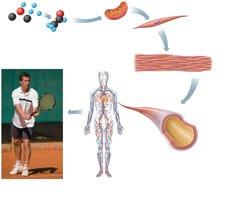
The human body is organized from the smallest chemical level to the entire organism:
Chemical level: Atoms, molecules, and organelles
Cellular level: Cells made up of molecules
Tissue level: Groups of similar cells
Organ level: Two or more types of tissues
Organ system level: Organs working closely together
Organismal level: All organ systems combined to form the whole organism
Necessary Life Functions
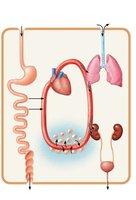
Basic functions required for life include maintaining boundaries, movement, responsiveness, digestion, metabolism, excretion, reproduction, and growth.
Maintaining boundaries: Separation between internal and external environments (e.g., plasma membranes, skin)
Movement: Muscular system enables movement of body parts and substances
Responsiveness: Ability to sense and respond to stimuli
Digestion: Breakdown and absorption of nutrients
Metabolism: All chemical reactions in the body (catabolism and anabolism)
Excretion: Removal of metabolic wastes
Reproduction: Cellular division for growth/repair and production of offspring
Growth: Increase in size of a body part or organism
Survival Needs
Essential factors for human survival include nutrients, oxygen, water, normal body temperature, and appropriate atmospheric pressure.
Homeostasis
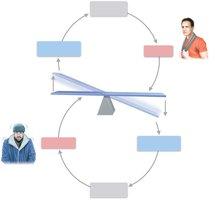
Homeostasis is the maintenance of relatively stable internal conditions despite continuous environmental changes. It is a dynamic equilibrium maintained by all organ systems, especially the nervous and endocrine systems.
Variables: Factors that can change (e.g., blood sugar, temperature, blood volume)
Homeostatic control mechanisms: Involve three components: receptor, control center, and effector
Feedback Mechanisms
Negative feedback: Most common; response reduces or shuts off the original stimulus (e.g., regulation of body temperature, blood glucose)
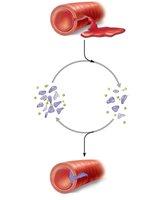
Positive feedback: Response enhances the original stimulus (e.g., blood clotting)
Anatomical Position and Directional Terms
Standard Anatomical Position
The body is erect, feet slightly apart, palms facing forward, and thumbs pointing away from the body. Directional terms are always based on this position.
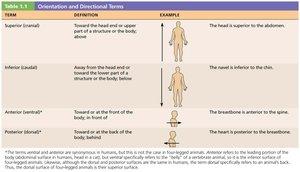
Orientation and Directional Terms
Directional terms are used to describe the locations of structures relative to other structures or locations in the body.
Term | Definition | Example |
|---|---|---|
Superior (cranial) | Toward the head end or upper part of a structure or the body; above | The head is superior to the abdomen. |
Inferior (caudal) | Away from the head end or toward the lower part of a structure or the body; below | The navel is inferior to the chin. |
Anterior (ventral) | Toward or at the front of the body; in front of | The breastbone is anterior to the spine. |
Posterior (dorsal) | Toward or at the back of the body; behind | The heart is posterior to the breastbone. |
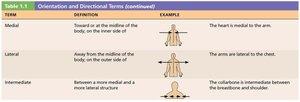
Term | Definition | Example |
|---|---|---|
Medial | Toward or at the midline of the body; on the inner side of | The heart is medial to the arm. |
Lateral | Away from the midline of the body; on the outer side of | The arms are lateral to the chest. |
Intermediate | Between a more medial and a more lateral structure | The collarbone is intermediate between the breastbone and shoulder. |
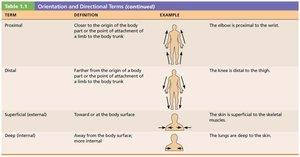
Term | Definition | Example |
|---|---|---|
Proximal | Closer to the origin of the body part or the point of attachment of a limb to the body trunk | The elbow is proximal to the wrist. |
Distal | Farther from the origin of a body part or the point of attachment of a limb to the body trunk | The knee is distal to the thigh. |
Superficial (external) | Toward or at the body surface | The skin is superficial to the skeletal muscles. |
Deep (internal) | Away from the body surface; more internal | The lungs are deep to the skin. |
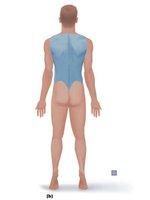
Regional Terms
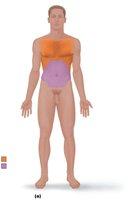
Major body divisions include axial (head, neck, trunk) and appendicular (limbs). Regional terms designate specific areas within these divisions.
Body Planes and Sections
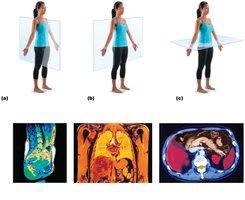
Common Anatomical Planes
Body planes are used to describe cuts or sections through the body:
Sagittal plane: Divides body into right and left parts
Midsagittal (median) plane: Cut on the midline
Parasagittal plane: Cut off-center from the midline
Frontal (coronal) plane: Divides body into anterior and posterior parts
Transverse (horizontal) plane: Divides body into superior and inferior parts
Oblique section: Cut at an angle other than 90° to a vertical plane
Body Cavities and Membranes
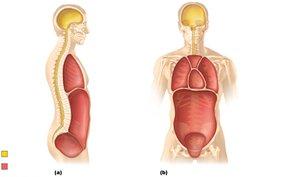
Main Body Cavities
The body contains dorsal and ventral cavities:
Dorsal body cavity: Protects the nervous system; includes cranial cavity (brain) and vertebral cavity (spinal cord)
Ventral body cavity: Houses internal organs (viscera); includes thoracic cavity (heart and lungs) and abdominopelvic cavity (digestive, urinary, and reproductive organs)
Membranes in the Ventral Body Cavity
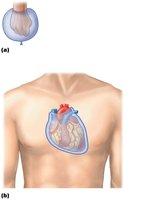
Serous membranes (serosa) are thin, double-layered membranes covering ventral body cavity surfaces. Parietal serosa lines internal body cavity walls; visceral serosa covers internal organs. Layers are separated by serous fluid to reduce friction.
Pericardium: Heart
Pleurae: Lungs
Peritoneum: Abdominopelvic cavity
Abdominopelvic Quadrants and Regions
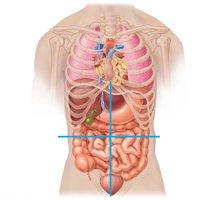
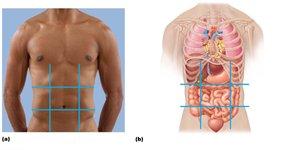
The abdominopelvic cavity is divided into four quadrants for clinical reference and nine regions for anatomical study.
Quadrants: Right upper quadrant (RUQ), Left upper quadrant (LUQ), Right lower quadrant (RLQ), Left lower quadrant (LLQ)
Nine Regions: Right hypochondriac, Epigastric, Left hypochondriac, Right lumbar, Umbilical, Left lumbar, Right iliac (inguinal), Hypogastric (pubic), Left iliac (inguinal)
The Cell & Its Chemical Foundations
Overview of Cell Structure and Function
The cell is the fundamental unit of life, with over 200 types in the human body, each specialized for unique functions. Cell structure and biochemical composition determine cellular activities and overall organism function.
Cell Theory: All living things are composed of cells; cells arise from preexisting cells.
Cell Diversity: Cells vary in size, shape, and internal components, leading to functional specialization.
Chemistry Review: Atoms, Molecules, and Ions
Understanding basic chemistry is essential for grasping cell structure and function.
Atoms: Smallest units of matter, composed of protons, neutrons, and electrons.
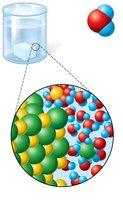
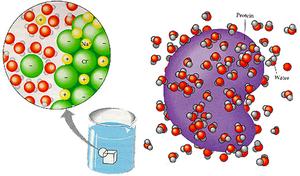
Molecules: Groups of atoms bonded together; water (H2O) is a key biological molecule.
Ions: Charged particles formed when atoms gain or lose electrons; important for cell signaling and membrane potential.
Electrolytes: Substances that dissociate into ions in solution, crucial for physiological processes.
Organic Compounds: Synthesis and Hydrolysis
Organic molecules are defined by the presence of carbon, which forms four covalent bonds and is unique to living systems. Major organic compounds include carbohydrates, lipids, proteins, and nucleic acids.
Synthesis: Formation of larger molecules from smaller ones (anabolism).
Hydrolysis: Breakdown of molecules by addition of water (catabolism).
Carbohydrates
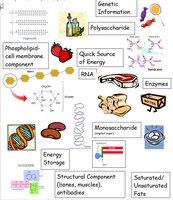
Carbohydrates are the body's primary source of energy and structural components.
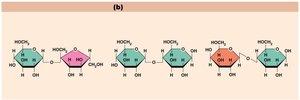
Monosaccharides: Simple sugars (glucose, fructose, galactose, deoxyribose, ribose).
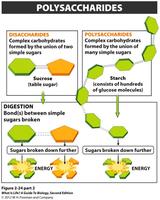
Disaccharides: Two monosaccharides linked (sucrose, maltose, lactose).
Polysaccharides: Long chains of monosaccharides (glycogen, starch).
Function: Energy storage and quick energy source.
Digestion and Absorption of Carbohydrates and Proteins
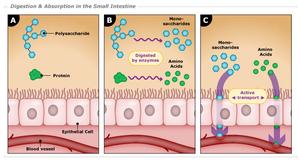
In the small intestine, complex carbohydrates and proteins are broken down into monosaccharides and amino acids, which are absorbed into the bloodstream.
Enzymatic Digestion: Enzymes break down polysaccharides and proteins.
Absorption: Monosaccharides and amino acids are transported across epithelial cells.
Lipids
Lipids are hydrophobic molecules essential for energy storage, membrane structure, and signaling.
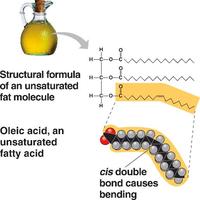
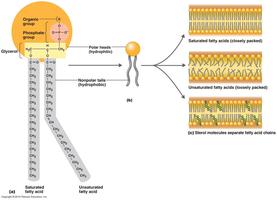
Triglycerides: Composed of glycerol and three fatty acids; main energy storage form.
Phospholipids: Modified triglycerides with a phosphate group; major component of cell membranes.
Saturated vs. Unsaturated Fats: Saturated fats have no double bonds; unsaturated fats have one or more, causing bends in the molecule.
Proteins
Proteins are polymers of amino acids, folded into complex structures that determine their function.
Primary Structure: Sequence of amino acids.
Secondary Structure: Alpha helices and beta sheets formed by hydrogen bonding.
Tertiary and Quaternary Structure: Further folding and assembly of polypeptide chains.
Functions: Enzymes, structural components, transport, signaling.
Nucleic Acids
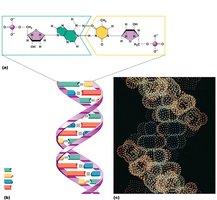
Nucleic acids store and transmit genetic information.
DNA: Double helix composed of nucleotides (adenine, thymine, cytosine, guanine).
RNA: Single-stranded, involved in protein synthesis.
Function: Genetic information storage, protein synthesis.
Cellular Organelles
Generalized Cell Structure
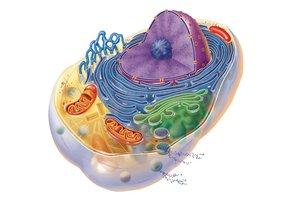
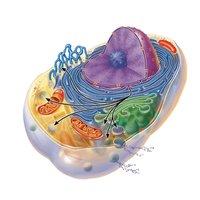
All human cells share common structures: plasma membrane, cytoplasm, and nucleus.
Plasma Membrane: Flexible boundary, regulates entry and exit of substances.
Cytoplasm: Contains organelles and cytosol.
Nucleus: Control center containing DNA.
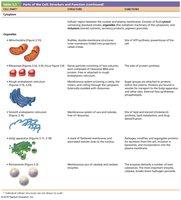
Cytoplasmic Organelles
Organelles are specialized structures performing distinct cellular functions.
Organelle | Function |
|---|---|
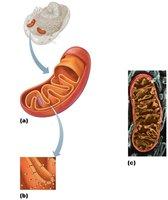
Mitochondria | ATP production via aerobic respiration |
Ribosomes | Protein synthesis |
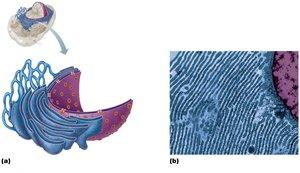
Endoplasmic Reticulum (ER) | Rough ER: protein synthesis; Smooth ER: lipid metabolism, detoxification |
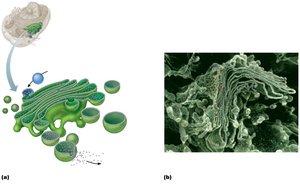
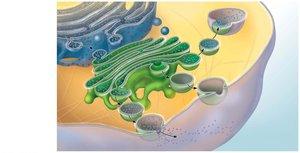
Golgi Apparatus | Modification, packaging, and sorting of proteins and lipids |
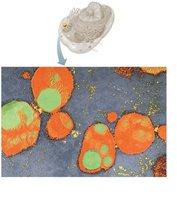
Lysosomes | Digestive enzymes, waste disposal |
Peroxisomes | Detoxification, fatty acid metabolism |
Cytoskeleton | Structural support, movement |
Cytoskeleton and Cell Movement
The cytoskeleton is a network of protein filaments providing structural support and enabling movement.
Microfilaments: Actin filaments, involved in cell shape and movement.
Intermediate Filaments: Provide mechanical strength.
Microtubules: Tubulin filaments, involved in intracellular transport and cell division.
Nucleus
The nucleus is the largest organelle, containing the genetic material and controlling cellular activities.
Nuclear Envelope: Double membrane with nuclear pores for transport.
Nucleoli: Sites of ribosomal RNA synthesis.
Chromatin: DNA-protein complex, condenses to form chromosomes during cell division.
Cell Reproduction
Cell reproduction occurs through mitosis, ensuring continuity of life and tissue growth.
Mitosis: Division of the nucleus into two genetically identical daughter cells.
Chromosomes: Condensed chromatin, visible during cell division.
Summary Table: Major Cell Organelles and Functions
Organelle | Structure | Function |
|---|---|---|
Mitochondria | Double membrane, cristae | ATP production |
Ribosomes | Protein and rRNA | Protein synthesis |
ER | Rough: ribosomes; Smooth: tubules | Protein and lipid synthesis |
Golgi Apparatus | Stacked sacs | Protein/lipid modification and sorting |
Lysosomes | Membranous sacs | Digestion, waste disposal |
Peroxisomes | Membranous sacs | Detoxification |
Nucleus | Envelope, nucleoli, chromatin | Genetic control |
Key Equations and Concepts
ATP Production (Cellular Respiration)
ATP is produced in mitochondria via cellular respiration:
Hydrolysis of Disaccharides
Disaccharides are broken down by hydrolysis:
Protein Structure
Proteins have four levels of structure: primary, secondary, tertiary, and quaternary.
DNA Structure
DNA is a double helix composed of nucleotides:
Additional info: The notes expand on brief points to provide context for cell structure, chemistry, and organelle function, suitable for exam preparation in Anatomy & Physiology. All included images directly reinforce the adjacent explanations and are essential for visualizing molecular and cellular structures.
