뒤로
뒤로Anatomy of the Ear: Structure and Function
스터디 가이드 - 스마트 노트
 자료에 맞춘 맞춤형 노트, 핵심 정의, 예시, 맥락을 확장해 제공합니다.
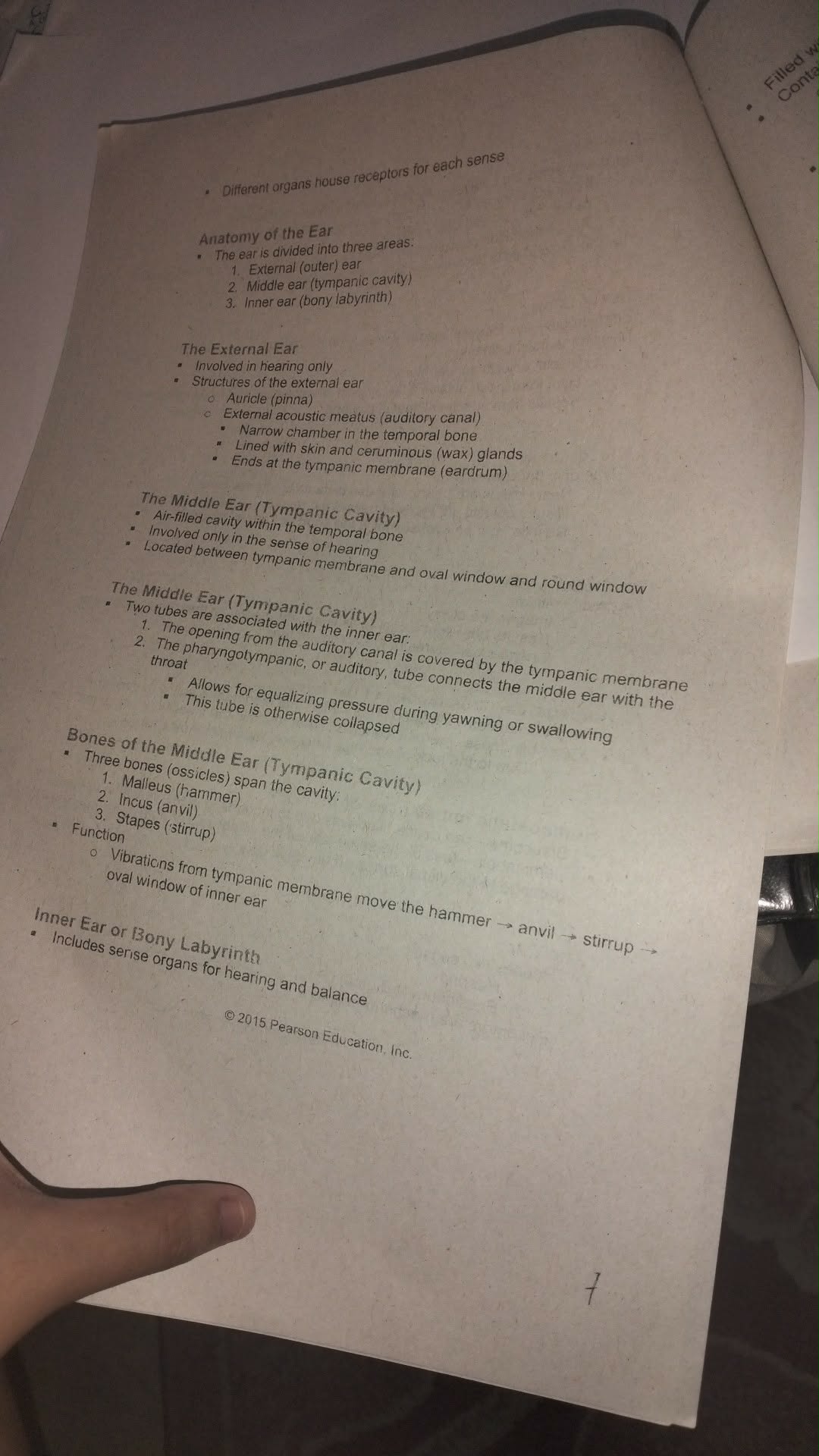
Anatomy of the Ear
Overview
The ear is a complex organ responsible for hearing and balance. It is divided into three main areas: the external (outer) ear, the middle ear (tympanic cavity), and the inner ear (bony labyrinth). Each section contains specialized structures that contribute to the processes of sound transmission and equilibrium.
External (outer) ear
Middle ear (tympanic cavity)
Inner ear (bony labyrinth)
The External Ear
The external ear is involved only in hearing and consists of several key structures:
Auricle (pinna): The visible part of the ear that collects sound waves.
External acoustic meatus (auditory canal): A narrow chamber within the temporal bone, lined with skin and ceruminous (wax) glands. It ends at the tympanic membrane (eardrum).
The Middle Ear (Tympanic Cavity)
The middle ear is an air-filled cavity located within the temporal bone. It is involved only in the sense of hearing and is situated between the tympanic membrane and the oval and round windows.
Air-filled cavity: Facilitates the transmission of sound vibrations.
Location: Between the tympanic membrane and the oval/round windows.
Tubes Associated with the Middle Ear
The opening from the auditory canal: Covered by the tympanic membrane.
Pharyngotympanic (auditory) tube: Connects the middle ear with the throat, allowing for equalizing pressure during yawning or swallowing. This tube is usually collapsed except during these actions.
Bones of the Middle Ear (Ossicles)
Three small bones, known as ossicles, span the middle ear cavity and play a crucial role in hearing:
Malleus (hammer)
Incus (anvil)
Stapes (stirrup)
Function: Vibrations from the tympanic membrane move the hammer (malleus), anvil (incus), and stirrup (stapes), transmitting sound to the oval window of the inner ear.
Inner Ear (Bony Labyrinth)
The inner ear, or bony labyrinth, contains sensory organs for hearing and balance. It is a complex structure embedded within the temporal bone.
Includes: Sensory organs for hearing (cochlea) and balance (vestibular apparatus).
Example: Sound Transmission Pathway
Sound waves enter the external ear and travel through the auditory canal.
They strike the tympanic membrane, causing it to vibrate.
Vibrations are transferred to the ossicles (malleus, incus, stapes).
The stapes transmits vibrations to the oval window, initiating movement in the inner ear fluids and activating sensory cells.
Additional info:
The inner ear also contains the semicircular canals, which are essential for maintaining balance and spatial orientation.