 뒤로
뒤로Atoms, Molecules, and Chemical Bonds: Foundations for Anatomy & Physiology
스터디 가이드 - 스마트 노트
 자료에 맞춘 맞춤형 노트, 핵심 정의, 예시, 맥락을 확장해 제공합니다.
Atoms, Molecules, and Bonds
Learning Objectives
This section introduces the fundamental concepts of chemical bonding, which are essential for understanding the molecular basis of anatomy and physiology. Students will learn about the role of electrons in chemical bonding, compare covalent and ionic bonds, distinguish between polar and nonpolar bonds, describe water's polarity, define hydrogen bonds, and discuss the relative strengths of major bond types.
Role of Electrons in Chemical Bonding: Electrons determine chemical reactivity and bond formation.
Covalent vs. Ionic Bonds: Covalent bonds involve sharing electrons; ionic bonds involve transferring electrons.
Polar vs. Nonpolar Bonds: Polar bonds have unequal electron sharing; nonpolar bonds have equal sharing.
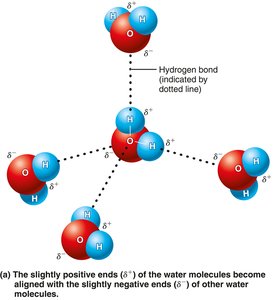
Polarity of Water: Water is a polar molecule, crucial for biological processes.
Hydrogen Bonds: Weak attractions between molecules, important for structure and function.
Bond Strengths: Covalent > Ionic > Hydrogen.
Mixtures and Their Types
Definition and Classification
Most matter in biological systems exists as mixtures, which are physical combinations of two or more substances. Understanding mixtures is important for physiology, as many body fluids are mixtures.
Mixture: Two or more components physically intermixed.
Types: Solutions, colloids, suspensions.
Solutions
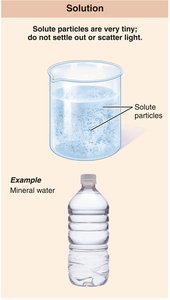
Solutions are homogeneous mixtures where solute particles are evenly distributed and do not settle out or scatter light. The solvent is present in the greatest amount, usually water in biological systems.
Solvent: Substance in greatest amount (e.g., water).
Solute: Substance dissolved in solvent (e.g., glucose in blood plasma).
Example: Blood sugar—glucose is solute, plasma is solvent.
Colloids
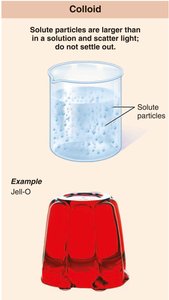
Colloids, also known as emulsions, are heterogeneous mixtures with larger solute particles that scatter light but do not settle out. Some colloids undergo sol-gel transformations, such as cytosol in cells.
Sol-gel transformation: Example: Jell-O, cytosol.
Appearance: Cloudy or milky.
Suspensions
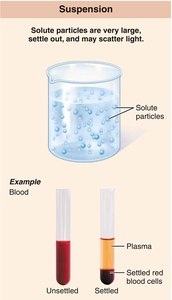
Suspensions are heterogeneous mixtures with large, visible solutes that settle out over time. Blood is a physiological suspension, as blood cells settle out if left undisturbed.
Example: Blood (cells settle out in a tube).
Properties: Solute particles are very large, settle out, may scatter light.
Comparison: Mixtures vs. Compounds
Mixtures differ from compounds in several ways:
No chemical bonding: Mixtures are physical combinations; compounds involve chemical bonds.
Separation: Mixtures can be separated by physical means; compounds require breaking chemical bonds.
Homogeneity: Mixtures can be heterogeneous or homogeneous; compounds are always homogeneous.
Chemical Bonds
Role of Electrons in Bonding
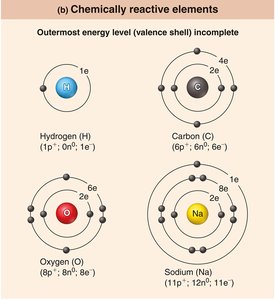
Chemical bonds are energy relationships between electrons of reacting atoms. Electrons occupy electron shells (energy levels) around the nucleus. The outermost shell, or valence shell, is most important for chemical reactions.
Electron Shells: Each shell holds a specific number of electrons.
Formula: , where n = shell number.
Valence Shell: Outermost shell; electrons here have highest potential energy.
Octet Rule
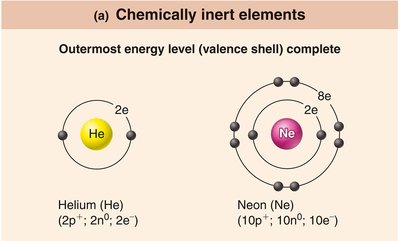
Atoms tend to have 8 electrons in their valence shell (except H and He, which have 2). Atoms gain, lose, or share electrons to achieve stability.
Noble Gases: Already have full valence shells; chemically inert.
Reactive Elements: Do not have full valence shells; tend to form bonds.
Types of Chemical Bonds
Ionic Bonds
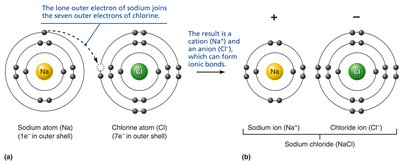
Ionic bonds form when electrons are transferred from one atom to another, resulting in charged ions. The attraction between oppositely charged ions creates the bond.
Anion: Atom that gains electrons (negative charge).
Cation: Atom that loses electrons (positive charge).
Example: Sodium (Na) transfers an electron to chlorine (Cl), forming Na+ and Cl-.
Covalent Bonds
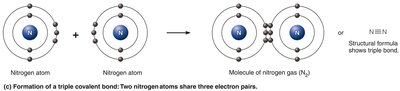
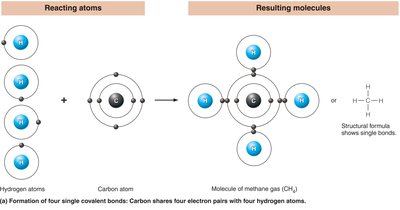
Covalent bonds are formed by sharing valence electrons between atoms. The number of shared electron pairs determines whether the bond is single, double, or triple.
Single Bond: Sharing 2 electrons.
Double Bond: Sharing 4 electrons.
Triple Bond: Sharing 6 electrons.
Strength: More shared pairs = stronger bond.
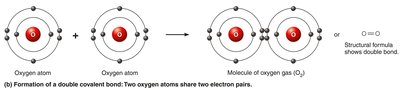
Nonpolar Covalent Bonds
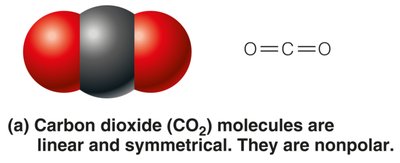
Nonpolar covalent bonds involve equal sharing of electrons, resulting in electrically balanced molecules. Examples include N2, CH4, O2, CO2.
Strength: Stronger than polar covalent bonds.
Polar Covalent Bonds
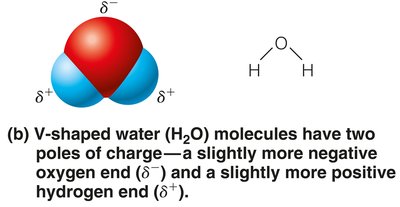
Polar covalent bonds involve unequal sharing of electrons, resulting in molecules with partial positive and negative charges (dipoles). Atoms with greater electron-attracting ability are electronegative; those with less are electropositive.
Example: Water (H2O) is a polar molecule; oxygen is more electronegative.
Dipole: Molecule with two different charges.
Bond Continuum Comparison
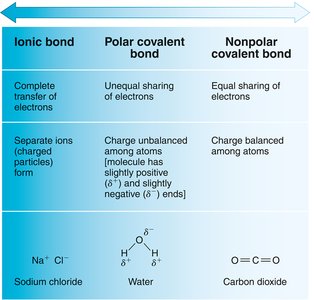
Ionic, polar covalent, and nonpolar covalent bonds can be compared based on electron sharing and charge distribution.
Bond Type | Electron Sharing | Charge Distribution | Example |
|---|---|---|---|
Ionic | Complete transfer | Separate ions form | NaCl |
Polar Covalent | Unequal sharing | Charge unbalanced (dipole) | H2O |
Nonpolar Covalent | Equal sharing | Charge balanced | CO2 |
Weak Chemical Interactions
Hydrogen Bonds
Hydrogen bonds are weak attractions between an electropositive hydrogen atom and an electronegative atom (such as oxygen or nitrogen) of another molecule. They are not true bonds but are important for stabilizing the three-dimensional structure of large biological molecules.
Intramolecular Bonds: Hold large molecules in shape.
Intermolecular Bonds: Occur between molecules, such as water.

Biological Importance of Hydrogen Bonds
Hydrogen bonds contribute to properties such as surface tension in water, which is essential for physiological processes.
Example: Water strider walking on water due to surface tension.
Van der Waals Interactions
Van der Waals interactions are weak attractions due to temporary regions of positive or negative charge in molecules. They are important when molecules are very close together and can cumulatively be strong.
Summary Table: Major Chemical Bond Types
This table summarizes the main types of chemical bonds, their descriptions, and relative strengths.
Type | Description | Strength |
|---|---|---|
Covalent bonds | Sharing of pairs of electrons. May be polar or nonpolar. | Strongest |
Ionic bonds | Attraction between two oppositely charged ions. | Intermediate |
Hydrogen bonds | Attraction between a hydrogen atom carrying a partial positive charge and an electronegative atom with a slightly negative charge. | Weakest |
Concept Check
Review questions are provided to reinforce understanding of chemical bonding concepts. Students should answer questions 16-20 from their Week 1 review.
Additional info:
These concepts are foundational for understanding molecular interactions in anatomy and physiology, including cell structure, tissue formation, and physiological processes.
