 뒤로
뒤로Biochemistry: Chemistry Comes Alive (Anatomy & Physiology Study Notes)
스터디 가이드 - 스마트 노트
 자료에 맞춘 맞춤형 노트, 핵심 정의, 예시, 맥락을 확장해 제공합니다.
Chemistry Comes Alive: Biochemistry
Introduction to Biochemistry
Biochemistry is the study of the chemical composition and reactions of living matter. All chemicals in the body are classified as either organic or inorganic compounds, both of which are essential for life.
Inorganic compounds: Include water, salts, acids, and bases; do not contain carbon.
Organic compounds: Include carbohydrates, fats, proteins, and nucleic acids; contain carbon and are usually large, covalently bonded molecules.
Water in Living Organisms
Water is the most abundant inorganic compound in living organisms, making up 60%–80% of cell volume. Its unique properties make it vital for life.
High heat capacity: Absorbs and releases heat with little temperature change, preventing sudden changes in body temperature.
High heat of vaporization: Evaporation requires large amounts of heat, providing a cooling mechanism.
Polar solvent properties: Dissolves and dissociates ionic substances, forms hydration layers around charged molecules, and acts as the body's major transport medium.
Reactivity: Participates in hydrolysis and dehydration synthesis reactions.
Cushioning: Protects organs from physical trauma (e.g., cerebrospinal fluid).
Salts
Salts are ionic compounds that dissociate into ions in water. These ions, known as electrolytes, conduct electrical currents and play specialized roles in body functions.
Ionic balance: Vital for homeostasis.
Common salts: NaCl, CaCO3, KCl, calcium phosphates.
Acids and Bases
Acids and bases are electrolytes that ionize and dissociate in water.
Acids: Proton donors; release H+ in solution (e.g., HCl → H+ + Cl–).
Bases: Proton acceptors; take up H+ from solution (e.g., NaOH → Na+ + OH–).
Important acids: HCl, HC2H3O2 (acetic acid), H2CO3.
Important bases: Bicarbonate ion (HCO3–), ammonia (NH3).
pH: Acid-Base Concentration
The pH scale measures the relative concentration of free hydrogen ions ([H+]) in a solution. It ranges from 0 to 14 and is logarithmic, meaning each unit represents a tenfold change in acidity.
Acidic solutions: pH 0–6.99; higher [H+], lower pH.
Neutral solutions: pH 7; equal numbers of H+ and OH– (e.g., pure water).
Alkaline (basic) solutions: pH 7.01–14; lower [H+], higher pH.
Formula:
Example: A solution with pH 5 is ten times more acidic than one with pH 6.
Neutralization and Acid-Base Homeostasis
Neutralization occurs when acids and bases mix, forming water and a salt. Maintaining pH homeostasis is critical, as even slight changes can interfere with cell function or be fatal. The kidneys, lungs, and chemical buffers regulate pH.
Buffers
Buffers resist abrupt changes in pH by releasing or binding hydrogen ions. They convert strong acids or bases into weak ones, helping maintain acid-base balance in the body.
Carbonic acid-bicarbonate system: An important buffer system in blood.
Example: The carbonic acid-bicarbonate buffer system:
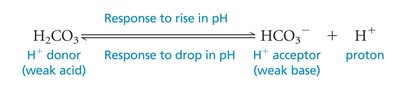
This system responds to changes in pH by shifting the equilibrium to either release or absorb H+ ions.
Organic Compounds
Introduction to Organic Compounds
Organic compounds contain carbon (except CO2 and CO, which are inorganic). Carbon is electroneutral, forming four covalent bonds, and is unique to living systems. Major classes include carbohydrates, lipids, proteins, and nucleic acids.
Many organic compounds are polymers, chains of similar units called monomers.
Synthesized by dehydration synthesis and broken down by hydrolysis reactions.
Carbohydrates
Carbohydrates are sugars and starches, serving as major sources of cellular fuel and structural molecules.
General formula: (CH2O)n
Monosaccharides: Simple sugars (3–7 carbon atoms); examples include ribose, deoxyribose, and glucose.
Disaccharides: Double sugars; examples include sucrose, maltose, and lactose.
Polysaccharides: Polymers of monosaccharides; examples include starch and glycogen.
Lipids
Lipids are hydrophobic molecules containing C, H, O (less than carbohydrates), and sometimes P. They are insoluble in water and serve various functions.
Triglycerides: Three fatty acids bonded to a glycerol molecule; function in energy storage, insulation, and protection.
Phospholipids: Modified triglycerides with a phosphorus-containing group; essential for cell membrane structure.
Steroids: Four-ring structure; includes cholesterol, vitamin D, steroid hormones, and bile salts.
Eicosanoids: Derived from arachidonic acid; includes prostaglandins, which play roles in blood clotting, blood pressure, inflammation, and labor contractions.
Other lipids: Fat-soluble vitamins (A, D, E, K) and lipoproteins (transport fats in blood).
Proteins
Proteins are polymers of amino acids (20 types), joined by peptide bonds. They contain C, H, O, N, and sometimes S and P. Proteins can act as acids or bases and differ by their "R group."
Fibrous proteins: Structural, strandlike, water-insoluble, stable; provide mechanical support and tensile strength (e.g., keratin, elastin, collagen).
Globular proteins: Functional, compact, spherical, water-soluble, sensitive to environmental changes; include antibodies, hormones, molecular chaperones, and enzymes.
Protein Denaturation
Denaturation is the unfolding and loss of functional, 3-D shape in globular proteins, destroying active sites. It can be caused by decreased pH or increased temperature and is usually reversible unless changes are extreme (e.g., cooking an egg).
Molecular Chaperones
Molecular chaperones are globular proteins that ensure proper folding and association of other proteins, prevent incorrect folding, assist in translocation, promote breakdown of damaged proteins, and help trigger immune responses. Stress proteins are produced in response to stressful stimuli and can delay aging by repairing damaged proteins.
Enzymes
Enzymes are globular proteins that act as biological catalysts, regulating and increasing the speed of chemical reactions by lowering activation energy.
Holoenzymes: Consist of an apoenzyme (protein portion) and a cofactor (metal ion) or coenzyme (organic molecule, often a vitamin).
Specificity: Enzymes act on specific substrates and are often named for the reactions they catalyze (e.g., hydrolases, oxidases).
Nucleic Acids
Nucleic acids include DNA and RNA, the largest molecules in the body. They are polymers of nucleotides, each composed of a nitrogen base, a pentose sugar, and a phosphate group.
DNA: Double-stranded helix in the nucleus; bases are adenine (A), guanine (G), cytosine (C), and thymine (T). Provides instructions for protein synthesis and replicates before cell division.
RNA: Single-stranded, mostly active outside the nucleus; bases are adenine (A), guanine (G), cytosine (C), and uracil (U). Three types: messenger RNA (mRNA), transfer RNA (tRNA), and ribosomal RNA (rRNA).
Adenosine Triphosphate (ATP)
ATP is the molecule that captures chemical energy from glucose and directly powers chemical reactions in cells. It is an adenine-containing RNA nucleotide with two additional phosphate groups.
Phosphorylation: Terminal phosphates are transferred to and energize other molecules, enabling cellular work using the phosphate bond energy.
Formula:
Example: ATP hydrolysis releases energy for muscle contraction, nerve impulse propagation, and other cellular processes.
