 뒤로
뒤로Body Cavities and Membranes in Human Anatomy
스터디 가이드 - 스마트 노트
 자료에 맞춘 맞춤형 노트, 핵심 정의, 예시, 맥락을 확장해 제공합니다.
Body Cavities and Membranes
Overview of Major Body Cavities
The human body contains several major cavities that house and protect vital organs. These cavities are lined by specialized membranes and are essential for organ function and protection. Understanding their structure and organization is fundamental in anatomy.
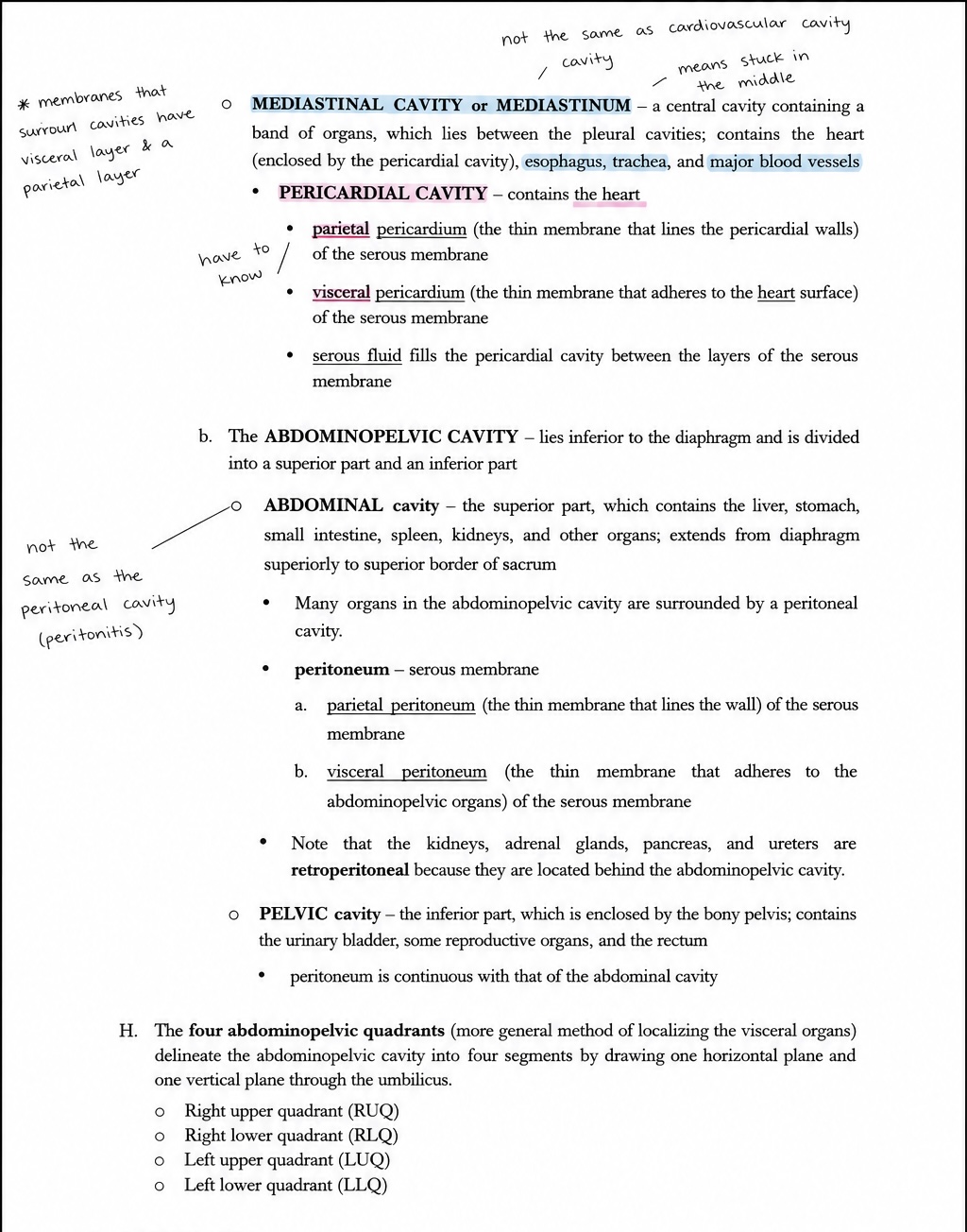
Mediastinal Cavity (Mediastinum): The central compartment of the thoracic cavity, located between the pleural cavities. It contains the heart (within the pericardial cavity), esophagus, trachea, and major blood vessels.
Pericardial Cavity: A subdivision of the mediastinum that specifically contains the heart.
Abdominopelvic Cavity: Located inferior to the diaphragm, it is divided into the abdominal and pelvic cavities.
Mediastinal and Pericardial Cavities
The mediastinum is not the same as the cardiovascular cavity; it is a central region that separates the lungs and contains several vital structures. The pericardial cavity is a fluid-filled space within the mediastinum that surrounds the heart.
Parietal Pericardium: The thin membrane lining the walls of the pericardial cavity.
Visceral Pericardium: The thin membrane adhering directly to the heart's surface.
Serous Fluid: Fills the pericardial cavity, reducing friction between the heart and pericardial membranes during heartbeats.
Additional info: The pericardium is a double-layered serous membrane that provides mechanical protection and limits the heart's motion.
Abdominopelvic Cavity
The abdominopelvic cavity lies below the diaphragm and is divided into two main parts: the abdominal cavity and the pelvic cavity. This cavity houses many digestive, urinary, and reproductive organs.
Abdominal Cavity: The superior portion, containing the liver, stomach, small intestine, spleen, kidneys, and other organs. It extends from the diaphragm to the superior border of the sacrum.
Peritoneal Cavity: Many abdominal organs are surrounded by this cavity, which is lined by a serous membrane called the peritoneum.
Peritoneum: The serous membrane of the abdominopelvic cavity, consisting of:
Parietal Peritoneum: Lines the cavity wall.
Visceral Peritoneum: Adheres to the surfaces of the organs.
Retroperitoneal Organs: The kidneys, adrenal glands, pancreas, and ureters are located behind the peritoneal cavity and are termed retroperitoneal.
Additional info: Inflammation of the peritoneum is called peritonitis, a serious medical condition.
Pelvic Cavity
The pelvic cavity is the inferior portion of the abdominopelvic cavity, enclosed by the bony pelvis. It contains the urinary bladder, some reproductive organs, and the rectum. The peritoneum is continuous with that of the abdominal cavity.
Abdominopelvic Quadrants
To localize organs and describe pain or pathology, the abdominopelvic cavity is divided into four quadrants by one horizontal and one vertical plane passing through the umbilicus:
Quadrant | Abbreviation |
|---|---|
Right Upper Quadrant | RUQ |
Right Lower Quadrant | RLQ |
Left Upper Quadrant | LUQ |
Left Lower Quadrant | LLQ |
Additional info: These quadrants are used clinically to help diagnose abdominal pain and organ pathology.
