 뒤로
뒤로Body Organization, Homeostasis, Basic Chemistry, and Terminology: Study Notes for Anatomy & Physiology
스터디 가이드 - 스마트 노트
 자료에 맞춘 맞춤형 노트, 핵심 정의, 예시, 맥락을 확장해 제공합니다.
Body Organization and Homeostasis
Homeostasis and Feedback Mechanisms
Homeostasis is the body's ability to maintain a stable internal environment despite external changes. It is regulated by feedback mechanisms, which are essential for physiological balance.
Negative Feedback: The most common feedback mechanism. The response reduces or shuts off the original stimulus, causing the variable to change in the opposite direction of the initial change. For example, regulation of body temperature and blood glucose levels.
Positive Feedback: The response enhances or exaggerates the original stimulus, often resulting in a cascade effect. This mechanism is less common and usually controls infrequent events, such as labor contractions and blood clotting.
Example: Negative feedback in body temperature regulation involves sensors, control centers, effectors, and responses that decrease heat loss when temperature exceeds 37°C. 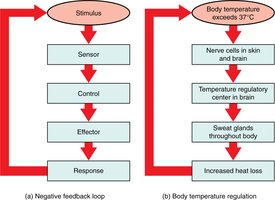 Example: Positive feedback in labor contractions involves oxytocin release, uterine contractions, and nerve impulses that amplify the process.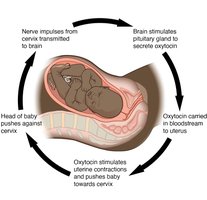
Disturbance of Homeostasis
Movement far from the homeostatic set point increases risk of disease and contributes to aging.
Control systems become less efficient, and overwhelmed negative feedback can lead to destructive positive feedback (e.g., heart failure).
Anatomical Terminology
Anatomical Position and Directional Terms
Anatomical position is the standard reference for describing body locations and directions.
Standard Position: Body erect, feet slightly apart, palms facing forward, thumbs pointing away from the body.
Directional Terms: Used to describe one body structure in relation to another. Always based on the standard anatomical position.
Right and Left: Refer to the body being viewed, not the observer.
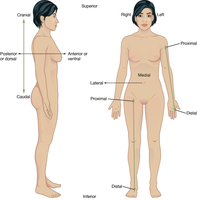
Directional Terms Explained
Anterior (ventral): Toward the front of the body.
Posterior (dorsal): Toward the back of the body.
Superior (cranial): Above or toward the head.
Inferior (caudal): Below or toward the tail.
Lateral: Away from the midline.
Medial: Toward the midline.
Proximal: Nearer to the point of attachment.
Distal: Farther from the point of attachment.
Superficial: Closer to the surface.
Deep: Farther from the surface.
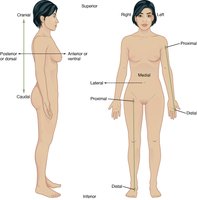
Body Regions
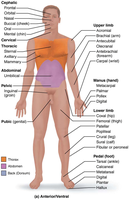
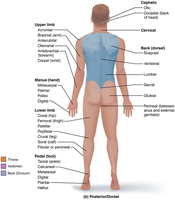
The body is divided into anterior (ventral) and posterior (dorsal) regions, each with specific anatomical terms.
Anterior Regions: Include cephalic, cervical, thoracic, abdominal, pelvic, and limb regions.
Posterior Regions: Include dorsal, lumbar, gluteal, and limb regions.
Body Planes and Sections
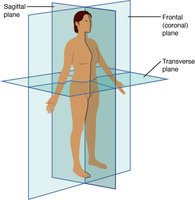
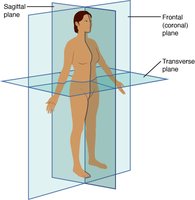
Body planes are imaginary flat surfaces used to divide the body for anatomical study.
Sagittal Plane: Divides body into right and left parts.
Frontal (Coronal) Plane: Divides body into anterior and posterior parts.
Transverse (Horizontal) Plane: Divides body into upper and lower parts.
Oblique Sections: Cuts not at right angles to any plane.
Body Cavities and Membranes
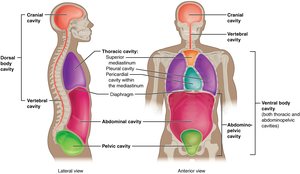
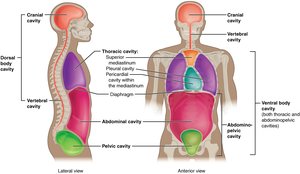
The body contains internal cavities that protect organs and allow for organ movement.
Dorsal (Posterior) Cavity: Protects the nervous system (cranial and vertebral cavities).
Ventral (Anterior) Cavity: Contains visceral organs (thoracic and abdominopelvic cavities).
Thoracic Cavity: Includes pleural, pericardial, and mediastinum.
Abdominopelvic Cavity: Includes abdominal and pelvic cavities.
Abdominal Regions and Quadrants
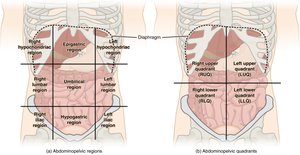
The abdomen is divided into regions and quadrants for clinical reference.
Regions: Nine regions (e.g., epigastric, umbilical, hypogastric).
Quadrants: Four quadrants (e.g., right upper, left lower).
Serous Membranes
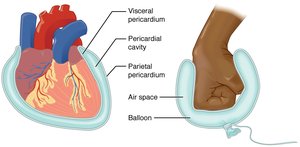
Serous membranes (serosa) line body cavities and cover organs, producing serous fluid for lubrication.
Visceral Layer: Covers organs (e.g., visceral pericardium).
Parietal Layer: Lines cavity walls (e.g., parietal pericardium).
Basic Chemistry and Physiological Reactions
Matter and Energy
Matter: Anything with mass and volume; exists as solids, liquids, or gases.
Energy: Capacity to do work; exists as kinetic (in action) or potential (stored).
Forms of Energy: Chemical, electrical, mechanical, radiant.
Atoms and Elements
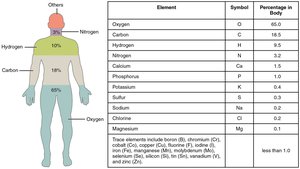
Elements: Pure substances that cannot be broken down further; listed in the periodic table.
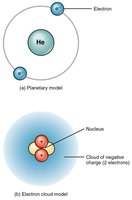
Atoms: Smallest unit of an element, composed of protons, neutrons, and electrons.
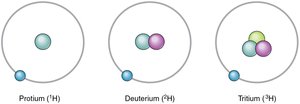
Atomic Number: Number of protons.
Mass Number: Protons plus neutrons.
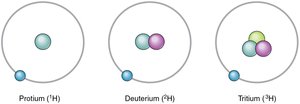
Isotopes: Variants of elements with different neutron numbers.
Radioisotopes
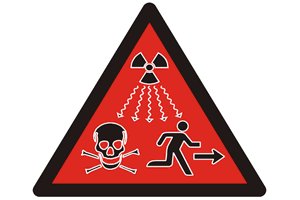
Radioisotopes: Unstable isotopes that decay, emitting radioactivity.
Uses: Medical imaging, cancer treatment, and research.
Risks: Can damage living tissue and cause cancer.
Molecules, Compounds, and Mixtures
Molecule: Two or more atoms bonded together.
Compound: Molecule with two or more different atoms.
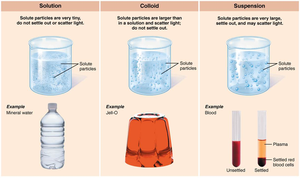
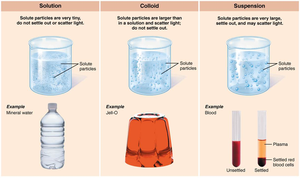
Mixtures: Physical combinations of substances; can be solutions, colloids, or suspensions.
Type | Solute Size | Settling | Example |
|---|---|---|---|
Solution | Tiny | No | Mineral water |
Colloid | Larger | No | Jell-O |
Suspension | Largest | Yes | Blood |
Chemical Bonds
Chemical bonds are energy relationships between electrons of reacting atoms.
Ionic Bonds: Transfer of electrons, forming charged ions (cations and anions).
Covalent Bonds: Sharing of electrons; can be polar (unequal sharing) or nonpolar (equal sharing).
Hydrogen Bonds: Weak attractions between hydrogen and electronegative atoms; important in water and biological molecules.
Chemical Reactions
Chemical reactions involve the formation, rearrangement, or breaking of chemical bonds.
Synthesis: Building larger molecules (anabolic).
Decomposition: Breaking down molecules (catabolic).
Exchange: Both synthesis and decomposition; includes redox reactions.
Energy Flow and Reaction Rates
Exergonic Reactions: Release energy.
Endergonic Reactions: Absorb energy.
Catalysts: Speed up reactions without being consumed; enzymes are biological catalysts.
Summary Table: Directional Terms
Term | Definition | Example |
|---|---|---|
Anterior (Ventral) | Toward the front | The sternum is anterior to the heart |
Posterior (Dorsal) | Toward the back | The spine is posterior to the heart |
Superior (Cranial) | Above | The head is superior to the chest |
Inferior (Caudal) | Below | The stomach is inferior to the lungs |
Lateral | Away from midline | The arms are lateral to the chest |
Medial | Toward midline | The nose is medial to the eyes |
Proximal | Near point of attachment | The elbow is proximal to the wrist |
Distal | Farther from attachment | The fingers are distal to the elbow |
Superficial | Closer to surface | The skin is superficial to muscles |
Deep | Farther from surface | The bones are deep to the skin |
Additional info:
Understanding these foundational concepts is essential for further study in Anatomy & Physiology, including cellular structure, tissue organization, and physiological systems.
