 뒤로
뒤로Body Orientation, Anatomical Terms, and Body Cavities
스터디 가이드 - 스마트 노트
 자료에 맞춘 맞춤형 노트, 핵심 정의, 예시, 맥락을 확장해 제공합니다.
Body Orientation and Directional Terms
Introduction
Understanding anatomical position and directional terms is fundamental in Anatomy & Physiology. These terms provide a standardized way to describe locations and relationships of body parts.
Anatomical Position: The body is upright, facing forward, arms at the sides with palms facing forward.
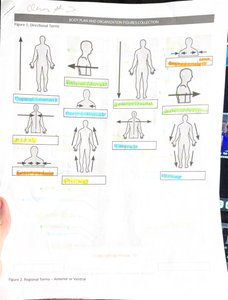
Directional Terms: Used to describe the positions of structures relative to other structures or locations in the body.
Key Directional Terms
Superior (Cranial): Toward the head or upper part of a structure.
Inferior (Caudal): Away from the head or toward the lower part of a structure.
Anterior (Ventral): Toward the front of the body.
Posterior (Dorsal): Toward the back of the body.
Medial: Toward the midline of the body.
Lateral: Away from the midline of the body.
Proximal: Closer to the origin of the body part or the point of attachment of a limb.
Distal: Farther from the origin of a body part or the point of attachment of a limb.
Superficial: Toward or at the body surface.
Deep: Away from the body surface; more internal.
Body Planes and Sections
Introduction
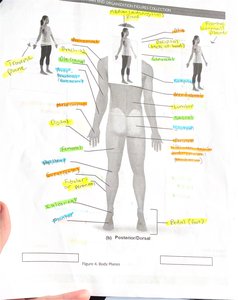
Body planes are imaginary lines used to divide the body into sections. These planes are essential for describing locations of structures and for medical imaging.
Frontal (Coronal) Plane: Divides the body into anterior (front) and posterior (back) parts.
Sagittal Plane: Divides the body into right and left parts. The midsagittal (median) plane divides the body into equal right and left halves, while the parasagittal plane divides it into unequal parts.
Transverse (Horizontal) Plane: Divides the body into superior (upper) and inferior (lower) parts.
Oblique Plane: Passes through the body at an angle between the horizontal and vertical planes.
Body Cavities and Membranes
Introduction
The human body contains several major cavities that house and protect vital organs. These cavities are lined by membranes that provide protection and reduce friction.
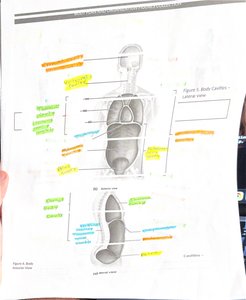
Dorsal Body Cavity: Includes the cranial cavity (encases the brain) and vertebral cavity (encases the spinal cord).
Ventral Body Cavity: Consists of the thoracic cavity (contains heart and lungs) and abdominopelvic cavity (contains digestive, urinary, and reproductive organs).
Thoracic Cavity: Subdivided into the pleural cavities (each surrounds a lung), the mediastinum (contains the heart, esophagus, trachea), and the pericardial cavity (encloses the heart).
Abdominopelvic Cavity: Subdivided into the abdominal cavity (contains stomach, intestines, spleen, liver) and pelvic cavity (contains bladder, reproductive organs, rectum).
Serous Membranes: Thin, double-layered membranes that cover the walls of the ventral body cavity and the outer surfaces of the organs. The parietal serosa lines the cavity walls, and the visceral serosa covers the organs.
Major Body Cavities Table
Cavity | Location | Major Organs |
|---|---|---|
Cranial | Head | Brain |
Vertebral | Spinal column | Spinal cord |
Thoracic | Chest | Heart, lungs |
Abdominal | Abdomen | Stomach, intestines, liver |
Pelvic | Pelvis | Bladder, reproductive organs |
Summary Table: Directional Terms
Term | Definition | Example |
|---|---|---|
Superior | Above; toward the head | The head is superior to the abdomen. |
Inferior | Below; away from the head | The navel is inferior to the chin. |
Anterior | Toward the front | The breastbone is anterior to the spine. |
Posterior | Toward the back | The heart is posterior to the breastbone. |
Medial | Toward the midline | The heart is medial to the arm. |
Lateral | Away from the midline | The arms are lateral to the chest. |
Proximal | Closer to the origin | The elbow is proximal to the wrist. |
Distal | Farther from the origin | The knee is distal to the thigh. |
Superficial | Toward the surface | The skin is superficial to the muscles. |
Deep | Away from the surface | The lungs are deep to the rib cage. |
Additional info:
Understanding these terms is essential for communication in health care and for interpreting medical imaging.
Body planes and cavities are foundational for later study of organ systems and clinical anatomy.
