 뒤로
뒤로Body Plan and Organization: Essential Concepts for Anatomy & Physiology
스터디 가이드 - 스마트 노트
 자료에 맞춘 맞춤형 노트, 핵심 정의, 예시, 맥락을 확장해 제공합니다.
Body Plan and Organization
Directional Terms
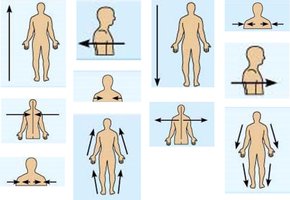
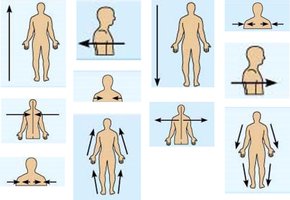
Directional terms are essential for describing the locations of structures in relation to other structures or locations in the body. These terms provide a standardized way to communicate anatomical positions and relationships.
Superior (Cranial): Toward the head or upper part of a structure.
Inferior (Caudal): Away from the head or toward the lower part of a structure.
Anterior (Ventral): Toward the front of the body.
Posterior (Dorsal): Toward the back of the body.
Medial: Toward the midline of the body.
Lateral: Away from the midline of the body.
Proximal: Closer to the point of attachment or origin.
Distal: Farther from the point of attachment or origin.
Superficial: Toward or at the body surface.
Deep: Away from the body surface, more internal.
Regional Terms
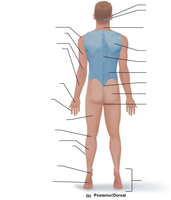
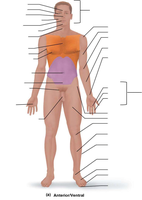
Regional terms identify specific areas of the body, which are useful for locating injuries, describing procedures, or referencing anatomical structures. The body is divided into anterior (ventral) and posterior (dorsal) regions.
Anterior (Ventral) Regions: Includes areas such as the thoracic, abdominal, pelvic, and limb regions.
Posterior (Dorsal) Regions: Includes the back, gluteal, and posterior limb regions.
Body Planes
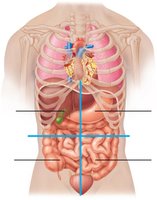
Body planes are imaginary lines that divide the body into sections, which are important for anatomical study and medical imaging. The three primary planes are:
Transverse (Horizontal) Plane: Divides the body into superior and inferior parts.
Frontal (Coronal) Plane: Divides the body into anterior and posterior parts.
Sagittal Plane: Divides the body into right and left parts. The midsagittal plane divides the body exactly at the midline.

Body Cavities
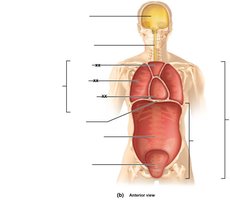
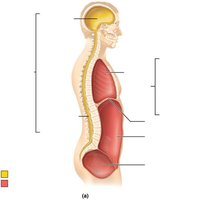
The human body contains several cavities that house and protect internal organs. These cavities are divided into dorsal and ventral groups, each with specific subdivisions.
Dorsal Body Cavity: Contains the cranial cavity (brain) and vertebral cavity (spinal cord).
Ventral Body Cavity: Includes the thoracic cavity (heart and lungs) and abdominopelvic cavity (digestive organs, reproductive organs, etc.).
Thoracic Cavity: Subdivided into pleural cavities (lungs), pericardial cavity (heart), and mediastinum (central region).
Abdominopelvic Cavity: Subdivided into abdominal cavity (digestive organs) and pelvic cavity (bladder, reproductive organs).


Abdominopelvic Quadrants
The abdominopelvic region is divided into four quadrants to help locate organs and describe pain or pathology. The quadrants are:
Right Upper Quadrant (RUQ)
Left Upper Quadrant (LUQ)
Right Lower Quadrant (RLQ)
Left Lower Quadrant (LLQ)
Summary Table: Directional Terms
This table summarizes the main directional terms used in anatomy:
Term | Definition |
|---|---|
Superior | Toward the head |
Inferior | Toward the feet |
Anterior | Toward the front |
Posterior | Toward the back |
Medial | Toward the midline |
Lateral | Away from the midline |
Proximal | Closer to origin |
Distal | Farther from origin |
Superficial | Toward surface |
Deep | More internal |
Summary Table: Body Planes
Plane | Division |
|---|---|
Transverse | Superior/Inferior |
Frontal | Anterior/Posterior |
Sagittal | Right/Left |
Summary Table: Body Cavities
Cavity | Contents |
|---|---|
Cranial | Brain |
Vertebral | Spinal cord |
Thoracic | Heart, lungs |
Abdominal | Digestive organs |
Pelvic | Bladder, reproductive organs |
Example: Clinical Application
When describing the location of pain, a physician may use directional and regional terms. For example, "pain in the right lower quadrant" may indicate appendicitis.
Additional info: These concepts are foundational for all subsequent study in anatomy and physiology, as they provide the language and framework for describing the human body in detail.
