 뒤로
뒤로Cell Communication, Signal Pathways, and Reflex Control in Human Physiology
스터디 가이드 - 스마트 노트
 자료에 맞춘 맞춤형 노트, 핵심 정의, 예시, 맥락을 확장해 제공합니다.
Cell-to-Cell Communication
Components of Cell Communication
Cell-to-cell communication is essential for the coordination of physiological processes. It involves the transmission of signals, detection by receptors, and a response by the target cell. - Signal: A molecule or electrical impulse that initiates communication. - Transport: Signals are transported via extracellular fluid. - Detection: Target cells must possess specific receptors to detect signals. - Response: Only cells with appropriate receptors can respond to the signal.
Types of Signals
Signals can be electrical or chemical, each with distinct mechanisms and effects. - Electrical signals: Changes in membrane potential, such as graded and action potentials, occur within and between cells. - Chemical signals: Molecules secreted into extracellular fluid, including hormones (e.g., insulin), paracrine and autocrine agents (e.g., nitric oxide, histamine), and neurotransmitters.
Types of Communication
Communication can be local or long-distance, depending on the signal and mechanism.
Local Communication
- Gap junctions: Direct cytoplasmic connections between adjacent cells, allowing electrical and chemical signals to pass. 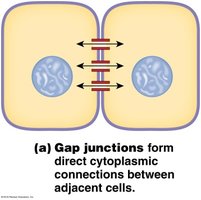 - Contact-dependent signals: Require interaction between membrane molecules on two cells, often involving cell adhesion molecules (CAMs).
 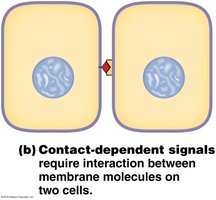 - Paracrine signals: Secreted by one cell and diffuse to adjacent cells. - Autocrine signals: Act on the same cell that secreted them.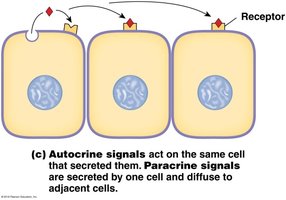
Long-Distance Communication
- Endocrine system: Endocrine cells release hormones into the bloodstream, which travel to distant target cells. - Neural system: Neurons transmit electrical signals and release neurocrine molecules (neurotransmitters, neuromodulators, neurohormones) to target cells. 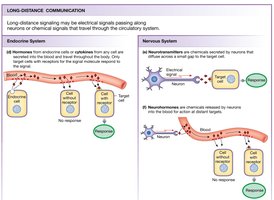
Cytokines
- Cytokines: Regulatory peptides or proteins produced by nucleated cells, acting locally (paracrine/autocrine) or at a distance (like hormones). They are crucial for immune system communication and cell differentiation.
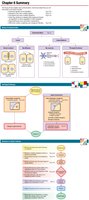
Summary of Communication Types
Signal Pathways
Overview of Signal Pathways
Signal pathways are the series of steps by which a signal molecule produces a cellular response. - Signal molecule: Initiates the pathway. - Receptor protein: Detects the signal. - Intracellular signaling: Transmits the signal inside the cell. - Target protein: Executes the response. - Response: The final effect on the cell. 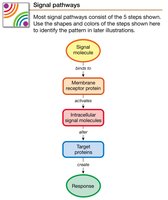
Target Cell Receptor Proteins
Receptors can be located inside the cell or on the cell membrane, depending on the nature of the signal molecule. - Intracellular receptors: Bind lipophilic messengers (e.g., steroid hormones) and typically alter gene activity. - Cell membrane receptors: Bind hydrophilic messengers and usually alter cytosolic activity. 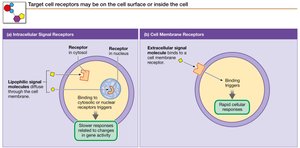
Metabotropic Pathways
Metabotropic pathways involve signal transduction, which is slower but can amplify the effect. - Reception: The first messenger binds to the receptor. - Signal transduction: Intracellular communication via second messengers. - Response: Target protein is affected. 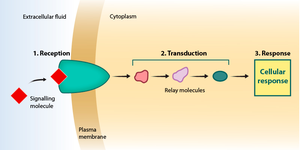
Signal Transduction Pathways
- First messenger: The original signal molecule. - Receptor: Detects the signal. - Transducer: Converts the signal. - Second messenger: Amplifies and relays the signal. - Target proteins: Execute the response. 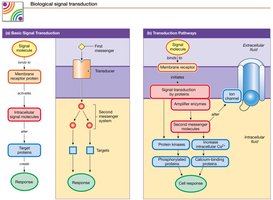
Categories of Membrane Receptors
- G protein-coupled receptors: Linked to G-proteins, most common form of signal transduction. - Receptor-enzyme: Often tyrosine-kinase, can be intrinsic or separate kinases. - Integrin receptor: Alters cytoskeleton and activates intracellular enzymes. 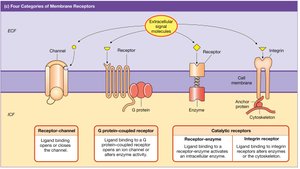
G Protein-Coupled Receptors
- Function: Alters enzyme function and can open ion channels. 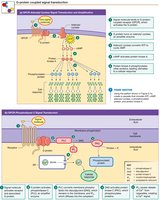
Receptor-Enzyme Pathways
- Tyrosine kinase: Transfers phosphate from ATP to tyrosine residues on proteins, activating them. 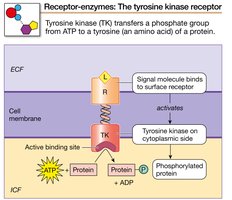
Integrin Receptor Pathways
- Function: Alters cytoskeleton and activates intracellular enzymes. 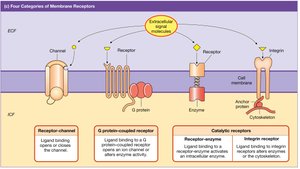
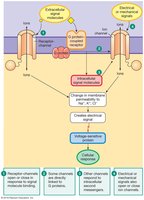
Ionotropic Pathways
Ionotropic pathways involve rapid, short-term responses via ligand-gated ion channels. - Reception: Signal molecule binds to integral membrane protein. - Activation: Channel opens, ions move, altering cell activity or membrane potential. - Key ions: Na+, K+, Cl-, Ca2+. 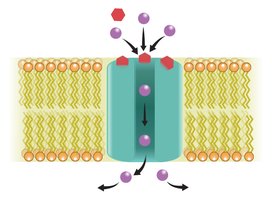
Special Signal Molecules
Calcium as an Intracellular Messenger
Calcium ions play multiple roles in cell signaling. - ECF vs. ICF: Higher Ca2+ concentration in extracellular fluid. - Channels: Ligand, voltage, and mechanically gated channels regulate Ca2+ entry. - Intracellular storage: Endoplasmic reticulum stores Ca2+. - Actions: Activates muscle fibers, exocytosis, alters protein function. 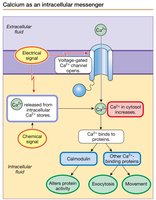
Gases as Paracrine Signals
Certain gases act as short-term paracrine signals, such as nitric oxide (NO), carbon dioxide (CO2), carbon monoxide (CO), and hydrogen sulfide (H2S). - Function: Often involved in vasodilation and local signaling.
Modification of Signal Pathways
Receptor Properties
Receptor proteins exhibit specificity, competition, saturation, and regulation. - Agonist: Activates the receptor. - Antagonist: Blocks receptor activity. 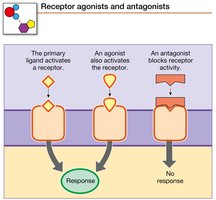 - Saturation: Maximum response when all receptors are occupied. - Up/down regulation: Adjusts receptor number in response to signal levels. - Isoforms: Different forms of receptors (e.g., α and β2 epinephrine receptors) produce opposing effects.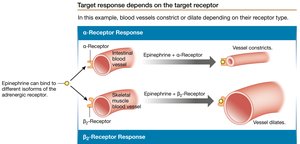
Termination and Blocking of Signals
- Termination: Enzyme hydrolysis, diffusion, re-uptake, or endocytosis of receptor-ligand complex. - Blocking: Channel blocker drugs (e.g., β-adrenergic blockers, calcium channel blockers, histamine receptor blockers).
Reflex Pathway Control
Tonic and Antagonistic Control
- Tonic control: Continuous modulation of activity (e.g., α-adrenergic receptors). 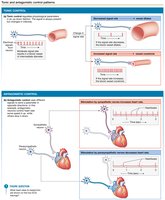 - Antagonistic control: Opposing effects by sympathetic (fight or flight) and parasympathetic (rest and digest) systems.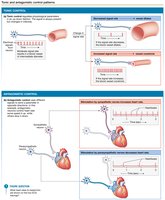
Long-Distance Reflexes
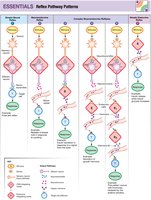
Reflexes can be simple or complex, involving neural, endocrine, or neuroendocrine pathways. - Simple endocrine: One system, hormone release. - Simple neural: One system, neural signal. - Complex neuroendocrine: Two systems, two integration centers. 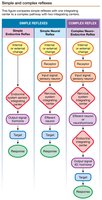
Summary Table: Neural vs. Endocrine Reflexes
Signal Pathway Nightmare: Protein Kinase-A Activation
cAMP-Dependent Protein Kinase
Protein kinase-A (PKA) is activated by cyclic AMP (cAMP), a second messenger. - Function: Phosphorylates target proteins, altering their activity. - Pathway: G protein-coupled receptor → adenylyl cyclase → cAMP → PKA activation. 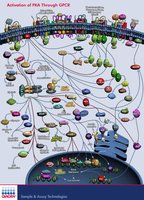 Additional info: This chapter integrates concepts from cell communication, signal transduction, and reflex control, which are foundational for understanding physiological regulation and homeostasis in human anatomy and physiology.
