 뒤로
뒤로Cells and Biomolecules: Foundations of Anatomy & Physiology
스터디 가이드 - 스마트 노트
 자료에 맞춘 맞춤형 노트, 핵심 정의, 예시, 맥락을 확장해 제공합니다.
Cells: The Living Units
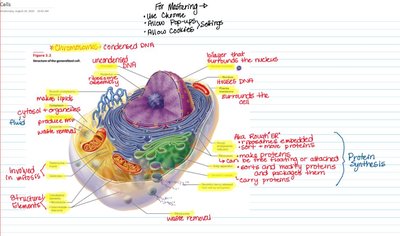
Introduction to Cells
Cells are the basic structural and functional units of all living organisms. Each cell contains specialized structures called organelles that perform distinct functions necessary for life.
Nucleus: Contains genetic material (DNA) and controls cellular activities.
Cytoplasm: Gel-like substance where organelles are suspended.
Organelles: Specialized structures such as mitochondria, endoplasmic reticulum, and Golgi apparatus.
Plasma Membrane Structure
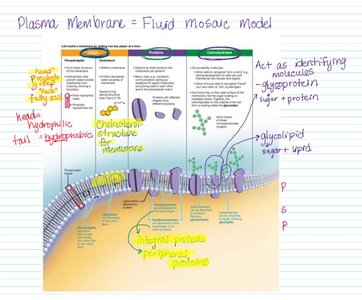
The plasma membrane is a selectively permeable barrier that surrounds the cell, maintaining the internal environment and mediating communication with the external environment. It is described by the Fluid Mosaic Model, which highlights its dynamic and complex structure.
Phospholipid Bilayer: Composed of hydrophilic (water-attracting) heads and hydrophobic (water-repelling) tails.
Proteins: Integral and peripheral proteins serve as channels, carriers, receptors, and enzymes.
Carbohydrates: Glycoproteins and glycolipids act as cell recognition and signaling molecules.
Cholesterol: Stabilizes membrane fluidity.
Membrane Transport Mechanisms
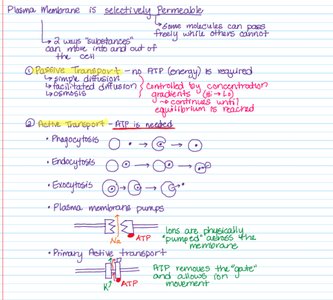
The plasma membrane regulates the movement of substances into and out of the cell through selective permeability. Transport mechanisms are classified as passive or active.
Passive Transport: Does not require energy (ATP). Includes:
Simple diffusion
Facilitated diffusion (via channels or carriers)
Osmosis (water movement)
Active Transport: Requires energy (ATP). Includes:
Phagocytosis (cell eating)
Endocytosis (bulk uptake)
Exocytosis (bulk release)
Plasma membrane pumps (e.g., sodium-potassium pump)
Example: The sodium-potassium pump actively transports Na+ out of and K+ into the cell, maintaining electrochemical gradients essential for nerve impulse transmission.
Cell Junctions
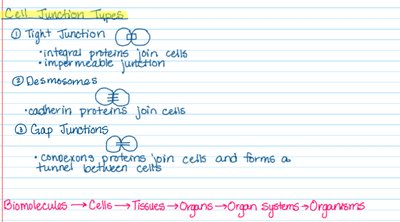
Cell junctions are specialized structures that connect adjacent cells, providing structural integrity and communication.
Tight Junctions: Integral proteins join cells to form impermeable barriers.
Desmosomes: Cadherin proteins anchor cells together, providing mechanical strength.
Gap Junctions: Connexon proteins form channels that allow communication and passage of ions between cells.
Chemistry Comes Alive
Basic Chemistry Concepts
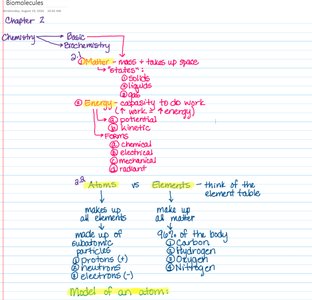
Chemistry underlies all physiological processes. Understanding matter and energy is essential for studying anatomy and physiology.
Matter: Anything that has mass and occupies space; exists as solids, liquids, or gases.
Energy: The capacity to do work; exists in various forms such as chemical, electrical, mechanical, and radiant.
Atoms: The smallest units of elements, composed of protons, neutrons, and electrons.
Elements: Pure substances made of only one type of atom; four elements (C, H, O, N) make up 96% of the human body.
Atomic Structure and Chemical Bonds
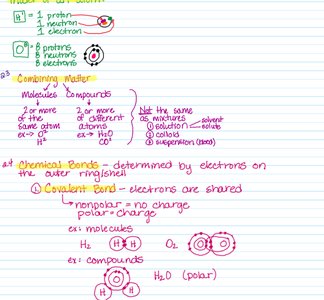
Atoms combine to form molecules and compounds through chemical bonds, which are determined by the arrangement of electrons.
Covalent Bonds: Electrons are shared between atoms. Can be nonpolar (equal sharing) or polar (unequal sharing).
Ionic Bonds: Electrons are transferred from one atom to another, creating charged ions.
Hydrogen Bonds: Weak attractions between polar molecules, important in water and biological molecules.
Example: Water (H2O) is a polar molecule due to unequal sharing of electrons.
Biochemistry: Inorganic and Organic Compounds
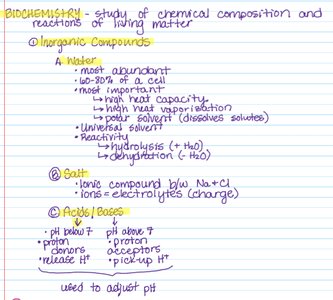
Biochemistry is the study of the chemical composition and reactions of living matter. Compounds are classified as inorganic or organic.
Inorganic Compounds
Water: Most abundant compound in cells; excellent solvent, high heat capacity, involved in hydrolysis and dehydration reactions.
Salts: Ionic compounds that dissociate into electrolytes in solution.
Acids and Bases: Acids donate H+; bases accept H+. pH measures hydrogen ion concentration.
Organic Compounds
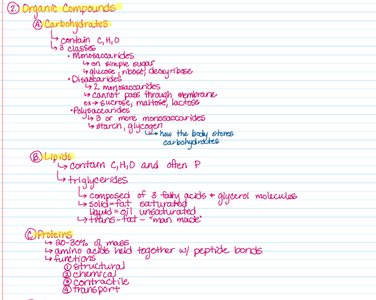
Carbohydrates: Contain C, H, O; main energy source. Classified as monosaccharides, disaccharides, and polysaccharides.
Lipids: Contain C, H, O (sometimes P); include triglycerides, phospholipids, and steroids. Function in energy storage, insulation, and membrane structure.
Proteins: Composed of amino acids linked by peptide bonds; serve structural, enzymatic, contractile, and transport roles.
Additional info: Nucleic acids (DNA and RNA) are also essential organic compounds, storing and transmitting genetic information.
Hierarchy of Biological Organization
Biomolecules combine to form cells, which organize into tissues, organs, organ systems, and ultimately, the organism.
Biomolecules → Cells → Tissues → Organs → Organ Systems → Organism
