 뒤로
뒤로Cellular Biology: Structure and Function of Cells and Plasma Membranes
스터디 가이드 - 스마트 노트
 자료에 맞춘 맞춤형 노트, 핵심 정의, 예시, 맥락을 확장해 제공합니다.
Cells: The Smallest Living Units
Cell Theory
The cell theory is a foundational concept in biology, stating that:
The cell is the smallest unit of life.
All organisms are composed of one or more cells.
Cells arise only from pre-existing cells through cellular division.
Generalized Cell Structure
All human cells share common structural features, which allow them to perform essential life functions. The three main parts of a typical human cell are:
Plasma membrane: The flexible outer boundary that separates the cell from its environment.
Cytoplasm: The intracellular fluid containing organelles.
Nucleus: The control center containing DNA.
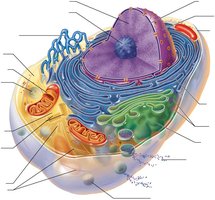
Plasma Membrane: Structure and Function
Overview of the Plasma Membrane
The plasma membrane, also known as the cell membrane, acts as an active barrier separating the intracellular fluid (ICF) from the extracellular fluid (ECF). It plays a dynamic role in cellular activity by controlling what enters and leaves the cell.
Structure of the Plasma Membrane
The plasma membrane is primarily composed of a flexible lipid bilayer, with embedded proteins and surface carbohydrates forming the glycocalyx. Membrane structures also help hold cells together through specialized cell junctions.
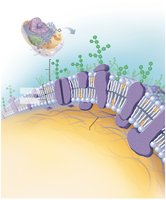
Components of the Plasma Membrane
Lipids: Form the basic structure of the membrane. The hydrophobic tails prevent water-soluble substances from crossing, creating a selective barrier.
Proteins: Determine membrane functions, including transport, communication, and cell adhesion. Proteins can be integral (embedded) or peripheral (attached to the surface).
Carbohydrates: Act as identity molecules, allowing cells to recognize each other and interact appropriately. Carbohydrates are found only on the outer surface, forming the glycocalyx.
Cholesterol: Stiffens the membrane and decreases its water solubility, contributing to membrane stability.
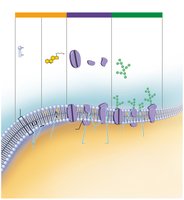
Phospholipid Bilayer
The lipid bilayer consists of:
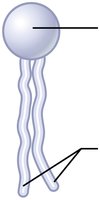
75% phospholipids: Each phospholipid has a polar, hydrophilic head and two nonpolar, hydrophobic fatty acid tails.
5% glycolipids: Lipids with attached sugar groups, found on the outer membrane surface.
20% cholesterol: Increases membrane stability.
Membrane Proteins
Types and Functions of Membrane Proteins
Membrane proteins are essential for communication with the environment and account for about half the mass of the plasma membrane. They can be:
Integral proteins: Firmly inserted into the membrane, often spanning the bilayer (transmembrane). They function as transport proteins, enzymes, or receptors.
Peripheral proteins: Loosely attached to integral proteins or the membrane surface. They function as enzymes, motor proteins, or in cell-to-cell connections.
Glycocalyx
Structure and Function
The glycocalyx is a layer of carbohydrates on the cell surface. Each cell type has a unique pattern, serving as biological markers for cell recognition and allowing the immune system to distinguish self from nonself.
Cell Junctions
Types of Cell Junctions
Most cells are bound together to form tissues and organs. The three main types of cell junctions are:
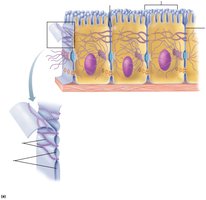
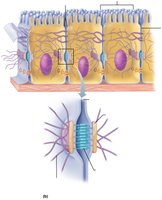
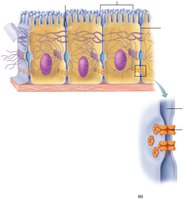
Tight junctions: Impermeable junctions that encircle the cell, preventing fluids and most molecules from moving between cells.
Desmosomes: Anchoring junctions that act like molecular Velcro, providing mechanical stability and preventing cells from tearing apart under stress.
Gap junctions: Communicating junctions formed by transmembrane proteins (connexons) that allow ions and small molecules to pass directly from cell to cell, facilitating rapid communication, especially in cardiac and smooth muscle cells.
Membrane Transport
Selective Permeability
The plasma membrane is selectively permeable, allowing only certain molecules to cross. Substances move across the membrane by two main mechanisms:
Passive transport: Does not require energy (ATP).
Active transport: Requires energy input (ATP).
Passive Membrane Transport
Passive transport involves the movement of molecules down their concentration gradient (from high to low concentration) and includes:
Simple diffusion
Facilitated diffusion
Osmosis
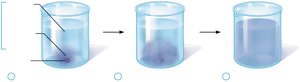
All molecules exhibit random, high-speed movement due to intrinsic kinetic energy, resulting in diffusion until equilibrium is reached.
Factors Affecting Diffusion Speed
Concentration: Greater differences increase diffusion rate.
Molecular size: Smaller molecules diffuse faster.
Temperature: Higher temperatures increase kinetic energy and diffusion rate.
Simple Diffusion
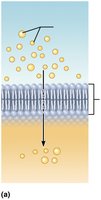
Simple diffusion is the movement of nonpolar, lipid-soluble (hydrophobic) substances directly through the phospholipid bilayer. Examples include oxygen, carbon dioxide, steroid hormones, and fatty acids.
Summary Table: Types of Cell Junctions
Junction Type | Main Function | Location Example |
|---|---|---|
Tight Junction | Prevents passage of molecules between cells | Intestinal lining |
Desmosome | Provides mechanical stability; resists tearing | Skin, cardiac muscle |
Gap Junction | Allows communication via passage of ions/small molecules | Heart, smooth muscle |
Key Equations
Fick's Law of Diffusion (describes the rate of diffusion):
Where J is the diffusion flux, D is the diffusion coefficient, and \frac{dC}{dx} is the concentration gradient.
Additional info: Facilitated diffusion and osmosis are also important passive transport mechanisms, but are not detailed in this section. Active transport mechanisms require ATP and are covered in later chapters.
