 뒤로
뒤로Cellular Physiology and Drug Transport: Core Concepts for Anatomy & Physiology
스터디 가이드 - 스마트 노트
 자료에 맞춘 맞춤형 노트, 핵심 정의, 예시, 맥락을 확장해 제공합니다.
Pharm Ch 2: Cellular Physiology
Basic Concepts of Cellular Function
Cells are the fundamental units of life, functioning as dynamic "factories" that sustain bodily processes. They take in raw materials, manufacture essential products, and deliver these products to appropriate destinations within the body. Although cells differ among tissues, they share several core characteristics.
Exchange of Materials: Cells interact with their immediate environment to import nutrients and export waste.
Energy Acquisition: Cells obtain energy from nutrients to fuel metabolic activities.
Synthesis: Cells synthesize complex molecules necessary for structure and function.
Reproduction: Cells have the ability to reproduce, ensuring tissue growth and repair.
Communication: Cells communicate via biologic chemicals, coordinating activities within tissues and organs.
Example: Muscle cells are specialized for contraction, while nerve cells are specialized for communication, but both share the above fundamental properties.
Major Cell Components
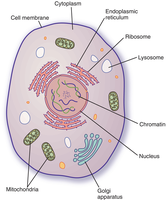
Cells contain various organelles, each with specialized functions essential for cellular physiology.
Cell Membrane: Regulates entry and exit of substances.
Cytoplasm: Gel-like substance where organelles are suspended.
Nucleus: Contains genetic material (DNA) and controls cellular activities.
Mitochondria: Site of ATP (energy) production.
Endoplasmic Reticulum (ER): Synthesizes proteins (rough ER) and lipids (smooth ER).
Golgi Apparatus: Modifies, sorts, and packages proteins and lipids for delivery.
Ribosomes: Sites of protein synthesis.
Lysosomes: Contain enzymes for intracellular digestion.
Chromatin: DNA and associated proteins within the nucleus.
Drug Transport Through Cell Membranes
Overview of Drug Transport
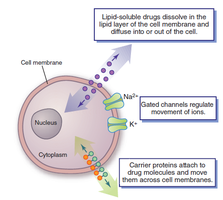
For drugs to exert their effects, they must reach and interact with or cross the cell membrane. Most drugs are administered for systemic effects, requiring movement through various transport pathways and mechanisms within the body.
Lipid-Soluble Drugs: Dissolve in the lipid bilayer of the cell membrane and diffuse into or out of the cell.
Gated Channels: Regulate the movement of ions such as Na+ and K+ across the membrane.
Carrier Proteins: Attach to drug molecules and move them across cell membranes via facilitated diffusion or active transport.
Pharmacokinetics
Definition and Processes
Pharmacokinetics is the study of drug movement through the body, encompassing four main processes:
Absorption: Entry of the drug into the bloodstream from the site of administration.
Distribution: Transport of drug molecules to various tissues and organs.
Metabolism (Biotransformation): Chemical alteration of the drug, primarily in the liver, to facilitate excretion.
Excretion: Removal of the drug from the body, mainly via the kidneys.
Absorption
Absorption occurs from the time a drug enters the body until it reaches the bloodstream. The onset of drug action is largely determined by the rate of absorption, which is influenced by:
Dosage form and route of administration
Blood flow at the administration site
Gastrointestinal function
Presence of food or other drugs
Distribution
Distribution is the process by which drugs are transported throughout the body by blood and tissue fluids to sites of action, metabolism, and excretion. It depends largely on blood circulation and is affected by:
Protein binding
Blood–brain barrier
Pregnancy and lactation
Metabolism (Biotransformation)
Metabolism refers to the body's method of altering drugs into new forms (metabolites). This process can result in inactive metabolites, active metabolites, or prodrugs (which become active after metabolism). Major sites of drug-metabolizing enzymes include:
Liver
Kidneys
Red blood cells and plasma
Lungs
Gastrointestinal mucosa
Factors affecting metabolism include enzyme induction (increases metabolism) and enzyme inhibition (decreases or delays metabolism).
Excretion
Excretion is the elimination of drugs from the body, requiring adequate function of the circulatory system and organs of excretion (kidneys, bowel, lungs, and skin).
Serum Drug Levels
Measurement and Clinical Significance
Serum drug level is a laboratory measurement of the amount of a drug in the blood at a specific time. It reflects dosage, absorption, bioavailability, half-life, and rates of metabolism and excretion. For efficacy, the minimum effective concentration (MEC) must be present. Excessive levels can lead to toxicity, caused by large or repeated doses or slow metabolism.
Mechanisms of Drug Action
Receptor Theory
Most drugs exert their effects by binding to specific receptor sites on cells, leading to:
Activation, inactivation, or alteration of intracellular enzymes
Changes in cell membrane permeability to ions
Modification of neurohormone synthesis, release, or inactivation
Drugs can act as agonists (activate receptors) or antagonists (block receptors).
Nonreceptor Drug Actions
Some drugs do not act on receptor sites, such as antacids, osmotic diuretics, certain anticancer drugs, and metal chelating agents.
Drug-Related and Patient-Related Variables
Drug-Related Variables
Dosage (frequency, size, number of doses)
Route of administration
Drug–diet and drug–drug interactions (additive effects, synergism, interference, displacement, antidotes, altered absorption or metabolism)
Patient-Related Variables
Age and body weight
Genetics, ethnicity, gender (pharmacogenomics and pharmacogenetics)
Preexisting pathologic conditions
Psychological factors
Tolerance and cross-tolerance
Adverse Effects and Toxicology
Adverse Effects of Drugs
Adverse effects are any undesired responses to medication administration. All drugs can produce adverse effects, which may occur at therapeutic doses but are more likely or severe with higher doses or in vulnerable populations (e.g., older adults, polypharmacy).
Toxicology: Drug Overdose
Drug overdose (poisoning) results from excessive medication intake and can damage body tissues. It may occur from a single large dose or prolonged ingestion of smaller doses and can involve various substances (alcohol, prescription, OTC, illicit drugs). Overdose is a medical emergency requiring prompt intervention.
Start treatment soon after ingestion
Support and stabilize vital functions
Prevent further damage by reducing absorption, increasing elimination, and administering antidotes when possible
