 뒤로
뒤로Chapter 1: An Introduction to Anatomy and Physiology - Study Notes
스터디 가이드 - 스마트 노트
 자료에 맞춘 맞춤형 노트, 핵심 정의, 예시, 맥락을 확장해 제공합니다.
Introduction to Anatomy & Physiology
Overview of Anatomy and Physiology
Anatomy and physiology are foundational sciences for understanding the structure and function of the human body. Anatomy focuses on the physical structures, while physiology examines how these structures operate to sustain life. The principle of complementarity states that structure and function are interdependent: the form of a structure is directly related to its function.
Anatomy: Study of internal and external body structures and their relationships.
Physiology: Study of how living organisms perform vital functions.
Complementarity: Specific functions are performed by specific structures.
Specialties of Anatomy
Gross (Macroscopic) Anatomy: Study of large structures visible to the naked eye.
Regional Anatomy: Focuses on specific body areas.
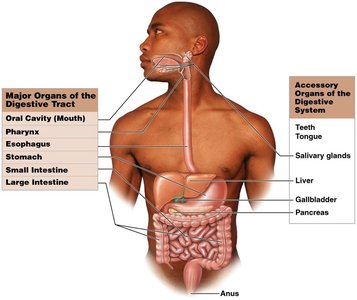
Systemic Anatomy: Examines organ systems.
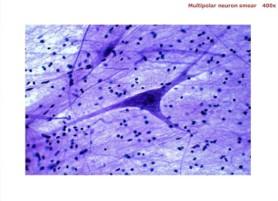
Microscopic Anatomy: Studies structures only visible with magnification.
Cytology: Study of cells.
Histology: Study of tissues.
Specialties of Physiology
Cell Physiology: Functions of cells and their chemical processes.
Organ Physiology: Functions of specific organs.
Systemic Physiology: Functions of organ systems.
Pathological Physiology: Effects of diseases on organs or systems.
Levels of Organization in the Human Body
Hierarchical Structure
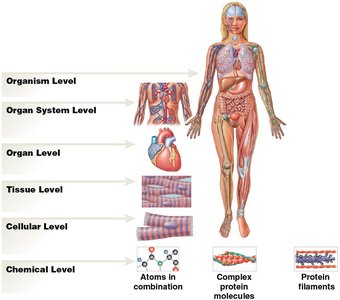
The human body is organized into six major levels, from the simplest chemical components to the complex organism.
Chemical Level: Atoms and molecules (e.g., protein molecules).
Cellular Level: Cells, the smallest living units.
Tissue Level: Groups of cells working together (epithelial, connective, muscle, neural).
Organ Level: Two or more tissues working together (e.g., heart).
Organ System Level: Groups of organs interacting for a particular function (e.g., cardiovascular system).
Organism Level: The individual life form.


Anatomical Terminology
Anatomical Position and Body Regions
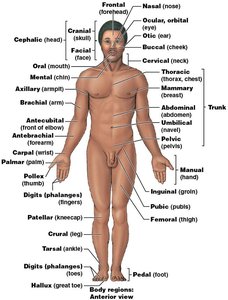
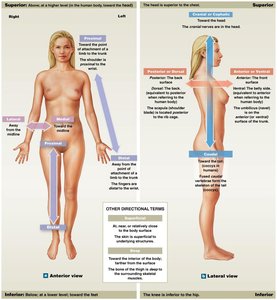
Standard anatomical position is used as a reference for describing locations and relationships of body parts. The body is upright, hands at the sides, palms facing forward, and feet together.
Anterior (front) and Posterior (back) views
Supine: Lying face up
Prone: Lying face down
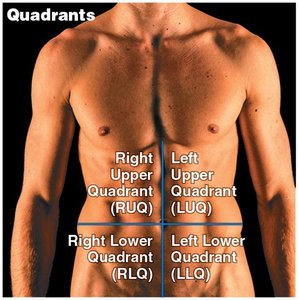
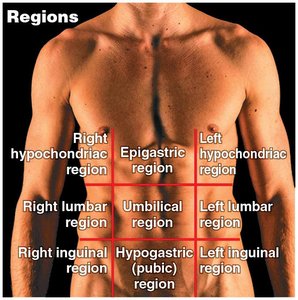
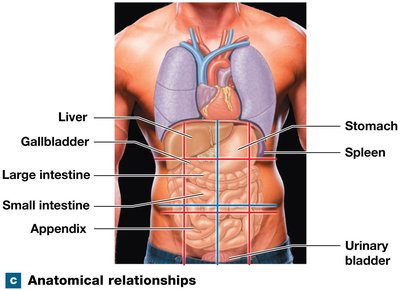
Abdominopelvic Quadrants and Regions
The abdominopelvic area is divided for clinical and anatomical purposes.
Quadrants: Right Upper (RUQ), Left Upper (LUQ), Right Lower (RLQ), Left Lower (LLQ)
Regions: Epigastric, Right/Left hypochondriac, Umbilical, Right/Left lumbar, Hypogastric, Right/Left inguinal
Directional Terms
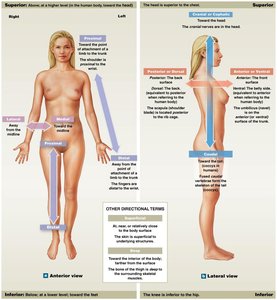
Directional terms are used to describe the relative location of body regions and structures.
Superior: Toward the head
Inferior: Toward the lower part
Anterior (ventral): Nearer to the front
Posterior (dorsal): Nearer to the back
Medial: Nearer to the midline
Lateral: Farther from the midline
Ipsilateral: Same side
Contralateral: Opposite sides
Proximal: Nearer to the point of attachment
Distal: Farther from the point of attachment
Superficial: Toward or on the surface
Deep: Away from the surface
Sectional Anatomy and Medical Imaging
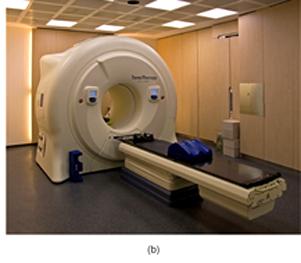
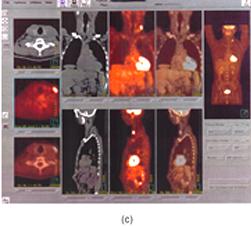
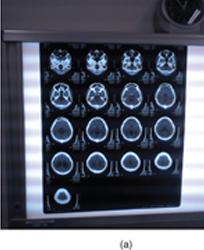
Sectional anatomy involves slicing through three-dimensional objects to visualize internal organization, important for interpreting medical scans.
MRI: Noninvasive, uses magnetic fields and radio waves, no radiation.
PET: Uses radioactive substances, diagnoses various conditions.
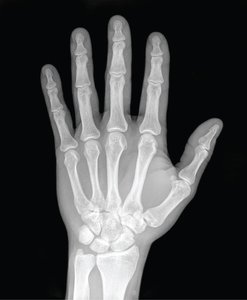
X-ray: High-energy electromagnetic radiation, penetrates solids.
CT: Cross-sectional X-rays analyzed by computers, higher radiation dose than X-rays.
Sectional Planes
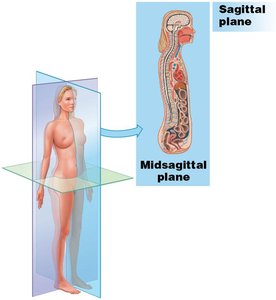
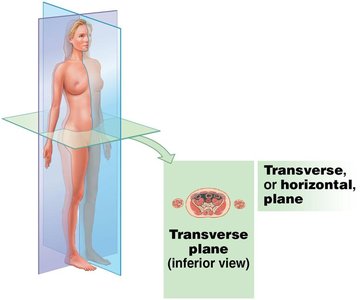
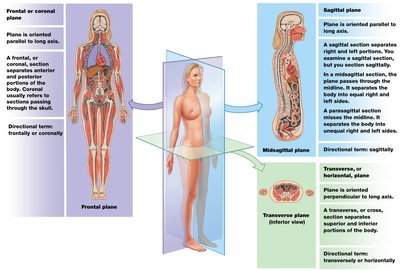
Sectional planes are used to describe slices through the body:
Frontal (coronal) plane: Divides body into anterior and posterior portions.
Sagittal plane: Divides body into left and right portions.
Midsagittal: Lies in the middle.
Parasagittal: Offset from the middle.
Transverse (horizontal) plane: Divides body into superior and inferior portions.
Body Cavities
Major Body Cavities and Their Functions
Body cavities are closed, fluid-filled spaces lined by serous membranes, containing vital organs (viscera) of the trunk. They protect organs and allow changes in size and shape.
Serous membrane (serosa): Lines cavities and covers organs; consists of parietal (lines cavity) and visceral (covers organ) layers; serous fluid reduces friction.
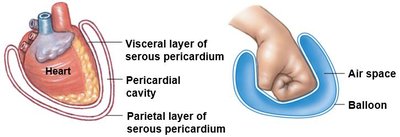
Thoracic and Abdominopelvic Cavities
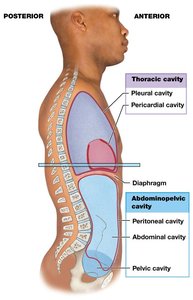
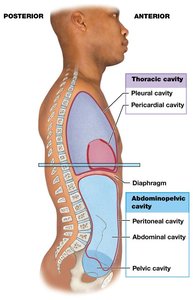
Thoracic cavity: Divided from abdominopelvic cavity by diaphragm; contains pleural (lungs), pericardial (heart), and mediastinum (connective tissue stabilizing organs).
Abdominopelvic cavity: Extends from diaphragm to pelvis; contains abdominal, pelvic, and peritoneal cavities.
Retroperitoneal space: Area between parietal peritoneum and back of body wall; contains pancreas and kidneys.
Pelvic cavity: Contains reproductive organs, rectum, and urinary bladder.
Homeostasis
Concept of Homeostasis
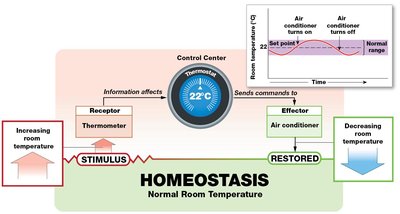
Homeostasis refers to the continuous physiological processes that maintain a stable internal environment. Systems respond to changes to keep variables within normal ranges (e.g., body temperature, blood pressure).
Receptor: Sensor that detects stimulus or change.
Control center: Receives and processes information, sends commands.
Effector: Cell or organ that carries out commands.
Set point: Desired value for a variable.
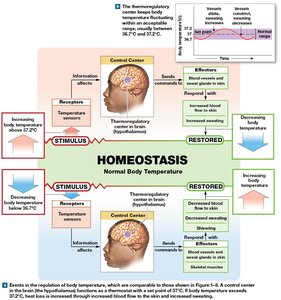
Negative and Positive Feedback
Negative feedback: Regulation that opposes variation from normal; effector negates original stimulus, maintaining variables within a normal range.
Positive feedback: Regulation that enhances variation from normal; response amplifies original change, used for rapid completion of processes (e.g., blood clotting).
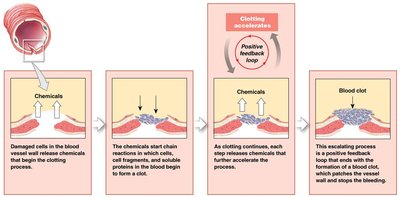
Summary Table: Levels of Organization
Level | Description |
|---|---|
Chemical | Atoms and molecules |
Cellular | Smallest living units |
Tissue | Groups of cells |
Organ | Two or more tissues |
Organ System | Groups of organs |
Organism | Individual life form |
Key Terms and Definitions
Anatomy: Study of body structure
Physiology: Study of body function
Homeostasis: Maintenance of stable internal environment
Serous membrane: Double-layered membrane lining cavities
Feedback: Regulatory mechanism (negative or positive)
Example: Homeostatic Regulation Equation
Homeostatic regulation can be described mathematically as:
$\text{Variable}_{\text{new}} = \text{Variable}_{\text{old}} + \text{Response}_{\text{effector}}$
This equation shows how the effector's response adjusts the variable toward the set point.
Additional info:
Scientific method is used in diagnosis: observation, hypothesis, experimentation.
Sectional anatomy is essential for interpreting medical imaging techniques.
