 뒤로
뒤로Chapter 1: Introduction to Anatomy and Physiology – Study Notes
스터디 가이드 - 스마트 노트
 자료에 맞춘 맞춤형 노트, 핵심 정의, 예시, 맥락을 확장해 제공합니다.
Introduction to Anatomy & Physiology
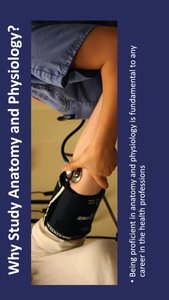
Why Study Anatomy and Physiology?
Anatomy and Physiology are foundational sciences for understanding the structure and function of the human body. Mastery of these subjects is essential for careers in health professions and for making informed decisions about personal health.
Career Relevance: Required for all health professions and biology-based careers.
Personal Health: Enables individuals to make informed choices about their health and understand medical news.
Critical Thinking: Helps distinguish reliable from unreliable health information.
Overall Well-being: Contributes to being a better-informed person.
Anatomy and Physiology: Definitions and Scope
Key Concepts
Anatomy is the study of internal and external body structures and their physical relationships. Physiology is the study of how living organisms perform their vital functions. These fields are closely integrated, as structure and function are interrelated.
Human Anatomy: Study of the structures of the human body.
Gross Anatomy: Study of large structures visible without a microscope (e.g., dissecting a cadaver).
Microscopic Anatomy: Study of structures only visible with a microscope (e.g., histology – study of tissues).
Human Physiology: Study of the functions of the human body.
Levels of Organization in the Human Body
Chemical and Cellular Levels
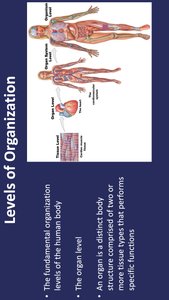
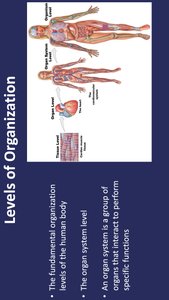
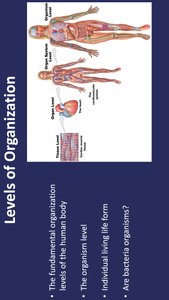
The human body is organized into hierarchical levels, starting from the simplest chemical components to the complex organism.
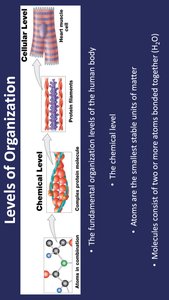
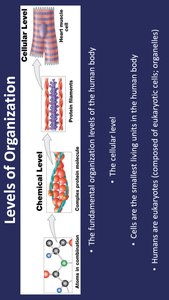
Chemical Level: Atoms (smallest stable units of matter) and molecules (two or more atoms bonded together, e.g., H2O).
Cellular Level: Cells are the smallest living units; humans are eukaryotes (cells with organelles).
Tissue, Organ, and Organ System Levels
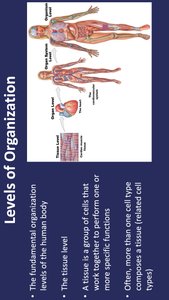
Tissue Level: Groups of cells working together to perform specific functions. Tissues often consist of more than one cell type.
Organ Level: Organs are distinct structures composed of two or more tissue types that perform specific functions.
Organ System Level: Organ systems are groups of organs that interact to perform coordinated functions.
Organism Level: The individual living human as a whole.
Organ Systems of the Human Body
Overview of Organ Systems
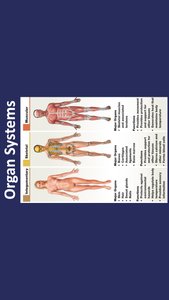
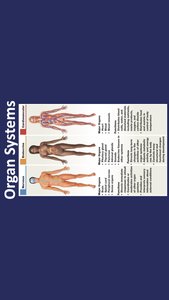
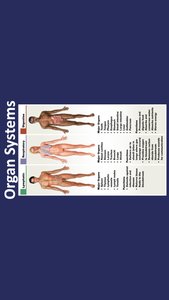
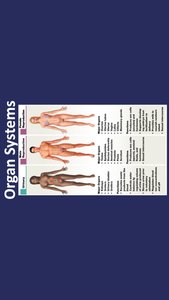
The human body consists of multiple organ systems, each with specific functions essential for survival and homeostasis.
System | Main Organs | Primary Functions |
|---|---|---|
Integumentary | Skin, hair, nails | Protection, temperature regulation, sensation |
Skeletal | Bones, cartilage | Support, movement, protection, blood cell production |
Muscular | Skeletal muscles | Movement, posture, heat production |
Nervous | Brain, spinal cord, nerves | Control, coordination, response to stimuli |
Endocrine | Glands (pituitary, thyroid, etc.) | Hormone production, regulation of metabolism |
Cardiovascular | Heart, blood vessels | Transport of nutrients, gases, wastes |
Lymphatic | Lymph nodes, lymph vessels | Immunity, fluid balance |
Respiratory | Lungs, trachea | Gas exchange (O2/CO2) |
Digestive | Stomach, intestines, liver | Breakdown and absorption of nutrients |
Urinary | Kidneys, bladder | Waste elimination, water balance |
Reproductive | Ovaries/testes, uterus/prostate | Production of offspring |
Anatomical Terminology
Importance of Anatomical Terms
Using precise anatomical terms eliminates ambiguity and ensures clear communication in healthcare and science.
Anatomical Position and Views
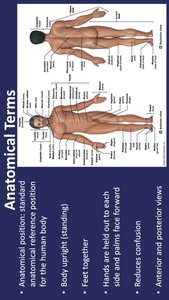
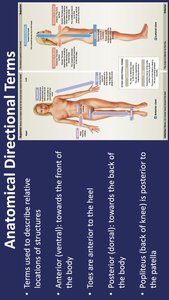
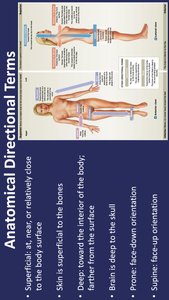
Anatomical Position: Standard reference position: body upright, feet together, hands at sides, palms forward.
Anterior (front) and Posterior (back) Views: Used to describe locations and directions.
Directional Terms
Anterior (ventral): Toward the front of the body.
Posterior (dorsal): Toward the back of the body.
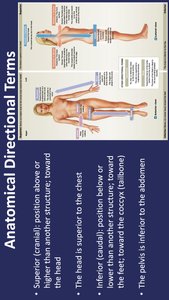
Superior (cranial): Above or toward the head.
Inferior (caudal): Below or toward the feet.
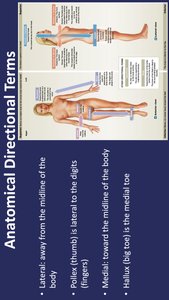
Lateral: Away from the midline.
Medial: Toward the midline.
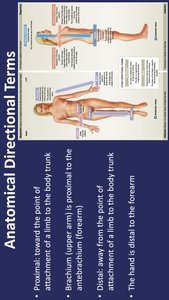
Proximal: Closer to the point of attachment.
Distal: Farther from the point of attachment.
Superficial: Near the surface.
Deep: Farther from the surface.
Sectional Anatomy
Body Planes and Sections
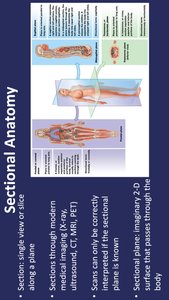
Sectional anatomy involves dividing the body into planes to study its internal structures.
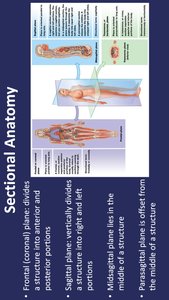
Frontal (coronal) plane: Divides the body into anterior and posterior portions.
Sagittal plane: Divides the body into right and left portions (midsagittal = equal halves).
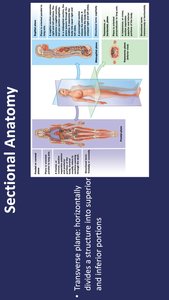
Transverse plane: Divides the body into superior and inferior portions.
Body Cavities
Major Body Cavities and Their Functions
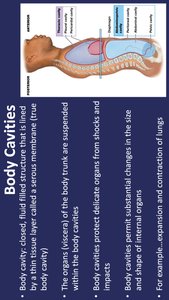
Body cavities are closed, fluid-filled spaces that protect internal organs and allow for changes in organ size and shape.
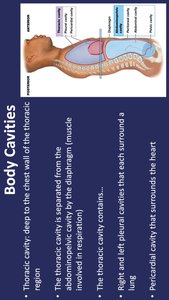
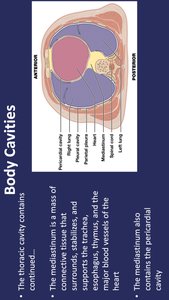
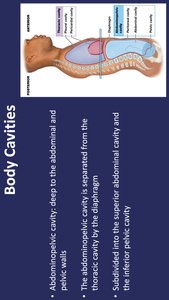
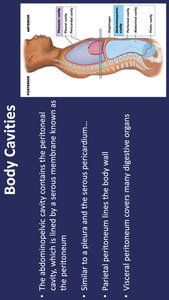
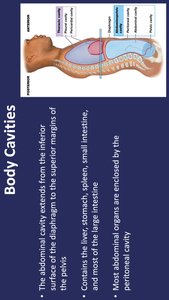
Thoracic Cavity: Contains the lungs and heart; separated from the abdominopelvic cavity by the diaphragm.
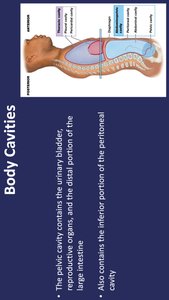
Abdominopelvic Cavity: Contains digestive, urinary, and reproductive organs; subdivided into abdominal and pelvic cavities.
Serous Membranes
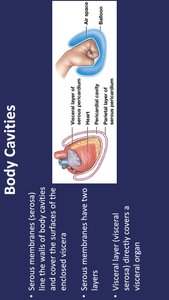
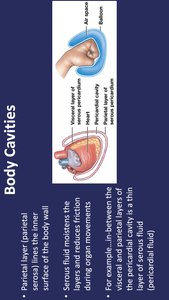
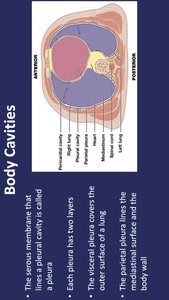
Serous Membranes (serosa): Line the walls of body cavities and cover organs.
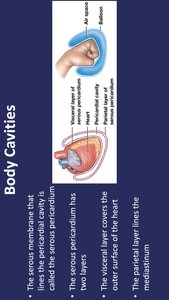
Two layers: Visceral layer (covers organs) and parietal layer (lines cavity walls).
Serous fluid between layers reduces friction during organ movement.
Thoracic and Abdominopelvic Cavity Details
Thoracic Cavity: Contains pleural cavities (lungs) and pericardial cavity (heart), separated by the mediastinum.
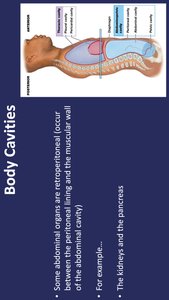
Abdominopelvic Cavity: Contains peritoneal cavity (digestive organs), abdominal cavity (stomach, liver, intestines), and pelvic cavity (bladder, reproductive organs).
Some organs (e.g., kidneys, pancreas) are retroperitoneal (behind the peritoneum).
Abdominopelvic Quadrants and Regions
Quadrants
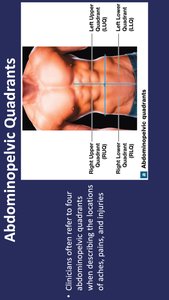
The abdominopelvic area is divided into four quadrants for clinical reference: Right Upper (RUQ), Left Upper (LUQ), Right Lower (RLQ), and Left Lower (LLQ).
Regions
For more precise anatomical study, the abdominopelvic area is divided into nine regions (e.g., right hypochondriac, epigastric, left lumbar, etc.).
Homeostasis
Definition and Importance
Homeostasis refers to the continuous physiological processes that maintain a relatively stable internal environment. It is vital for survival, as physiological systems respond to changes to keep conditions within normal ranges (e.g., temperature, blood pressure).
Homeostatic Regulation
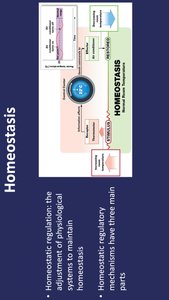
Homeostatic Regulation: Adjustment of physiological systems to maintain homeostasis.
Three main parts: Receptor (detects change), Control Center (processes information), Effector (carries out response).
Example of Homeostatic Mechanism
Receptor: Senses a change (e.g., temperature rise).
Control Center: Receives and processes information, sends commands.
Effector: Responds to commands (e.g., sweat glands increase secretion to cool the body).
Additional info: Homeostatic mechanisms often involve negative feedback loops, where the response counteracts the initial change, maintaining balance.
