뒤로
뒤로Chapter 1: Introduction to Anatomy & Physiology – Structured Study Notes
스터디 가이드 - 스마트 노트
 자료에 맞춘 맞춤형 노트, 핵심 정의, 예시, 맥락을 확장해 제공합니다.
Introduction to Anatomy & Physiology
Overview of Anatomy and Physiology
Anatomy and physiology are foundational sciences in understanding the structure and function of the human body. Anatomy focuses on the physical structures, while physiology explores how these structures perform vital functions. The principle of complementarity states that structure and function are inherently linked: the form of a structure enables its function.
Anatomy: Study of internal and external body structures and their relationships.
Physiology: Study of how living organisms perform vital functions.
Complementarity: Specific functions are performed by specific structures; form determines function.

Levels of Organization
Hierarchical Structure of the Human Body
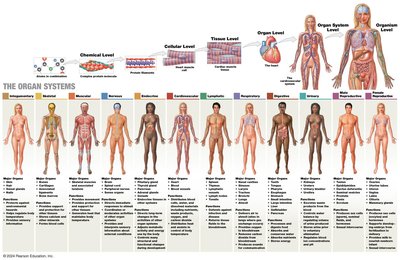
The human body is organized into six hierarchical levels, each building upon the previous. This organization allows for increasing complexity and specialization.
Chemical Level: Atoms and molecules form the chemical basis of life.
Cellular Level: Cells are the smallest living units, composed of molecules.
Tissue Level: Groups of similar cells working together to perform specific functions.
Organ Level: Structures composed of two or more tissue types working together.
Organ System Level: Groups of organs that interact to perform a coordinated function. Humans have 11 organ systems.
Organism Level: The complete individual life form.
Medical and Anatomical Terminology
Medical Terminology
Medical terminology uses word roots, prefixes, suffixes, and combining forms to describe body structures, functions, and diseases. Understanding these components aids in learning anatomy and physiology. Eponyms (terms based on discoverers' names) are often replaced by more precise terms, though both may be used.
Anatomical Terminology
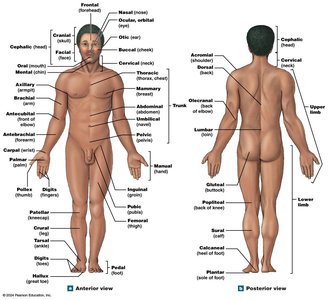
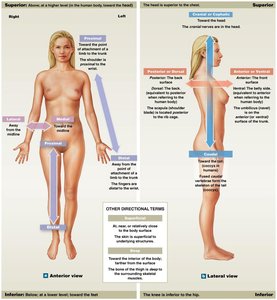
Standardized terms describe locations and positions of body parts. The anatomical position is the reference posture: standing, hands at sides, palms forward, feet together. Terms such as anterior (front), posterior (back), supine (lying face up), and prone (lying face down) are used to describe orientation.
Surface anatomy: Locating structures on or near the body surface using anatomical landmarks.
Anatomical Regions and Quadrants
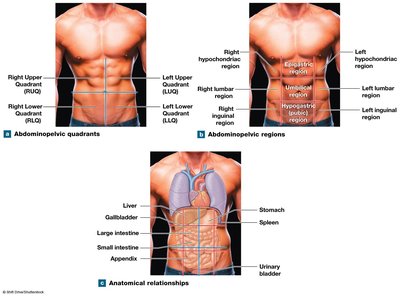
The abdominopelvic region is divided for clinical and descriptive purposes:
Quadrants: Right Upper (RUQ), Left Upper (LUQ), Right Lower (RLQ), Left Lower (LLQ).
Regions: Nine regions including epigastric, umbilical, hypogastric, and others for more precise localization.
Directional References
Directional terms describe the relative positions of body parts:
Superior/Inferior: Above/below
Anterior/Posterior: Front/back
Medial/Lateral: Toward the midline/away from the midline
Proximal/Distal: Closer to/farther from the point of attachment
Sectional Anatomy and Planes
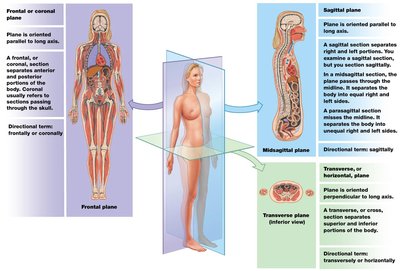
Sectional anatomy involves slicing the body along specific planes to view internal structures:
Frontal (coronal) plane: Divides body into anterior and posterior portions.
Sagittal plane: Divides body into left and right portions (midsagittal = equal halves; parasagittal = unequal).
Transverse (horizontal) plane: Divides body into superior and inferior portions.
Body Cavities
Major Body Cavities and Their Functions
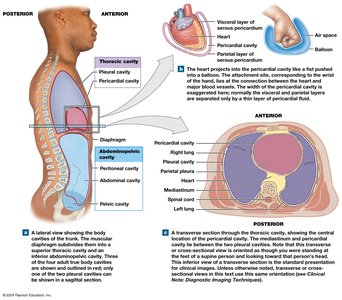
Body cavities are closed, fluid-filled spaces that protect internal organs and allow for changes in organ size and shape. They are lined by serous membranes (serosa), which have parietal (lining cavity) and visceral (covering organ) layers, separated by lubricating serous fluid.
Thoracic cavity: Contains pleural cavities (lungs), pericardial cavity (heart), and mediastinum (central compartment).
Abdominopelvic cavity: Contains abdominal (digestive organs) and pelvic (reproductive, urinary, rectum) cavities. The peritoneal cavity is within the abdominopelvic cavity.
Retroperitoneal: Organs behind the peritoneum (e.g., kidneys, pancreas).
Infraperitoneal: Organs below the peritoneal cavity (e.g., bladder).
Homeostasis
Definition and Importance
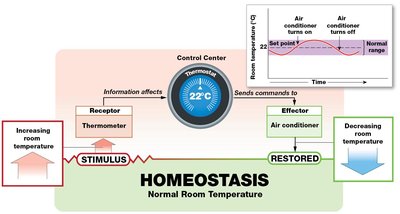
Homeostasis is the maintenance of a stable internal environment through continuous physiological processes. Homeostatic regulation involves mechanisms that keep variables (e.g., temperature, pH, blood pressure) within normal ranges despite external and internal changes.
Autoregulation: Local, automatic response to environmental change.
Extrinsic regulation: Controlled by nervous (fast, short-term) or endocrine (slow, long-term) systems.
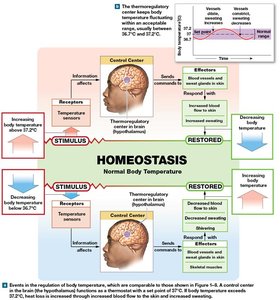
Components of regulation: Receptor (detects change), control center (processes information), effector (carries out response).
Negative and Positive Feedback
Feedback mechanisms regulate homeostasis:
Negative feedback: The effector opposes the original stimulus, maintaining variables within a normal range. Example: body temperature regulation.
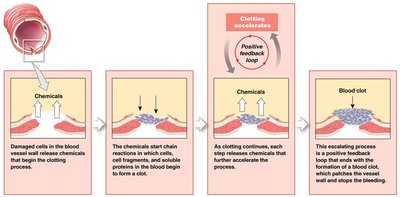
Positive feedback: The effector amplifies the original stimulus, used for rapid completion of processes (e.g., blood clotting).
Systems Integration and Dynamic Equilibrium
Organ systems work together to maintain homeostasis. Adjustments by one system affect others, resulting in a dynamic equilibrium where physiological systems continually adapt to changing conditions. Failure to maintain homeostasis leads to disease or death.
Roles of Organ Systems in Homeostatic Regulation
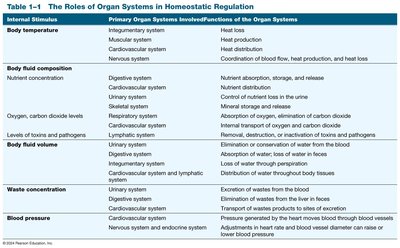
Different organ systems contribute to the regulation of internal conditions. The following table summarizes their roles:
Internal Stimulus | Primary Organ Systems Involved | Functions of the Organ Systems |
|---|---|---|
Body temperature | Integumentary, muscular, cardiovascular, nervous | Heat production, heat loss, coordination of blood flow, heat production, and heat loss |
Body fluid composition | Digestive, cardiovascular, urinary, skeletal, respiratory | Nutrient absorption, storage, release, distribution, control of mineral content, absorption of oxygen, elimination of carbon dioxide |
Levels of toxins and pathogens | Lymphatic, cardiovascular, integumentary, digestive, respiratory, urinary | Removal, destruction, inactivation of toxins and pathogens |
Body fluid volume | Urinary, digestive, cardiovascular, lymphatic | Elimination, absorption, distribution of water |
Waste concentration | Urinary, digestive, cardiovascular | Elimination of wastes from blood, liver, and kidneys |
Blood pressure | Cardiovascular, nervous, endocrine | Heart rate, blood vessel diameter, blood volume regulation |