 뒤로
뒤로Chapter 1: Introduction to Anatomy – The Human Body: An Orientation
스터디 가이드 - 스마트 노트
 자료에 맞춘 맞춤형 노트, 핵심 정의, 예시, 맥락을 확장해 제공합니다.
Introduction to Anatomy
Overview of Anatomy and Physiology
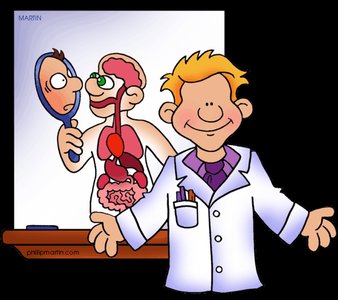
Anatomy and physiology are foundational sciences in understanding the human body. Anatomy is the study of body structures, while physiology focuses on how these structures function. The relationship between structure and function is a central principle: anatomical features are designed to support their physiological roles.
Anatomy: Study of the form and structure of organisms and their parts.
Physiology: Study of the functions and mechanisms occurring in living organisms.
Rule #1: Structure is related to function.
Types of Anatomy
Anatomy can be divided into several types, each focusing on different aspects of the body:
Gross Anatomy: Study of structures visible to the naked eye.
Microscopic Anatomy: Study of structures requiring magnification, such as cells and tissues.
Developmental Anatomy: Study of structural changes throughout the lifespan.
Structural Organization of the Human Body
Levels of Structural Organization
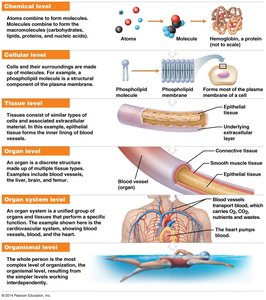
The human body is organized into hierarchical levels, from the simplest chemical components to the complex organism:
Chemical Level: Atoms and molecules form the basis of life.
Cellular Level: Cells are the basic units of life.
Tissue Level: Groups of similar cells performing a common function.
Organ Level: Structures composed of two or more tissue types.
Organ System Level: Groups of organs working together for a common purpose.
Organismal Level: The complete living individual.
Body Systems and Their Functions
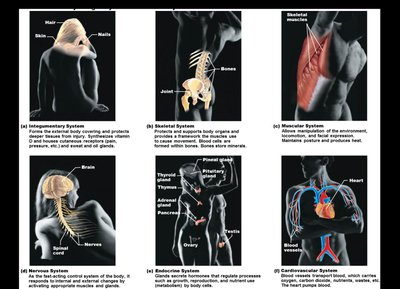
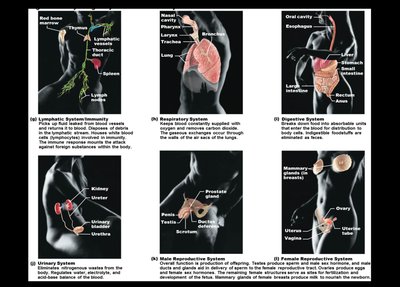
The human body consists of several organ systems, each with specific functions:
Integumentary System: Protects the body, regulates temperature, and provides sensory information.
Skeletal System: Supports and protects organs, stores minerals, and produces blood cells.
Muscular System: Enables movement, maintains posture, and produces heat.
Nervous System: Controls responses to stimuli and coordinates activities of other systems.
Endocrine System: Regulates processes via hormones.
Cardiovascular System: Transports blood, nutrients, gases, and wastes.
Lymphatic System: Defends against infection and disease.
Respiratory System: Facilitates gas exchange.
Digestive System: Processes food and absorbs nutrients.
Urinary System: Eliminates waste and regulates water balance.
Reproductive System: Produces offspring.
Language of Anatomy
Anatomical Position
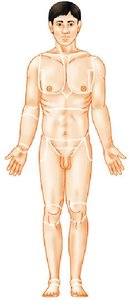
The anatomical position is a standardized posture used as a reference in anatomy. The body stands upright, facing forward, arms at the sides, palms facing forward, and feet together. This position ensures consistency when describing locations and directions.
Directional Terms
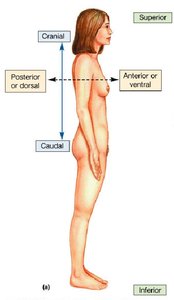
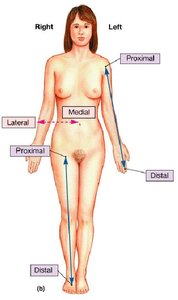
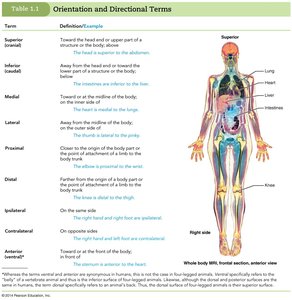
Directional terms are used to describe the locations of structures relative to other structures or locations in the body:
Anterior (Ventral): Toward the front of the body.
Posterior (Dorsal): Toward the back of the body.
Superior (Cranial): Toward the head or upper part.
Inferior (Caudal): Toward the lower part or feet.
Medial: Toward the midline.
Lateral: Away from the midline.
Proximal: Closer to the origin of a body part.
Distal: Farther from the origin.
Superficial: Toward or at the body surface.
Deep: Away from the body surface.
Regional Terms
Regional terms specify distinct areas of the body, aiding in precise anatomical description. Examples include cephalic (head), cervical (neck), thoracic (chest), abdominal, pelvic, and appendicular regions.
Abdominal Regions and Quadrants
Abdominal Regions
The abdomen is divided into nine regions for clinical and anatomical reference. These regions help localize pain, injuries, or disease.
Right hypochondriac
Epigastric
Left hypochondriac
Right lumbar
Umbilical
Left lumbar
Right iliac
Hypogastric
Left iliac
Abdominal Quadrants
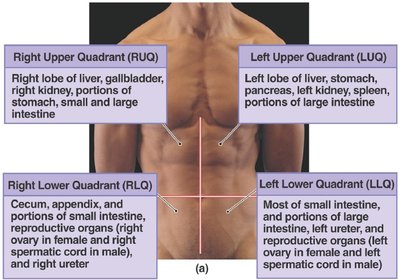
The abdomen is also divided into four quadrants: Right Upper Quadrant (RUQ), Left Upper Quadrant (LUQ), Right Lower Quadrant (RLQ), and Left Lower Quadrant (LLQ). Each quadrant contains specific organs.
Quadrant | Main Organs |
|---|---|
Right Upper Quadrant (RUQ) | Right lobe of liver, gallbladder, right kidney, portions of stomach, small and large intestine |
Left Upper Quadrant (LUQ) | Left lobe of liver, stomach, pancreas, left kidney, spleen, portions of small and large intestine |
Right Lower Quadrant (RLQ) | Cecum, appendix, portions of small intestine, reproductive organs (right ovary in female, right spermatic cord in male), right ureter |
Left Lower Quadrant (LLQ) | Most of small intestine, portions of large intestine, left ureter, reproductive organs (left ovary in female, left spermatic cord in male) |
Body Planes and Sections
Body Planes
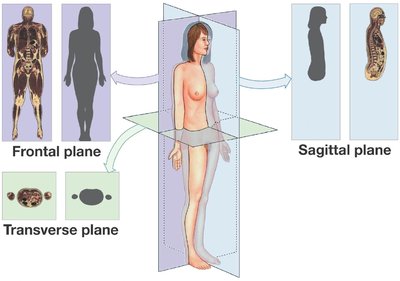
Body planes are imaginary lines used to divide the body and describe locations of structures:
Frontal (Coronal) Plane: Divides the body into anterior and posterior parts.
Sagittal Plane: Divides the body into right and left parts.
Transverse (Horizontal) Plane: Divides the body into superior and inferior parts.
Applications in Medical Imaging
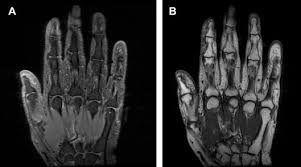
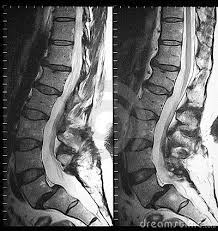
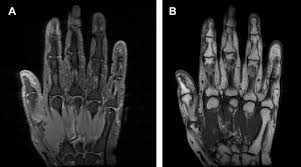
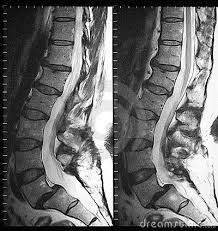
Body planes are used in medical imaging, such as X-rays and MRIs, to view internal structures from different perspectives.
Body Cavities
Main Body Cavities
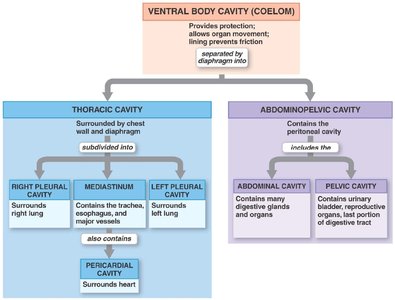
The body contains internal chambers called cavities, which protect organs and allow them to change shape and size. The two main cavities are:
Dorsal Body Cavity: Contains the cranial cavity (brain) and vertebral cavity (spinal cord).
Ventral Body Cavity: Contains the thoracic cavity (heart and lungs) and abdominopelvic cavity (digestive, urinary, and reproductive organs).
Homeostasis
Definition and Importance
Homeostasis is the body's ability to maintain a relatively stable internal environment despite external changes. It is essential for survival and proper functioning of all organ systems.
Examples include regulation of body temperature, blood pressure, and pH.
Organ systems such as the urinary, respiratory, and endocrine systems play key roles in homeostasis.
Review Questions
What level of organization is made of similar cells that perform a specialized function? Tissue
Describe the difference between proximal and distal. Use each in a sentence. Proximal means closer to the midline; distal means further from the midline. Example: The fingers are distal to the shoulder.
The term carpal is referring to what region on the body? Wrist
Describe the location of the epigastric region using anatomical terminology. Superior to the umbilical region.
